Clear Sky Science · en
Light cone cancellation for variational quantum eigensolver in solving noisy Max-Cut
Cutting Through Quantum Noise
As quantum computers grow, they promise to tackle tough real-world puzzles, from routing data through networks to designing better materials. But today’s devices are small and noisy: add more quantum bits, or qubits, and errors quickly swamp the calculation. This paper explores a way to make better use of imperfect machines by trimming quantum circuits so they stay accurate even when hardware is far from ideal, focusing on a classic puzzle called the Max-Cut problem.
Why Slicing Networks Matters
Max-Cut is a simple-sounding challenge with wide applications. Imagine a network of points connected by links—these could represent social ties, communication lines, or components on a chip. The goal is to split the points into two groups so that as many links as possible run between the groups rather than within them. This is easy for small networks but becomes extremely hard as the network grows, and no fast exact method is known on standard computers. Because of this, Max-Cut has become a testbed for new algorithms, including those that run on quantum hardware.
Hybrid Quantum Methods in a Noisy World
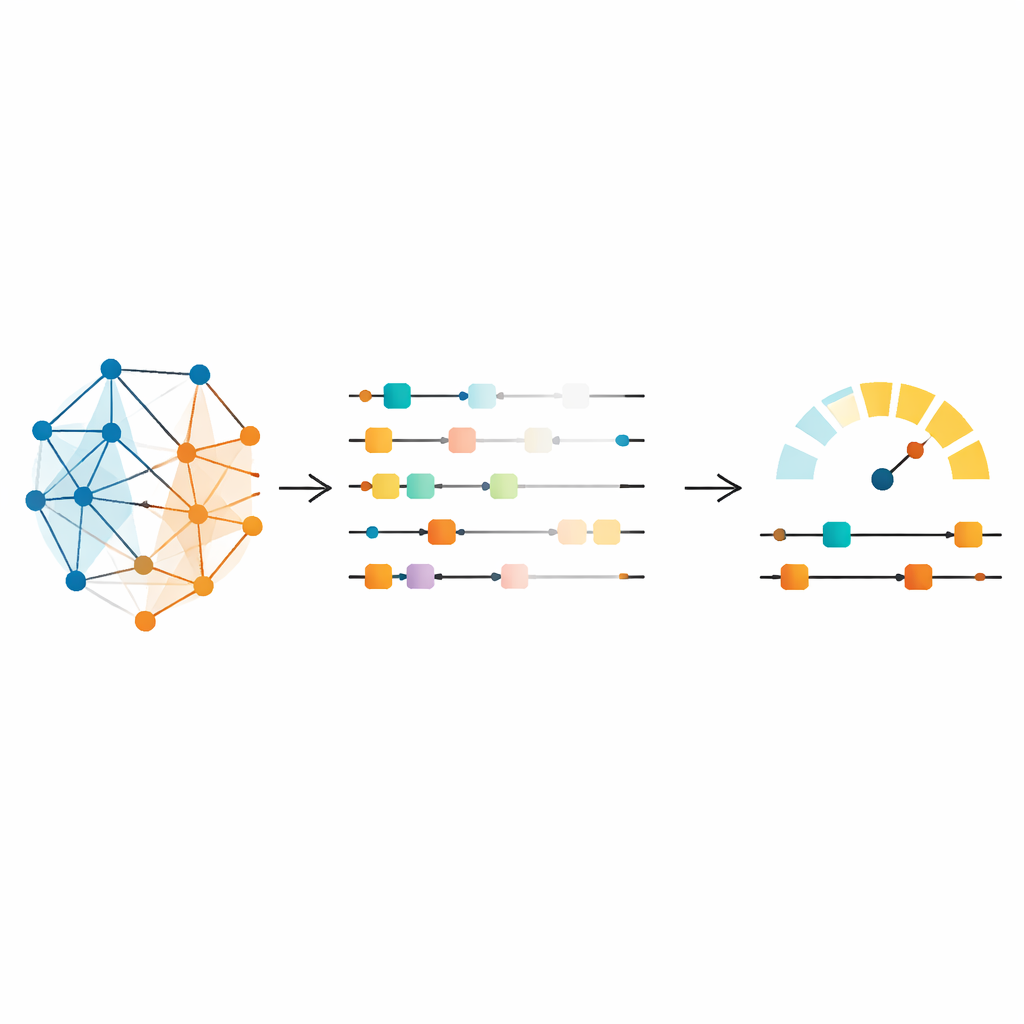
The study builds on a popular family of hybrid methods called variational quantum algorithms. In these schemes, a quantum circuit produces a trial answer, while an ordinary computer adjusts the circuit’s settings to make that answer better step by step. The specific method here, the variational quantum eigensolver, is usually associated with chemistry but can also be repurposed for optimization problems like Max-Cut. Compared with another well-known quantum approach, the quantum approximate optimization algorithm, this style of circuit can reach good solutions with fewer layers of gates, which is crucial when every extra operation introduces more noise.
Keeping Only What Really Counts
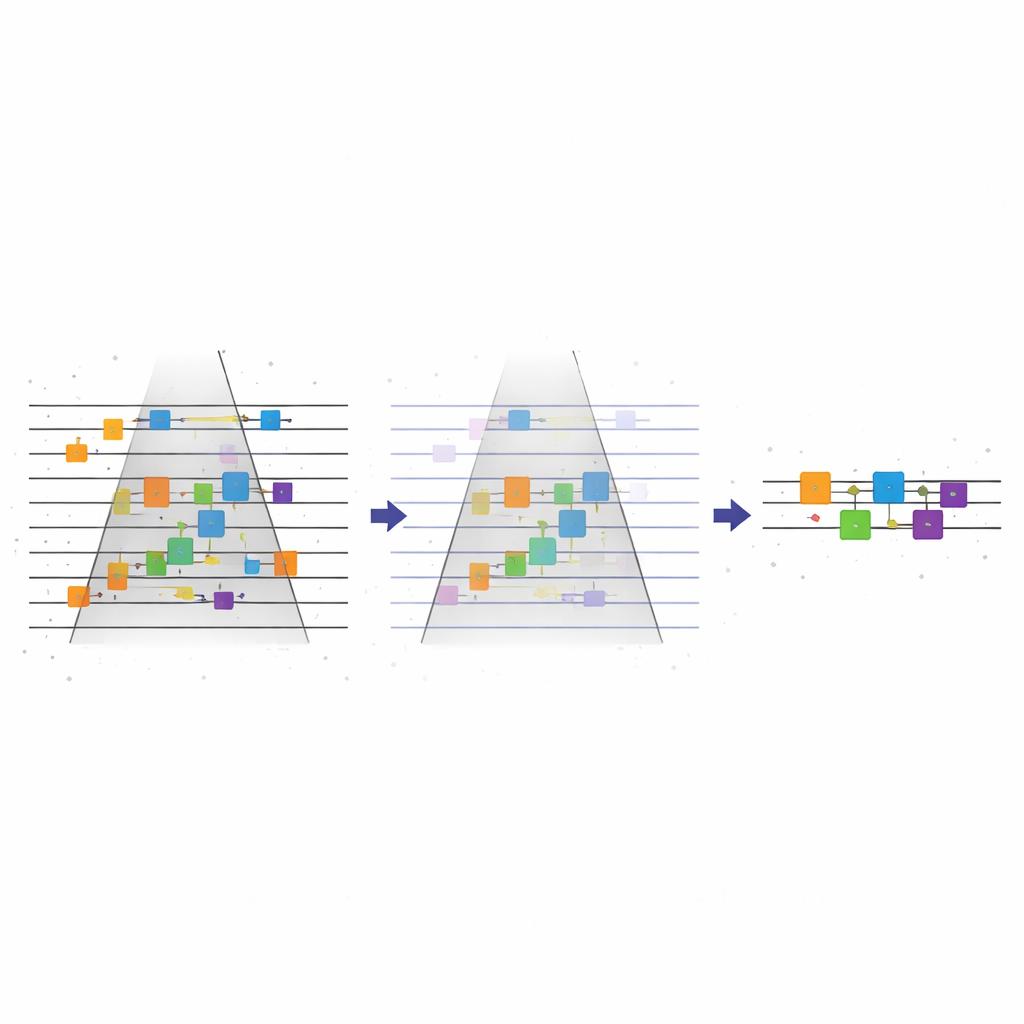
The central idea of the paper is called light cone cancellation. When evaluating how good a candidate solution is, only a small neighborhood of qubits actually influences each local measurement. Gates that sit outside this “light cone” do not change that particular number, even though they are present in the full circuit. The authors show how to systematically remove these redundant gates for each local piece of the Max-Cut calculation. Instead of simulating one big circuit acting on all qubits, they break the job into several much smaller subcircuits, each using only a handful of qubits but together reproducing exactly the same overall quantity of interest.
Doing More With Fewer Qubits
This pruning has two major payoffs. First, it slashes how many qubits and gates are needed in any single run. For the specific Max-Cut setup studied, the authors prove that no matter how large the original network is, each subcircuit needs at most five qubits when using a single layer of gates. That means problems with up to 100 nodes can effectively be explored using hardware that physically has only seven qubits. Second, shorter and smaller circuits suffer less from noise in today’s devices. Simulations on realistic “fake” quantum backends, which mimic two different IBM machines, show that circuits using light cone cancellation consistently achieve higher approximation ratios—that is, they come closer to the true best cut—than circuits without this simplification, even when both run on the same noisy hardware.
How It Stacks Up Against Classical Shortcuts
The researchers also compare their noise-free method against a famous classical approximation scheme for Max-Cut known as the Goemans–Williamson algorithm. On large graphs with 100 nodes, they find that the quantum-based approach with light cone cancellation performs especially well on denser networks, often edging out the classical benchmark in terms of how close it gets to the optimal answer. They further explore what happens when more layers of quantum gates are added. Although extra layers make the circuits more expressive in principle, in practice they introduce harder optimization landscapes and larger effective subcircuits, so the chances of finding very high-quality solutions actually drop.
Trimming Quantum Circuits for the Road Ahead
In everyday terms, this work shows that carefully trimming away parts of a quantum calculation that do not affect the final score can make small, noisy quantum devices punch above their weight. By focusing only on the regions of a circuit that truly matter for each local piece of the problem, the light cone cancellation technique turns an otherwise unwieldy calculation into many smaller, cleaner ones. For Max-Cut, that means solving very large network-splitting tasks using only a few effective qubits, while reducing the impact of hardware errors. As quantum processors slowly improve, such circuit-saving tricks may be key to turning fragile machines into useful tools for tackling complex optimization problems.
Citation: Lee, X., Yan, X., Xie, N. et al. Light cone cancellation for variational quantum eigensolver in solving noisy Max-Cut. Sci Rep 16, 9597 (2026). https://doi.org/10.1038/s41598-025-31798-1
Keywords: quantum optimization, Max-Cut, variational quantum algorithms, noise mitigation, light cone cancellation