Clear Sky Science · en
A server-assisted secure blockchain model for residential demand response in smart grids
Why our future homes may trade power with each other
As more households add rooftop solar panels, batteries, and even electric cars, our homes are quietly turning into miniature power plants. This is good news for clean energy, but it also makes the job of keeping the lights on much more complicated. This paper explores a new way for neighborhoods to share electricity directly with one another using ideas borrowed from digital currencies, while still keeping the system fast, fair, and secure.
From one-way power to active neighbors
In the traditional grid, electricity flowed in one direction: from distant power stations to passive customers. Today, many residents both consume and produce energy, earning the new label “prosumers.” They may export solar power on bright afternoons and draw power from the grid at night. This local generation can cut losses on long power lines and ease pressure on big plants, but it also makes the overall pattern of supply and demand more erratic. To smooth things out, utilities encourage “demand side management,” programs that nudge people to shift flexible uses like water heating or washing clothes away from peak hours.
Why simple central control is not enough
Most current programs rely on large, centralized control centers. Smart meters send detailed household data to a utility server, which then decides when appliances should run or how prices should change over the day. While this can be efficient, it also creates problems. A single control hub can become a bottleneck or a tempting target for cyberattacks. Storing fine-grained data in one place raises serious privacy concerns because it can reveal when people are home and what devices they use. And with millions of devices trying to communicate, these systems can struggle to scale. These weaknesses have pushed researchers to look for more distributed, “trust-less” solutions where no single party has to be blindly trusted.
Bringing blockchain and a smart server together
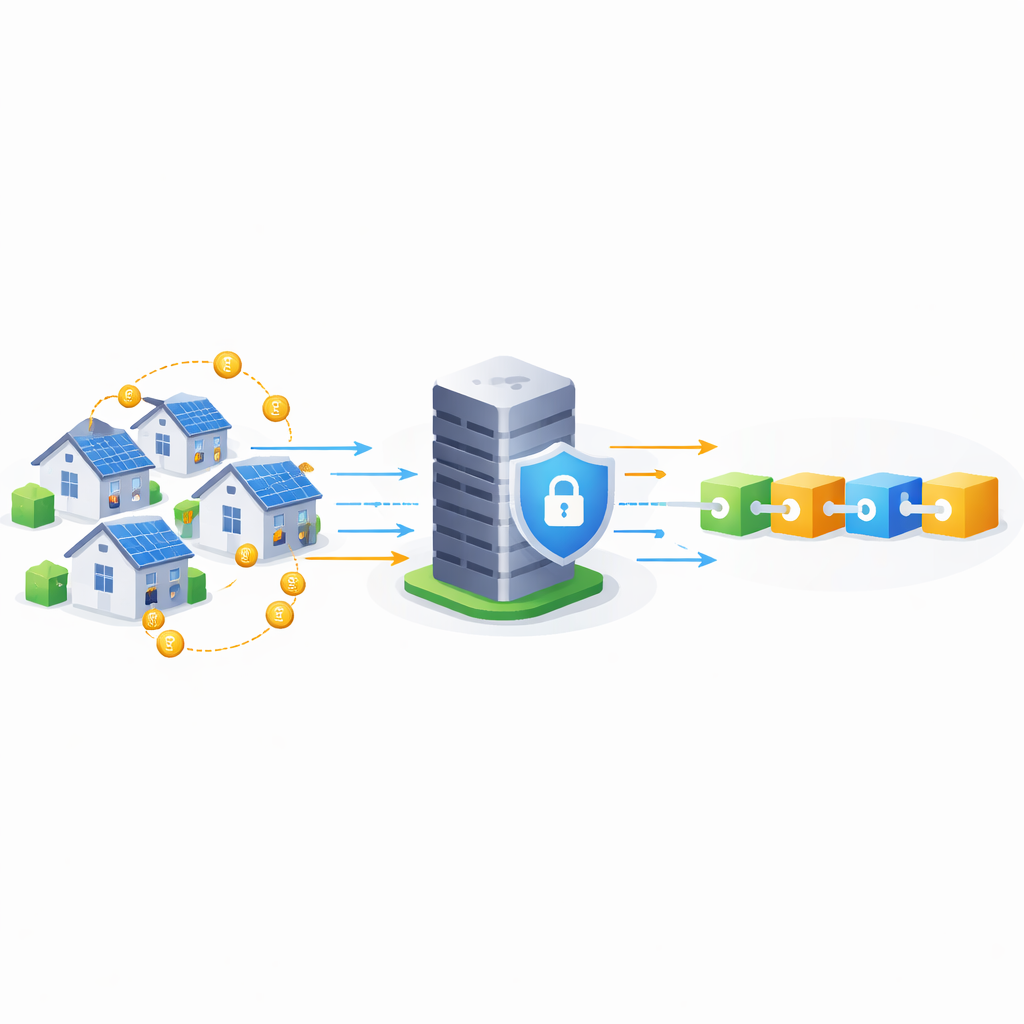
Purely decentralized blockchain systems—like those used for popular cryptocurrencies—offer tamper‑resistant records and automated “smart contracts,” but they are often too slow and power‑hungry for second‑by‑second energy management. The authors propose a hybrid approach that blends the strengths of both worlds. In their design, each home uses a smart meter and a local control unit to measure use and solar output. This data is encrypted and sent to a secure central server, called EnPlus, which handles the heavy calculations: forecasting tomorrow’s demand for each home with a machine‑learning model, planning appliance schedules, and matching buyers and sellers of surplus solar power. Once EnPlus has checked that a trade is valid and beneficial, the actual record of the transaction is written to a private blockchain, where smart contracts settle payments automatically using a special digital token called the Green Energy Reward (GER).
How secure, tokenized energy sharing works
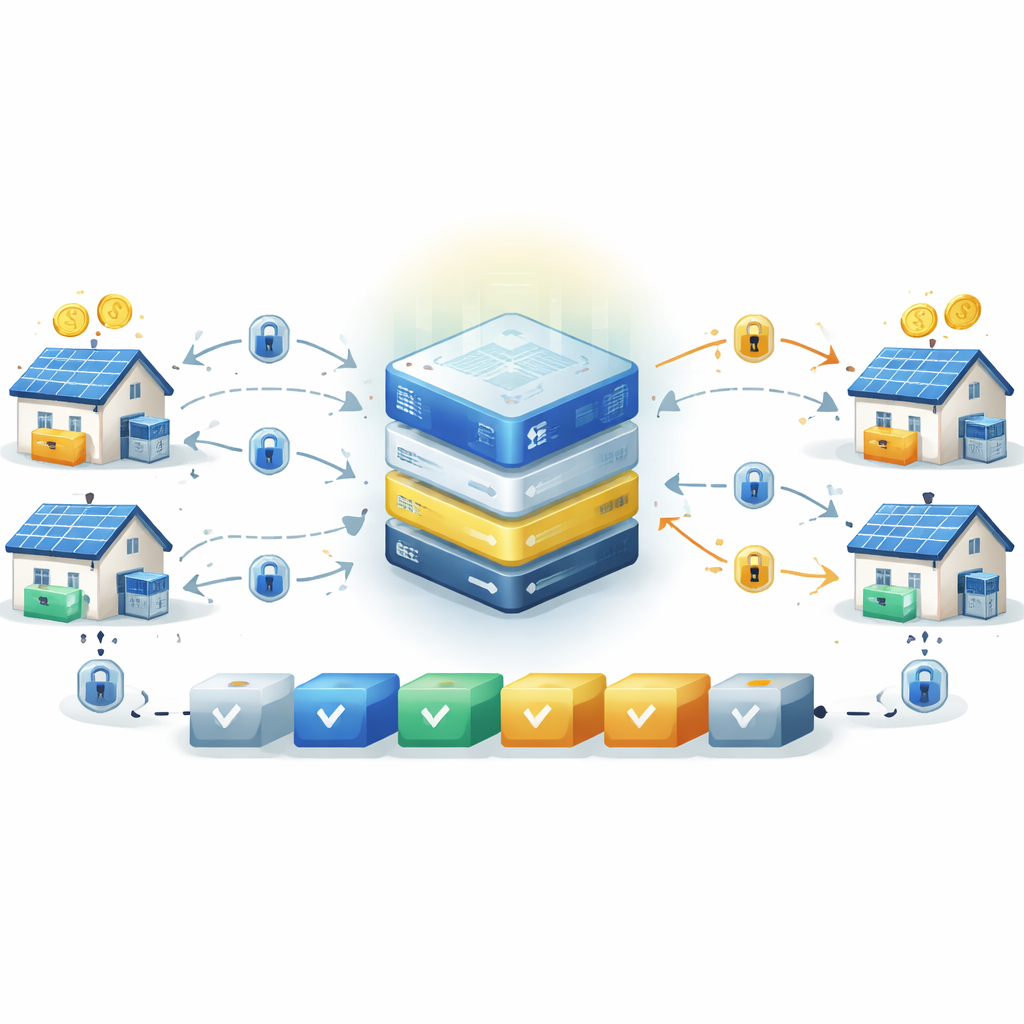
Security is built into every step of the process. Each household is given a digital identity based on cryptographic keys and certificates, so only approved devices can participate. The smart meter encrypts its readings before sending them; the server verifies the source and signs transactions before they reach the blockchain. Inside EnPlus, a forecasting model called a Long Short‑Term Memory network learns daily patterns of consumption and solar output from real data gathered at a housing complex in Kolkata. An optimization method then decides which appliances can be shifted in time, balancing lower bills with the householder’s preferred usage times. When households have extra solar energy, they can offer it to neighbors in exchange for GER tokens instead of simply pushing it back to the main grid. The server’s matching engine pairs buyers and sellers, checks that energy and token balances make sense, and then triggers a smart contract to transfer both energy rights and tokens on the blockchain.
What happens in a real neighborhood
The researchers tested their design using data from 25 homes in a real solar housing project, and then extended the scenario to 52 homes by generating statistically similar demand patterns. Each home had a 2.5‑kilowatt rooftop solar system. First, they examined a traditional program where only appliance timing was adjusted; then they added the token‑based trading layer. In both cases, the central server scheduled flexible loads to avoid high‑price periods and to better align with local solar output. With demand scheduling alone, overall electricity costs for the 52 homes fell by about 14 percent and the daily demand curve became noticeably flatter. When peer‑to‑peer trading with GER tokens was added, total costs dropped by roughly 22 percent compared with no management, and the peak‑to‑average demand ratio—a measure of how spiky the load is—improved by nearly 40 percent. A fairness index also rose, indicating that the benefits of lower bills and token earnings were shared more evenly across the community.
Why this matters for the grid of tomorrow
For non‑experts, the key message is that our future grid does not have to be either tightly centralized or fully decentralized. This work sketches a middle path in which a smart, trusted server does the fast, complex thinking, while a blockchain ledger guarantees that the resulting energy trades are transparent, auditable, and hard to tamper with. The case study suggests that such a system can lower household bills, reward those who invest in clean energy, and make neighborhood demand more predictable—all while protecting privacy and remaining scalable as more homes join. If adopted widely, architectures like this could help turn clusters of houses into cooperative, self‑balancing energy communities that support a cleaner and more resilient power system.
Citation: Ghosh, A., Goswami, A.K., Shuaibu, H.A. et al. A server-assisted secure blockchain model for residential demand response in smart grids. Sci Rep 16, 9595 (2026). https://doi.org/10.1038/s41598-025-31668-w
Keywords: smart grid, peer-to-peer energy trading, blockchain energy, demand side management, rooftop solar