Clear Sky Science · en
Bulk single crystal growth and scintillation properties of Ce and Mg co-doped Y3Ga3Al2O12 for advanced X-ray imaging
Sharper Medical Scans from Smarter Crystals
Modern X‑ray and CT scans are powerful tools, but making images clearer while keeping radiation doses low is a constant challenge. This study introduces a new type of crystal that lights up when hit by X‑rays and gamma rays, designed specifically for the next generation of medical scanners called photon‑counting CT. By carefully growing large, high‑quality crystals with improved speed and stability, the researchers aim to help doctors see finer details inside the body with cleaner images and safer scans.
Why Today’s Detectors Need an Upgrade
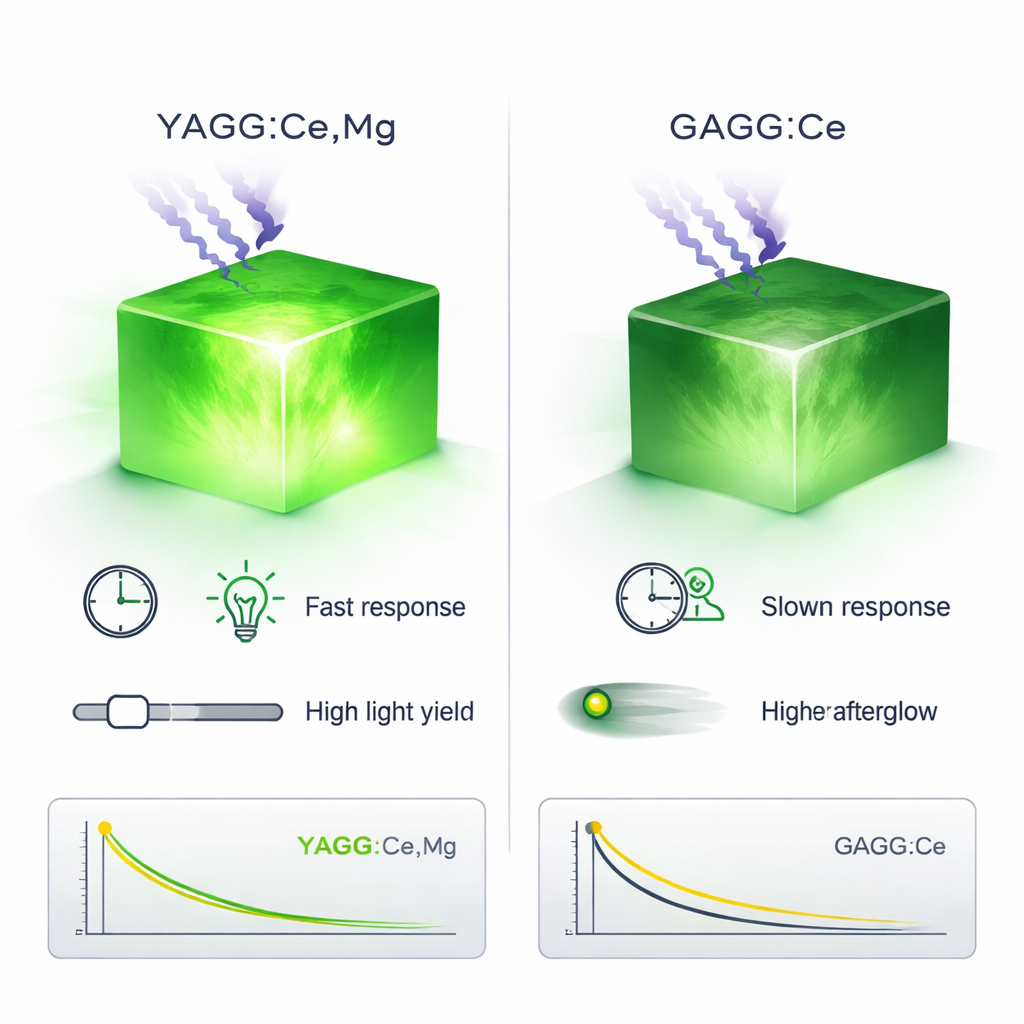
Most current CT scanners use detectors that sum up all incoming X‑ray energy, which limits how well they can distinguish different tissues or materials. Photon‑counting CT works differently: it counts individual X‑ray photons and measures their energy, promising sharper contrast, material separation (like calcium versus iodine), and lower patient dose. To make this work, the detector material must meet several strict requirements at once: it must produce a lot of light for each photon, respond very quickly, leave almost no lingering glow between pulses, and avoid certain atomic “fingerprints” (K‑edges) in the energy range used in medicine, which can distort the spectrum. Existing commercial crystals such as GAGG:Ce perform well but suffer from a gadolinium K‑edge in the medical X‑ray range and from slower, lingering light signals that limit performance.

Building a Better Light‑Up Crystal
The team focused on a related material called YAGG:Ce,Mg, a yttrium‑based garnet crystal doped with small amounts of cerium and magnesium. Yttrium’s key absorption edge lies below the medical X‑ray window, avoiding the spectral artifacts that plague gadolinium‑based crystals. However, turning this material into large, uniform crystals suitable for real detectors is challenging. They used the Czochralski technique, in which a seed crystal is slowly pulled from a hot, molten mixture. At the very high temperatures needed, gallium oxide tends to evaporate and can damage the iridium crucible, while uneven mixing in the melt can cause the dopant atoms to distribute unevenly. By carefully tuning the gas atmosphere around the melt—shifting from nitrogen–carbon dioxide to argon with a small, controlled amount of oxygen—the researchers were able to suppress gallium loss and crucible damage, and successfully grow a 1‑inch‑diameter crystal about 8 cm long.
Keeping the Crystal Perfect from End to End
To check whether the crystal’s composition was uniform, the team cut it into pieces along its length and measured how the different elements were distributed. Using electron probe microanalysis and plasma emission techniques, they found that the key atoms—yttrium, gallium, aluminum, cerium, and magnesium—were remarkably evenly spread, with only small disturbances where the pulling conditions briefly changed. They calculated “segregation coefficients,” numbers that describe how easily each element enters the solid crystal compared with the melt. Aluminum and yttrium were slightly favored, while gallium, cerium, and magnesium were less so. Interestingly, magnesium entered the YAGG crystal much more easily than in earlier gadolinium‑based materials, a difference the authors traced back to the relative sizes of the ions. This favorable behavior helped them maintain consistent doping and, as a result, consistent scintillation performance along the whole crystal.
Fast, Bright, and with Almost No Lingering Glow
The ultimate test was how well the new crystal performs as a scintillator—that is, how efficiently and how quickly it turns radiation into light. Under gamma rays from a cesium‑137 source, YAGG:Ce,Mg produced about 46,700 photons per million electron volts, essentially matching a high‑grade commercial GAGG:Ce standard. Across the crystal, light output stayed within about 8.5% of this value, showing good uniformity. The energy resolution, a measure of how well the detector can distinguish different photon energies, ranged from 8.5% to 11.4% at 662 keV. Most strikingly, the light died away very quickly: the main decay components were around 50 nanoseconds, faster than in GAGG:Ce. Magnesium co‑doping helped stabilize cerium in a mixed charge state and reduced trapping of charge carriers, which in turn slashed the slow “afterglow” signal to levels far below those of commercial comparison crystals. Spectral measurements also showed that unwanted ultraviolet emissions seen in some related materials were absent, indicating a cleaner, more direct energy transfer to the cerium light centers.
What This Means for Future X‑Ray Imaging
In plain terms, the researchers have shown that it is possible to grow large, high‑quality YAGG:Ce,Mg crystals that are bright, fast, and very “quiet” after each X‑ray pulse, without the spectral drawbacks of gadolinium. This combination is exactly what photon‑counting CT detectors need to deliver clearer images and more precise energy information at clinically reasonable doses. Beyond improving image quality, the optimized growth conditions also reduce damage to the expensive iridium crucibles, which is important for keeping manufacturing costs under control. The authors suggest that further tuning of the cerium and magnesium levels, scaling to larger diameters, and even moving to crucible‑free growth methods could push performance and producibility even further, paving the way for next‑generation medical and industrial imaging systems built on this new crystal platform.
Citation: Suezumi, H., Kamada, K., Gushchina, L. et al. Bulk single crystal growth and scintillation properties of Ce and Mg co-doped Y3Ga3Al2O12 for advanced X-ray imaging. Sci Rep 16, 6780 (2026). https://doi.org/10.1038/s41598-025-31659-x
Keywords: photon-counting CT, scintillator crystals, YAGG Ce Mg, X-ray imaging, Czochralski growth