Clear Sky Science · en
Testing of milling cutter with the conformal cooling channels produced by the selective laser melting technology
Cooler tools for smoother machining
Modern factories rely on metal-cutting tools that must survive huge forces and intense heat. This study shows how 3D printing can build a smarter milling cutter with tiny curved channels inside it that guide coolant right to the cutting edge. By redesigning the tool from the inside out and carefully testing the metal it is made from, the authors created a cutter that keeps its inserts cooler and lasting longer than a standard tool.
Why tool temperature matters
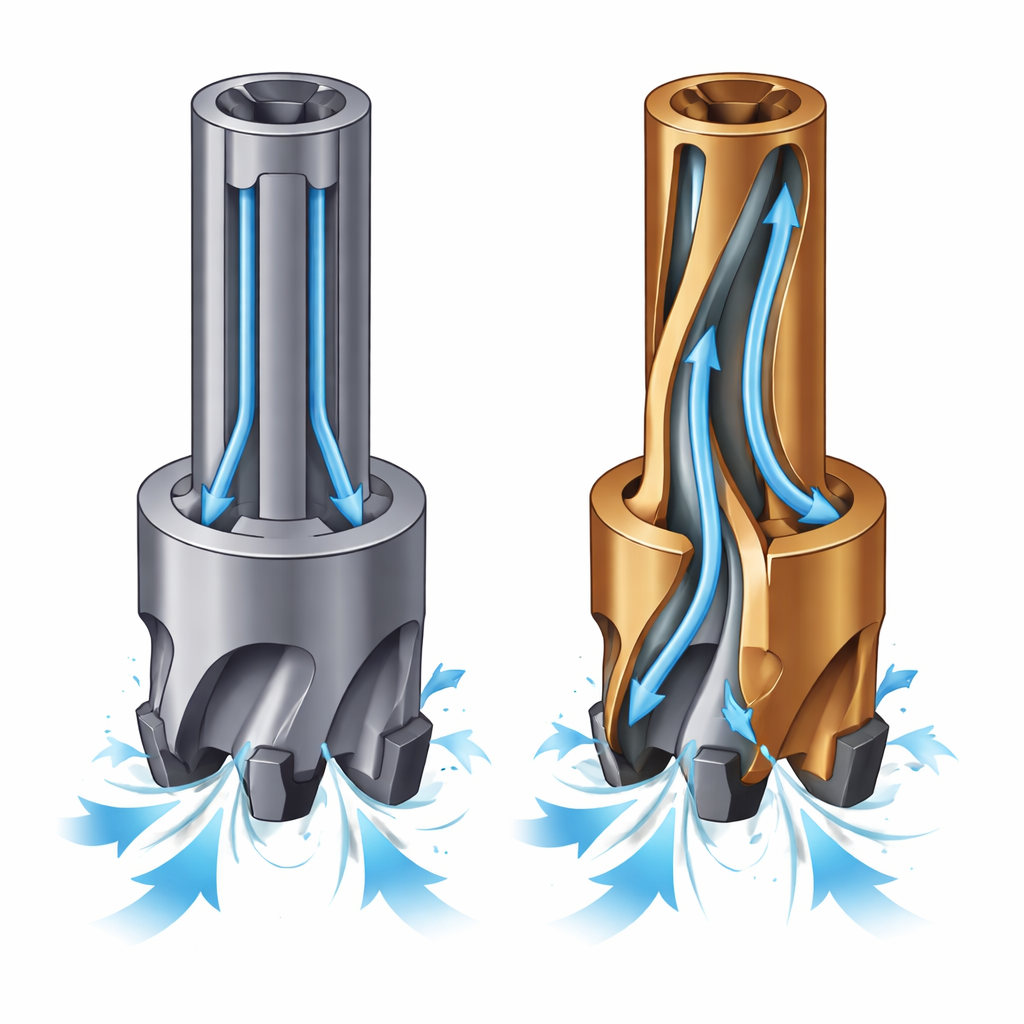
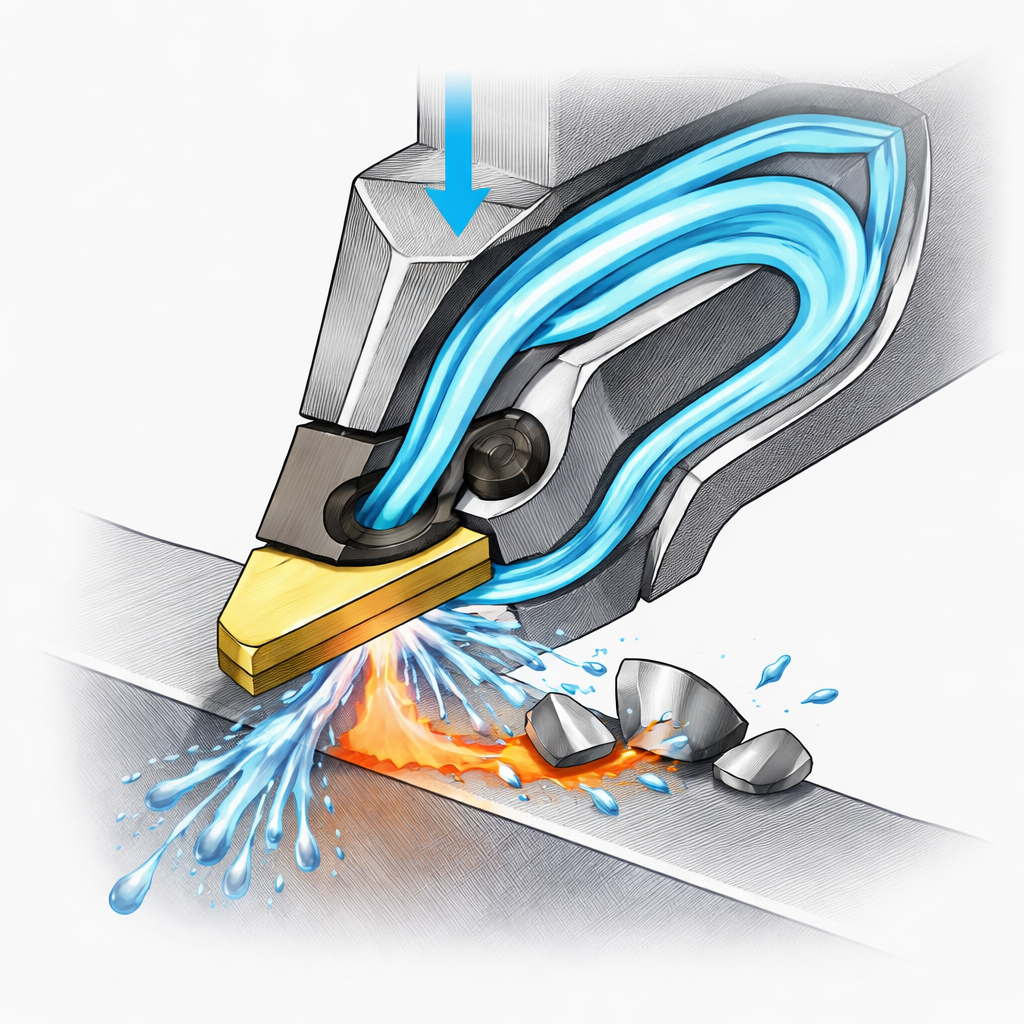
Whenever a rotating cutter machines steel or aluminum, the contact zone between the insert and the workpiece heats up rapidly. If this heat is not removed, the cutting edge softens, wears out, and may even chip or break. Conventional milling cutters have straight drilled holes that bring coolant somewhere near the inserts, but not exactly where it is needed most. As machining speeds and productivity demands rise, this older approach to cooling becomes a limiting factor, shortening tool life and increasing costs.
Building a new kind of cutter
The team used metal 3D printing, specifically selective laser melting, to fabricate the body of a 25-millimeter milling cutter from a high-strength maraging steel known as M300. Before trusting this material in a demanding tool, they printed and heat-treated test samples, then examined their internal structure and measured strength and hardness. Microscopes revealed a dense steel with only tiny pores and many nanoscale particles formed during heat treatment, which significantly increased hardness and resistance to deformation. These checks confirmed that the printed steel could safely handle the heavy loads that occur during cutting.
Shaping coolant paths to hug the edge
With the material qualified, the authors designed a new cutter body whose hidden channels bend and curve so that coolant exits directly behind each insert’s cutting edge. Computer simulations were used to ensure that these channels and the overall shape would not weaken the tool under load. Finite element analysis showed that stresses in the 3D-printed design stayed well below the steel’s strength and were even lower than in a conventional tool, partly because the new geometry avoided sharp corners that concentrate stress. After printing, only the key contact surfaces and threads were machined to precision so that standard commercial inserts could be mounted accurately.
Putting the printed tool to the test
The researchers then compared the 3D-printed cutter with a traditional solid body in a series of real machining trials. They performed face, slot, and shoulder milling on aluminum and construction steel, and later ran long-term durability tests on tool steels, both in the soft state and after hardening. They measured cutting forces with a dynamometer and surface roughness with high-resolution optical equipment, and they tracked how quickly the inserts wore out under both dry cutting and internal coolant conditions. In almost all cutting operations, the printed tool required lower cutting forces, meaning it cut more easily. Surface quality was sometimes slightly worse for the printed body, a result they traced to minor imbalance because not all of its outer surfaces were fully finished.
Coolant-focused design boosts tool life
The clearest advantage of the conformal cooling channels appeared in the durability tests. When coolant was fed through the tool, inserts mounted in the 3D-printed body lasted about 20 percent longer than those in the conventional cutter, thanks to more direct cooling of the cutting edge and better chip removal. Under dry cutting, where no coolant was used, both tools performed similarly, confirming that the main gain came from the improved cooling path rather than from any other design detail. Taken together, the results show that metal 3D printing can deliver dense, strong tool bodies with built-in curved channels that traditional drilling cannot achieve, opening the door to longer-lasting, more efficient cutters, especially for tough-to-machine materials.
Citation: Kolomy, S., Slany, M., Sedlak, J. et al. Testing of milling cutter with the conformal cooling channels produced by the selective laser melting technology. Sci Rep 16, 9599 (2026). https://doi.org/10.1038/s41598-025-31338-x
Keywords: 3D-printed cutting tools, conformal cooling channels, maraging steel M300, milling cutter durability, selective laser melting