Clear Sky Science · en
Large-scale environmental DNA survey reveals niche axes of a regional coastal fish community
Why hidden fish neighborhoods matter
Along Japan’s long and varied coastline, thousands of fish species support food, culture, and jobs. Yet we still know surprisingly little about how these species share space, and how rising temperatures and shifting ocean currents might rearrange their underwater neighborhoods. This study uses traces of DNA drifting in seawater to map where more than a thousand coastal fish species actually live, and to uncover the invisible “rules of the game” that organize this bustling marine community.
Reading the ocean with stray DNA
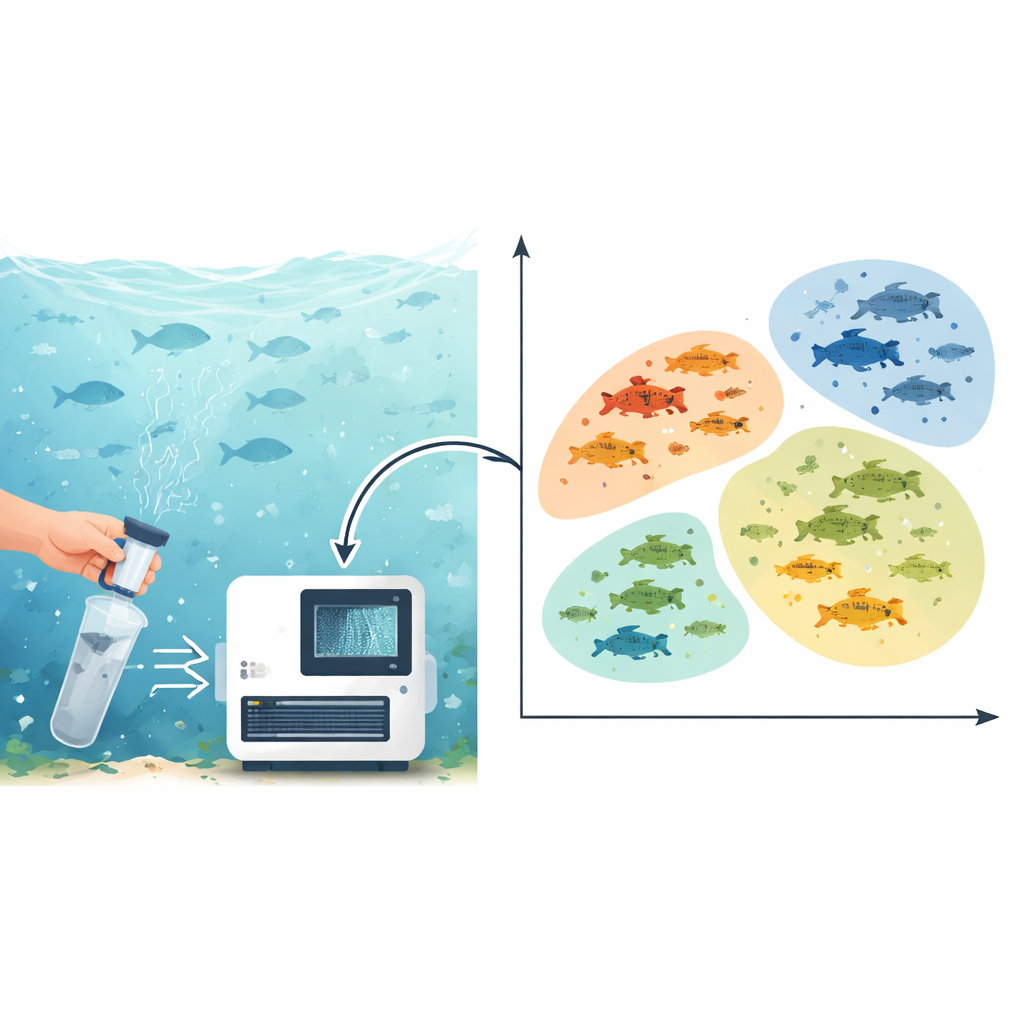
Instead of catching fish one by one, the researchers sampled seawater at 528 sites that ring the Japanese islands, from subarctic Hokkaido in the north to subtropical islands in the south. Each bucket of water contains tiny fragments of genetic material shed by nearby fish. By filtering the water, extracting this environmental DNA, and sequencing it in the lab, the team could identify which species had recently been present. This large-scale survey, conducted in a single summer, detected 1,220 coastal fish species from hundreds of families, capturing both common species and many that showed up at only a handful of locations.
Patterns along a changing shoreline
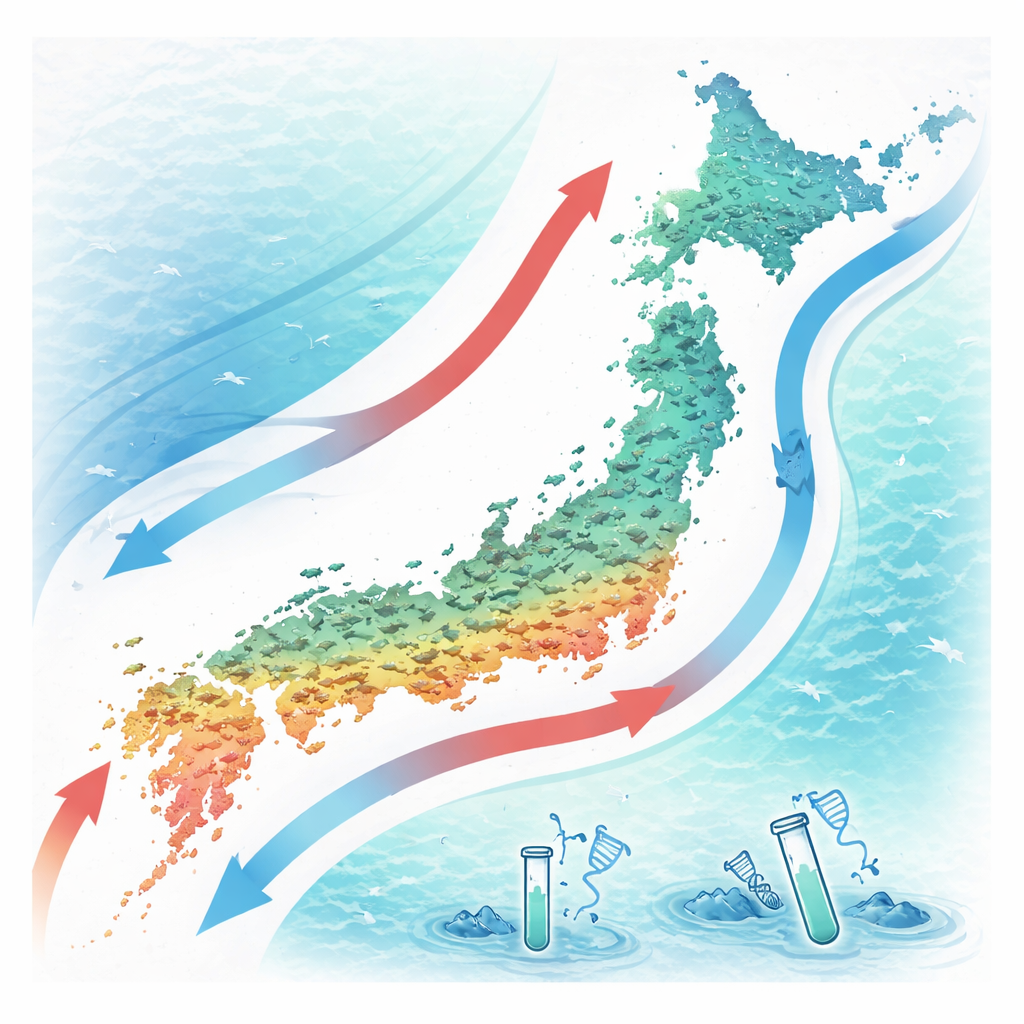
The DNA survey revealed a clear pattern: fish diversity was lowest in colder northern waters and highest in the warmer south, echoing a well-known global trend. When the team used a method that groups sites by how similar their fish lists were, they found distinct geographic clusters. Subtropical communities on remote southern islands differed strongly from the chilly subarctic communities in the north, with temperate regions forming a bridge between them. These patterns showed that Japan’s coasts are not a single uniform habitat but a mosaic of fish neighborhoods shaped by climate and geography.
Uncovering invisible environmental axes
To go beyond simple north–south comparisons, the scientists applied a statistical tool that looks for “hidden axes” that many species respond to in similar ways. These axes act like underlying gradients of conditions or history that are not directly measured. Using this model, they found three main niche axes that together explained almost all of the shared patterns in where species occurred. Two of these axes split the coastline into five broad regions separated by biogeographic boundaries that match known features of Japan’s ocean currents and seafloor. For example, one boundary aligns with the powerful Kuroshio Current, which can block some species from crossing between mainland Japan and the southern island chains. Other boundaries track shifts from warm, shallow seas to colder, deeper waters, and correspond not only to changes in fish but also to differences in large seaweeds, seagrasses, and even some land plants.
Special places and insurance against change
The third niche axis highlighted scattered, partially enclosed seas and bays such as the Seto Inland Sea and Tokyo Bay. These areas tend to be cooler and less salty than nearby open coasts and host distinctive species that likely reflect long-term isolation and unique histories. The team also asked how “response diversity” — the range of ways species in a community react to environmental shifts — is spread along the coast. Communities with more species generally had higher response diversity, which is thought to buffer ecosystem functions like productivity and fisheries yields. Yet some regions, especially along the Pacific coast of western Japan, stood out as having unusually high response diversity, likely because of complex coastlines, coral reefs, and steady inflows of fish carried by warm currents from the south.
What this means for future oceans
For non-specialists, the key message is that Japan’s coastal fish are organized by a few powerful, but mostly hidden, environmental and historical dimensions closely tied to ocean currents and long-term climate. These same forces are now being altered by global warming. As currents shift and temperatures rise, the invisible niche axes that structure fish communities are likely to move as well, reshuffling which species live where and how reliably coastal ecosystems can provide food and other benefits. By combining environmental DNA surveys with advanced modeling, this study offers a fast, repeatable way to track those hidden changes — and to identify regions whose rich and varied fish communities may be especially important to protect as a form of insurance against an uncertain future.
Citation: Osada, Y., Miya, M., Araki, H. et al. Large-scale environmental DNA survey reveals niche axes of a regional coastal fish community. Sci Rep 16, 3276 (2026). https://doi.org/10.1038/s41598-025-31307-4
Keywords: environmental DNA, coastal fish, ocean currents, marine biodiversity, climate change