Clear Sky Science · en
Polymer additive manufacturing tools for sheet metal forming: a combined simulation and experimental study
Why plastic tools for metal might matter to you
Modern products, from cars to kitchen appliances, depend on metal sheets that are cut and shaped into parts. Traditionally, the heavy tools that press and bend these sheets are made from steel, which is expensive and slow to machine. This study explores a different path: using strong plastic tools made by 3D printers to shape real steel and aluminum sheet metal. If such tools prove accurate and durable enough for small production runs, manufacturers could prototype new designs faster, at lower cost, and with less waste—benefits that ultimately ripple down to consumers through cheaper, more customized products. 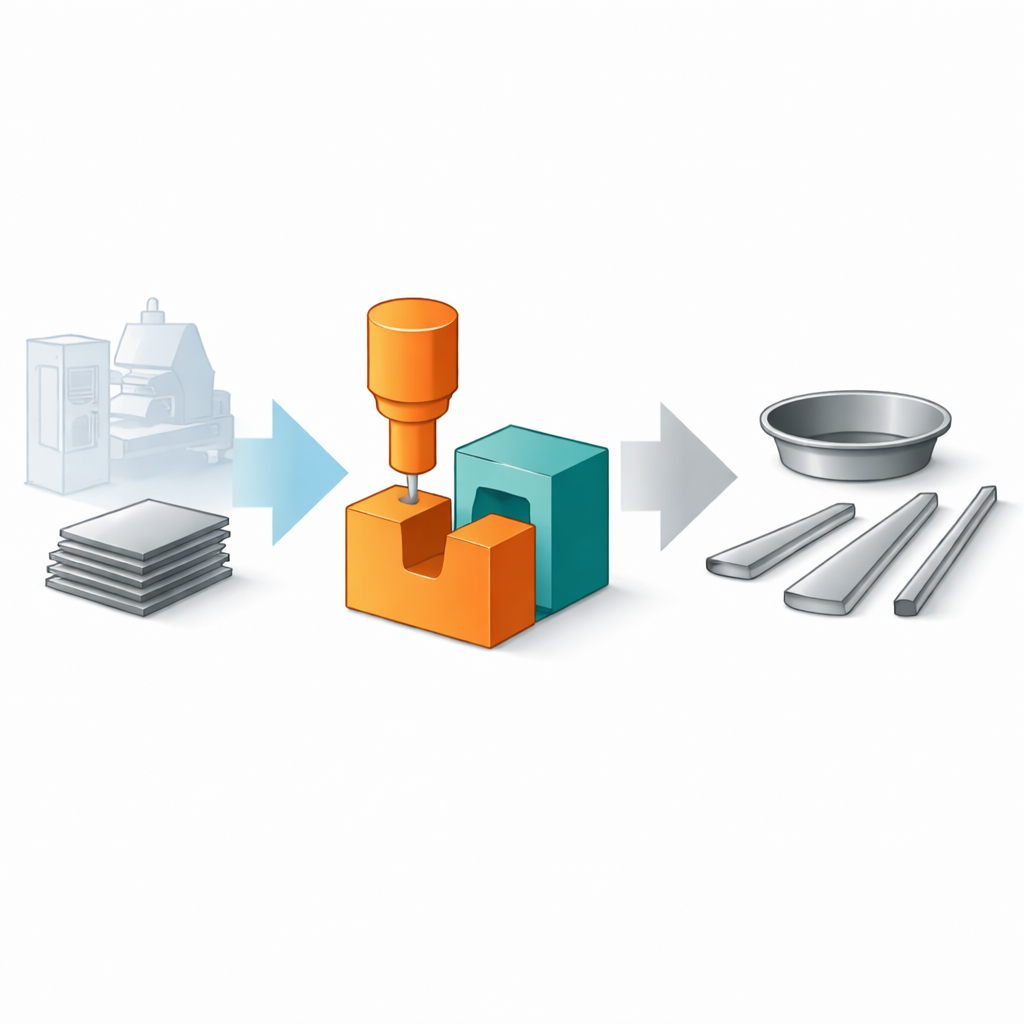
From digital design to plastic forming tools
The researchers focused on two common shaping steps: drawing a shallow cup and bending a strip of metal into a V. Instead of conventional steel tooling, they 3D-printed punches and dies from two engineering plastics. For cup drawing, they used a tough grade of polylactic acid (PLA Pro); for V-bending, they printed tools from ABS, a plastic often found in durable consumer goods. Using industrial fused deposition modeling printers, they carefully tuned settings like layer thickness, infill pattern, and temperature so the printed tools would be stiff, dimensionally stable, and strong enough to withstand repeated loading in a press machine.
Testing metal shaping in the virtual world
Before heading to the workshop, the team built detailed computer models of both processes. They used finite element analysis to predict how two widely used sheet metals—stainless steel SS304 and aluminum alloy AA6061—would deform, thin, or fail under different tool radii, sheet thicknesses, and forces. The simulations also checked how much stress and deflection the plastic tools themselves would experience. For cup drawing, digital experiments showed that a 6 mm punch radius and 1 mm sheet thickness gave a good balance: the metal flowed smoothly into the die, thinning stayed below commonly accepted safety limits, and the plastic punch and die remained well within their strength margins.
Putting 3D-printed tools to work
Armed with these optimized settings, the team ran systematic trials on hydraulic presses. PLA Pro tools were used to draw cups from 1 mm thick steel and aluminum discs, both with and without a blank holder ring to control wrinkling. In parallel, ABS V-dies and punches bent strips of the same metals to angles of 30°, 45°, and 60°. Across dozens of samples, they measured forces, final shapes, wall thickness, and common forming flaws like wrinkles, cracks, or tears. They then compared these measurements back to the computer predictions, looking at how closely real load–displacement curves and formed shapes matched their virtual counterparts. 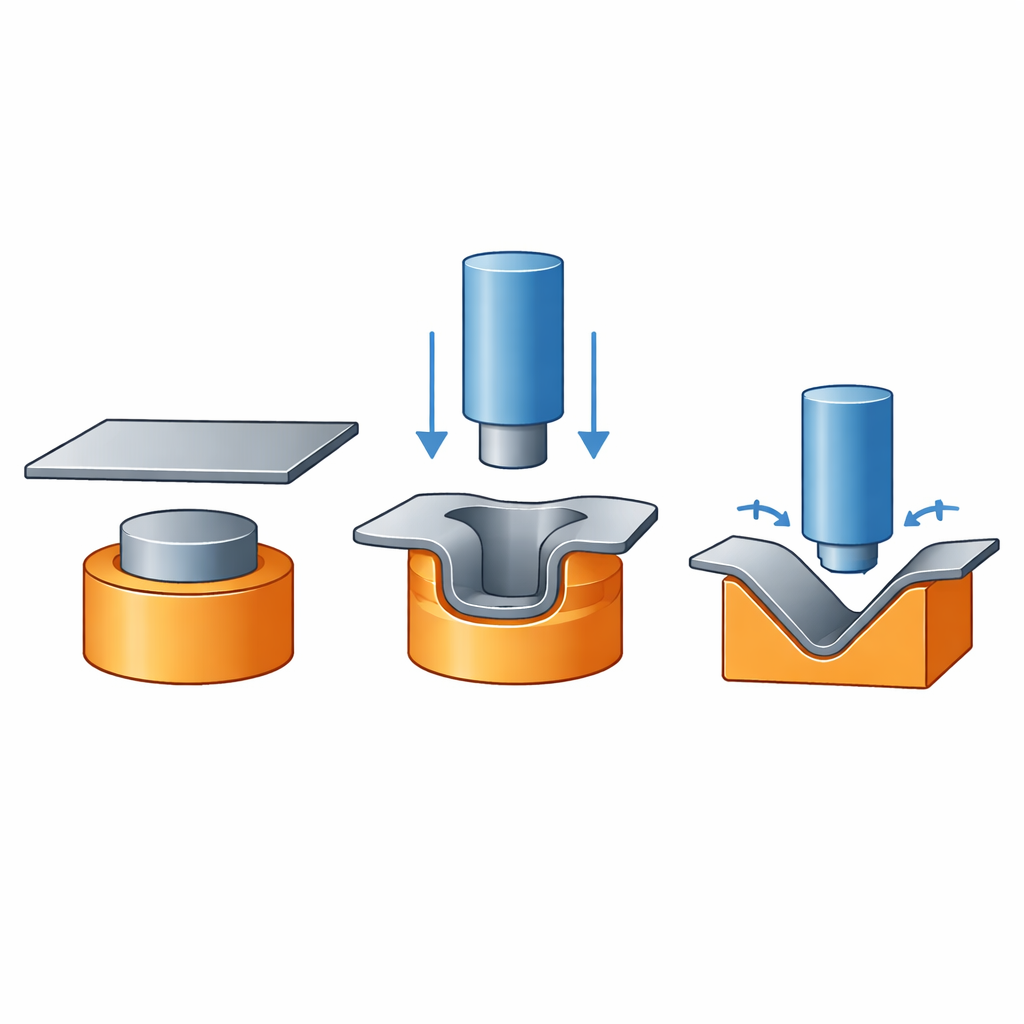
How well did plastic tools stand up?
The results were encouraging. In cup drawing, both metals could be formed without visible cracks or serious surface defects, and the maximum thinning in the walls stayed in the generally accepted safe range. Stainless steel needed higher forces but showed more uniform thickness and a wider safety margin before failure, while aluminum required less force but thinned more where the punch curved the sheet. For V-bending, the plastic tools produced angles and bending lengths that differed from theory and simulation by only a few hundredths of a percent—small enough to be negligible in most prototype or small-batch settings. Wear on the 3D-printed tools was modest: the ABS dies showed only minor polishing and skid marks after batches of bends, and the PLA cup tools degraded mainly after more intensive use, which the authors linked to tool life limits rather than one-off failure.
Saving time and money while staying accurate
Because plastic is lighter and easier to shape than steel, the team also examined costs. For the cup drawing tools, 3D-printed PLA Pro sets were slightly cheaper than their steel counterparts and significantly faster to produce, especially when machining and surface finishing for metal dies were taken into account. In V-bending, ABS tools were roughly half the cost of steel tooling for batch sizes up to around 60 parts; beyond that, the longer life of steel tools made them more economical. Overall, the work shows that while 3D-printed polymer tools will not replace hardened steel in high-volume production, they offer a compelling option for early-stage prototyping, experimental studies, and short runs. In practical terms, that means manufacturers can iterate more designs, more quickly, with less waste—helping bring better, more customized products to market sooner.
Citation: Bhatia, C.V., Patel, D., Vats, R. et al. Polymer additive manufacturing tools for sheet metal forming: a combined simulation and experimental study. Sci Rep 16, 9293 (2026). https://doi.org/10.1038/s41598-025-30841-5
Keywords: additive manufacturing, 3D printed tooling, sheet metal forming, rapid prototyping, polymer dies and punches