Clear Sky Science · en
The future of European outdoor summer sports through the lens of 50 years of the tour de France
Racing in a Warming World
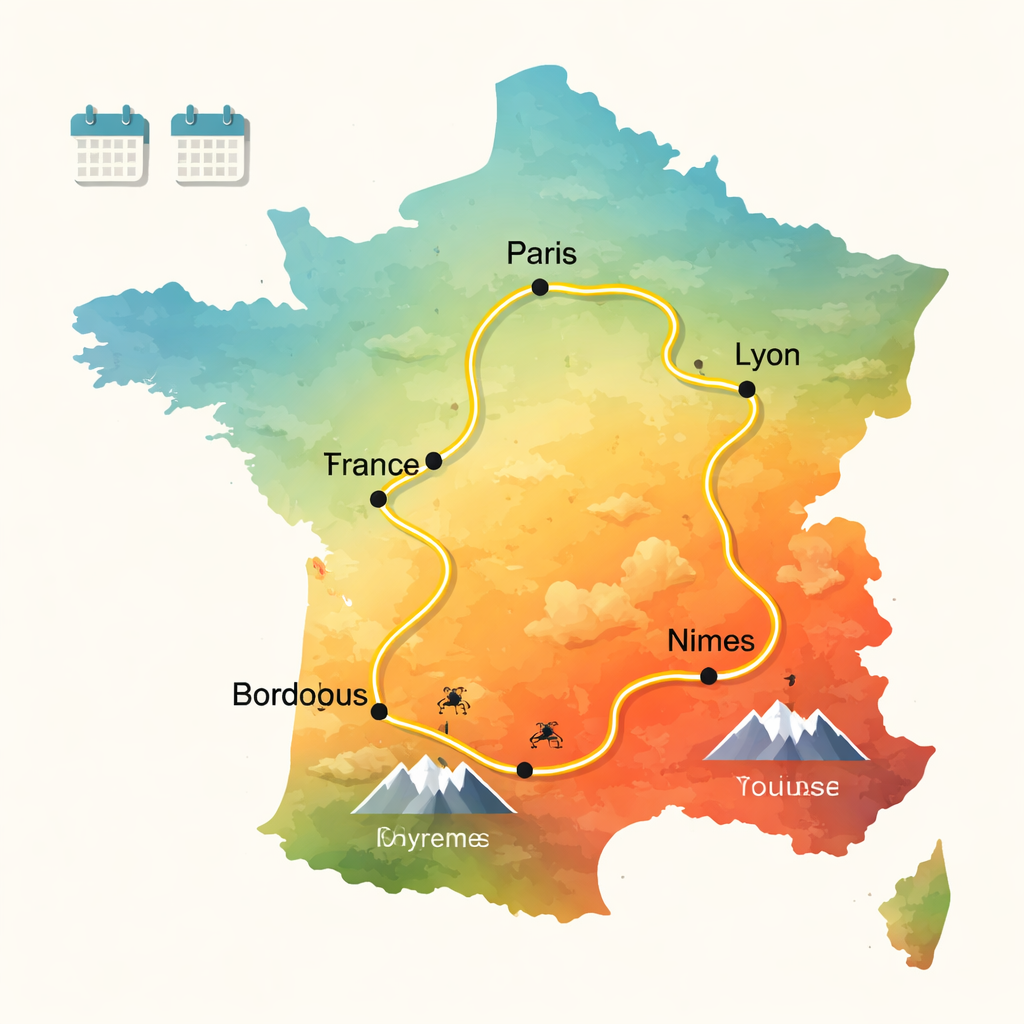
For many fans, the Tour de France is the ultimate summer spectacle: athletes pushing their limits across mountains, villages and city streets. But as European summers grow hotter, the question is no longer just who will win the yellow jersey, but whether it will be safe to race at all. This study uses 50 years of data from France to examine how rising heat is changing conditions for the Tour de France and what that means for outdoor summer sports more broadly.
Heat, Health and High-Speed Effort
Heat waves are becoming more frequent, more intense and longer-lasting across Europe. Extreme heat is particularly dangerous when combined with hard physical effort, because the body is already working to produce energy and must also get rid of excess heat. In everyday life, people can slow down, seek shade or cool off. During elite races, however, athletes often push through discomfort, sometimes past safe limits. The Tour de France, one of the toughest endurance events on Earth, offers a clear test case of how the climate signal is now intersecting with human performance.
Measuring How Hot Is Too Hot
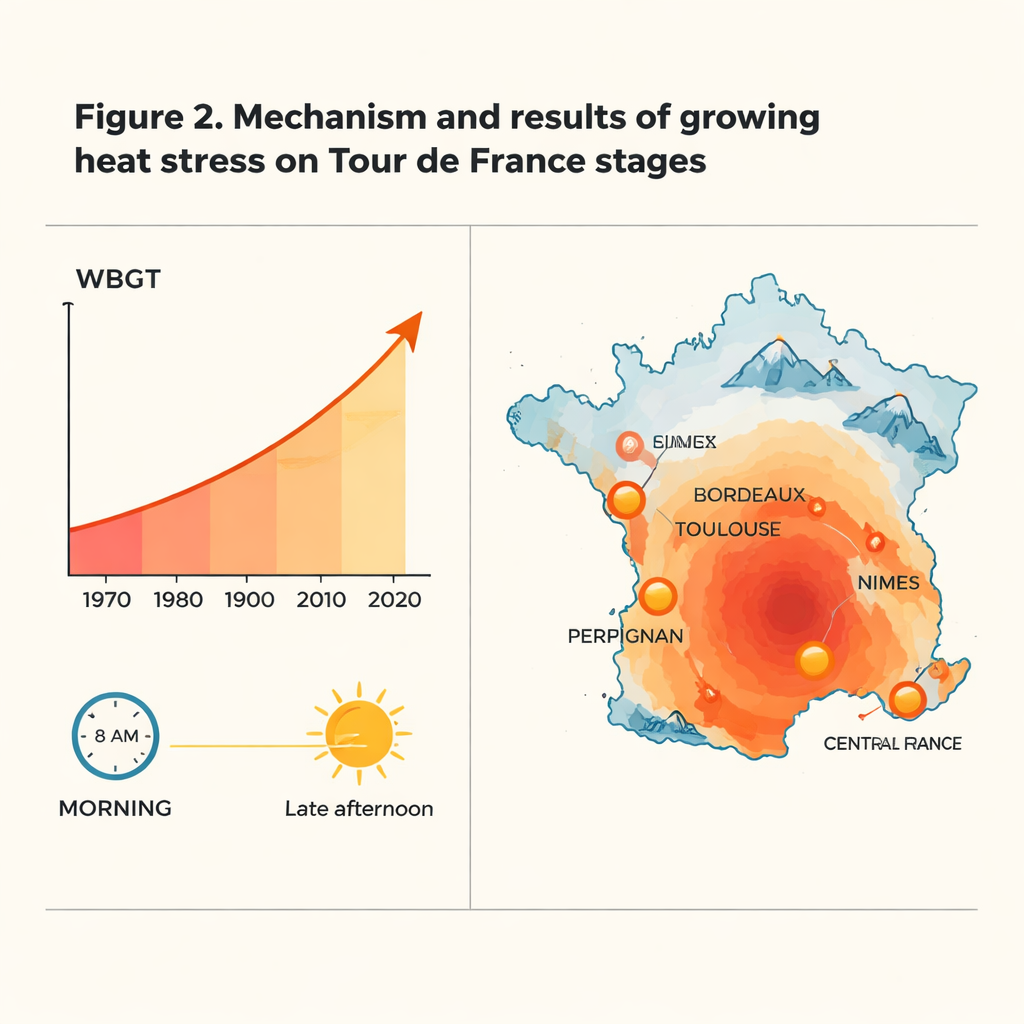
To understand risk, the authors do not just look at air temperature. They use a measure called Wet Bulb Globe Temperature, which blends temperature, humidity, sunshine and wind into a single “heat stress” value. This index is widely used in occupational health and by sports bodies to decide when conditions are low, moderate or high risk. Using detailed hourly weather data from 1974 to 2023, the team calculated heat stress every day in July at key Tour locations such as Paris, Bordeaux, Toulouse, Nîmes and famous mountain passes, and compared those values with the days when the race actually passed through.
Lucky Race Days, Hotter Background Climate
The analysis reveals a striking contrast: July heat stress across France has clearly increased over the past five decades, but Tour de France stages have so far mostly dodged the very worst days by chance. Around Paris, for example, mid-afternoon heat stress has crossed the cycling federation’s “high-risk” threshold on five July days in the last 50 years, four of them since 2014 — yet none of those days coincided with a Tour stage. The hottest Paris finish, in 2002, came close but stayed just below the high-risk mark. In southwestern and southeastern France, cities such as Toulouse, Pau, Bordeaux, Nîmes and Perpignan have repeatedly seen dangerous heat levels, and new hotspots are emerging in central France and around Paris and Lyon. By contrast, high mountain areas like Alpe d’Huez and the Col du Tourmalet remain relatively safe, with much lower heat stress even in recent years.
When the Day Turns Dangerous
Time of day turns out to be as important as place. Across most of France, the safest July period is the late morning, while the highest heat stress typically occurs from mid-afternoon into early evening. In the most recent decade, much of the country has seen at least one July afternoon where heat stress crossed the cycling federation’s high-risk threshold, whereas such events remain rare before noon. This pattern suggests that shifting race starts earlier in the day could significantly reduce risk for riders and spectators, even without changing the routes.
Protecting Athletes in the Heat
Sports organizations are already responding to these trends with “extreme heat” protocols. Many, including cycling, football and tennis federations, now use heat stress indices like Wet Bulb Globe Temperature to trigger cooling breaks, schedule changes or, in the most extreme cases, postponements. Still, there is no single, agreed-upon cut-off, and current thresholds may be too lenient for long, intense efforts like Grand Tour cycling. The authors argue that better data on how athletes’ bodies actually respond to heat in real-world races — including core temperatures, sweating rates and on-course weather — are essential to fine-tune safety limits and cooling strategies for each sport.
What This Means for the Future of Summer Sport
The study concludes that July heat stress in France is rising, dangerous episodes are becoming more frequent and new hotspots are appearing where major stages and finishes are held. So far, the Tour de France has largely been “lucky” in its scheduling, but as summers continue to warm, relying on luck is no longer a viable safety plan. To keep iconic events like the Tour both thrilling and safe, organizers will need to plan around known hot regions, favor cooler morning hours, strengthen heat protocols and embrace continuous monitoring of both weather and athlete health. The message extends beyond cycling: in a warming Europe, the future of outdoor summer sport depends on learning to race smart in the heat, not just fast.
Citation: Cvijanovic, I., Begg, J.D., Mistry, M.N. et al. The future of European outdoor summer sports through the lens of 50 years of the tour de France. Sci Rep 16, 2644 (2026). https://doi.org/10.1038/s41598-025-30129-8
Keywords: heat stress, Tour de France, climate change, endurance sports, athlete safety