Clear Sky Science · en
Measurement of the d31 piezoelectric coefficient of compliant materials by non-contact polarization and resonant signal enhancement
Soft materials that make electricity
From phone touchscreens to medical ultrasound, many modern gadgets rely on special materials that can turn pressure into electricity and electricity back into motion. These so‑called piezoelectric materials are moving from hard, brittle ceramics toward soft, flexible fibers and films that could be woven into clothing or implanted in the body. The paper behind this summary introduces a new way to accurately measure how well such gentle, fabric‑like materials convert electric signals into mechanical motion, without even touching them with wires or metal coatings.
Why measuring soft power is so hard
Traditional piezoelectric materials are stiff, often based on lead‑containing ceramics that work very well but raise toxicity and environmental concerns. Flexible polymer fibers and nanofibers made by electrospinning offer a promising alternative: they can bend with the body, are often biocompatible, and can be turned into meshes, yarns, or thin films. But the very softness that makes them attractive also makes them tricky to test. Many standard methods either press directly on the sample or require shiny, flat, metal‑coated surfaces, which can damage delicate structures or misread their performance. Other high‑resolution microscopes probe areas so tiny that they fail to represent a full device. As a result, reported values for key performance numbers can differ widely from one lab to another.
A new non‑touch testing bench
To tackle this problem, the authors built an instrument they call PiezoGauge, designed specifically for ribbons, meshes, and wires made of compliant materials. Instead of squeezing the sample, PiezoGauge stretches it gently between two clamps and places it between a pair of flat electrodes that never make contact. When an alternating voltage is applied, an electric field passes through the material and causes it to pull along its length. One clamp is attached to a slender spring‑like beam, or cantilever. As the sample tries to contract and expand, it tugs on the cantilever, making it bend. A laser beam reflected from a mirror on the cantilever tracks this bending with high precision. By driving the system at the cantilever’s natural resonance frequency, the instrument amplifies tiny motions, allowing it to detect extremely weak piezoelectric responses. 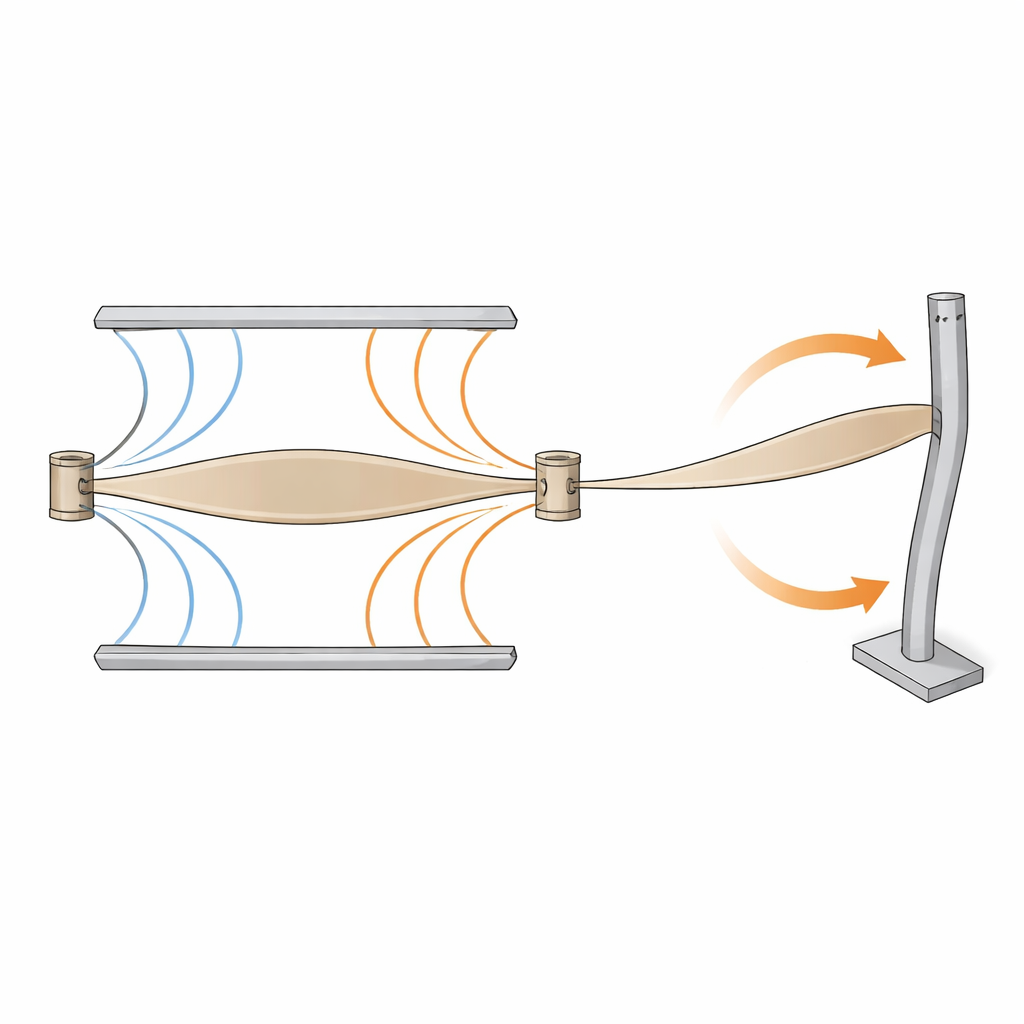
Turning tiny motions into hard numbers
Measuring motion alone is not enough; the challenge is to turn those motions into a reliable number for the material’s piezoelectric strength. PiezoGauge does this by comparing two nearly identical experiments. In the first, the sample is shaken mechanically by a calibrated piezoelectric block connected in series, which produces a known pull on the cantilever. In the second, the sample is driven electrically through the surrounding electrodes. Because both situations share the same frame and spring, many unknowns cancel out when the two signals are divided. A carefully developed formula then yields the desired coefficient that describes how much strain the material generates per unit of applied electric field. Importantly, this approach works without knowing the sample’s own stiffness beforehand, a common stumbling block in other methods. 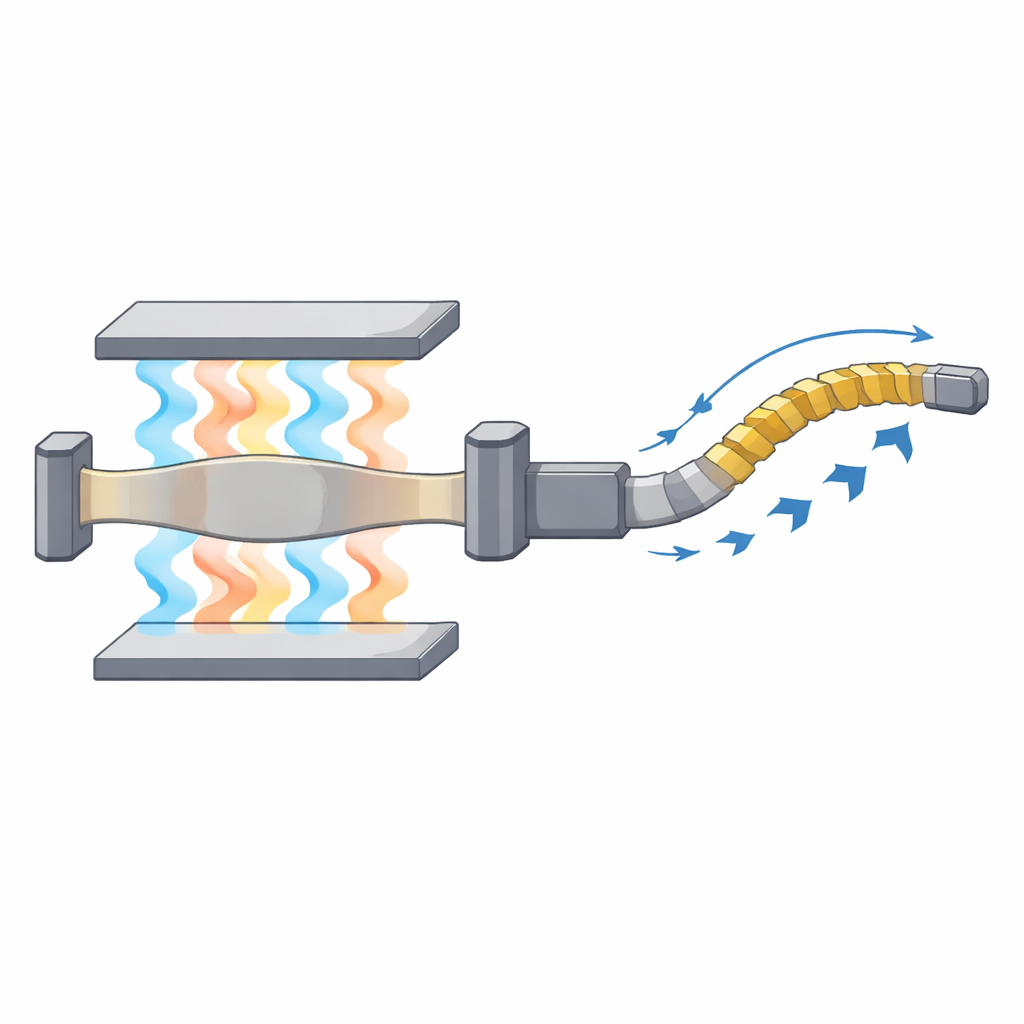
Keeping stray charges under control
Soft polymers do not just respond to electric fields; they can also trap static charges, a bit like a balloon rubbed on hair. These charges may mimic or mask a true piezoelectric response. The researchers therefore explored how sample position, trapped charge, and air humidity affect the readings. They found that even small misalignments between the sample and the electrodes can introduce unwanted forces, visible as signals at twice the driving frequency, and used this behavior as a built‑in alignment test. They also observed that static charges linger longer in dry nitrogen than in humid air, where water molecules help them leak away. From these studies they derived a step‑by‑step measurement protocol: carefully center the sample, check for charge‑related signals, neutralize the sample if needed, and only then record the piezoelectric response.
Putting the system to work
With the protocol in place, the team tested several real‑world materials, focusing on electrospun meshes of polyacrylonitrile (PAN), a polymer of interest for wearable and implantable devices. PiezoGauge revealed that aligned fiber meshes produced stronger and more consistent signals than randomly oriented ones, and that pre‑tension and waiting time after mounting both influenced the measured response. The instrument also captured clear differences in mechanical behavior: aligned meshes stretched further and bore more load, while random meshes showed more internal rearrangement during stretching. Moving from flat meshes to twisted polymer yarns, the system detected very low overall piezoelectric output, likely because the twisting cancels out the directions of individual fibers. Finally, the authors measured chitosan films, a bio‑derived material made from crustacean shells, and showed that PiezoGauge can resolve piezoelectric coefficients smaller than one trillionth of a meter per volt, highlighting its sensitivity.
What this means for future soft devices
For non‑specialists, the key message is that the authors have built a kind of “stethoscope” for soft energy‑harvesting and sensing materials. PiezoGauge listens to how flexible fibers and films move when exposed to electric fields, without having to touch them with metal contacts that could change their nature. By combining non‑contact excitation, resonance‑based amplification, and a clever built‑in calibration, it provides trustworthy numbers even when signals are vanishingly small. This makes it easier to compare different recipes, fiber arrangements, or processing steps, and to optimize materials for flexible electronics, smart textiles, and biomedical implants. In short, the work delivers both a tool and a roadmap for turning promising soft piezoelectric materials into reliable components in everyday devices.
Citation: Scarpelli, L., Zavagna, L., Strangis, G. et al. Measurement of the d31 piezoelectric coefficient of compliant materials by non-contact polarization and resonant signal enhancement. Sci Rep 16, 8659 (2026). https://doi.org/10.1038/s41598-025-29842-1
Keywords: piezoelectric polymers, electrospun nanofibers, noncontact measurement, flexible sensors, mechanical resonance