Clear Sky Science · en
Development of ranking alternatives of micro-cup production from directionally rolled copper rods using the Intuitionistic Fuzzy MARCOS method
Shaping Tiny Metal Parts for Big Technologies
From smartphones to medical implants, many modern devices rely on metal parts so small they’re hard to see with the naked eye. Making these micro-scale components accurately and at low cost is a major challenge. This paper explores a smarter way to design and fine‑tune one such process—forming tiny copper cups used in electronics and biomedical devices—by combining computer simulations with an advanced decision-making tool that helps engineers balance many competing goals at once.
From Copper Rod to Tiny Cup
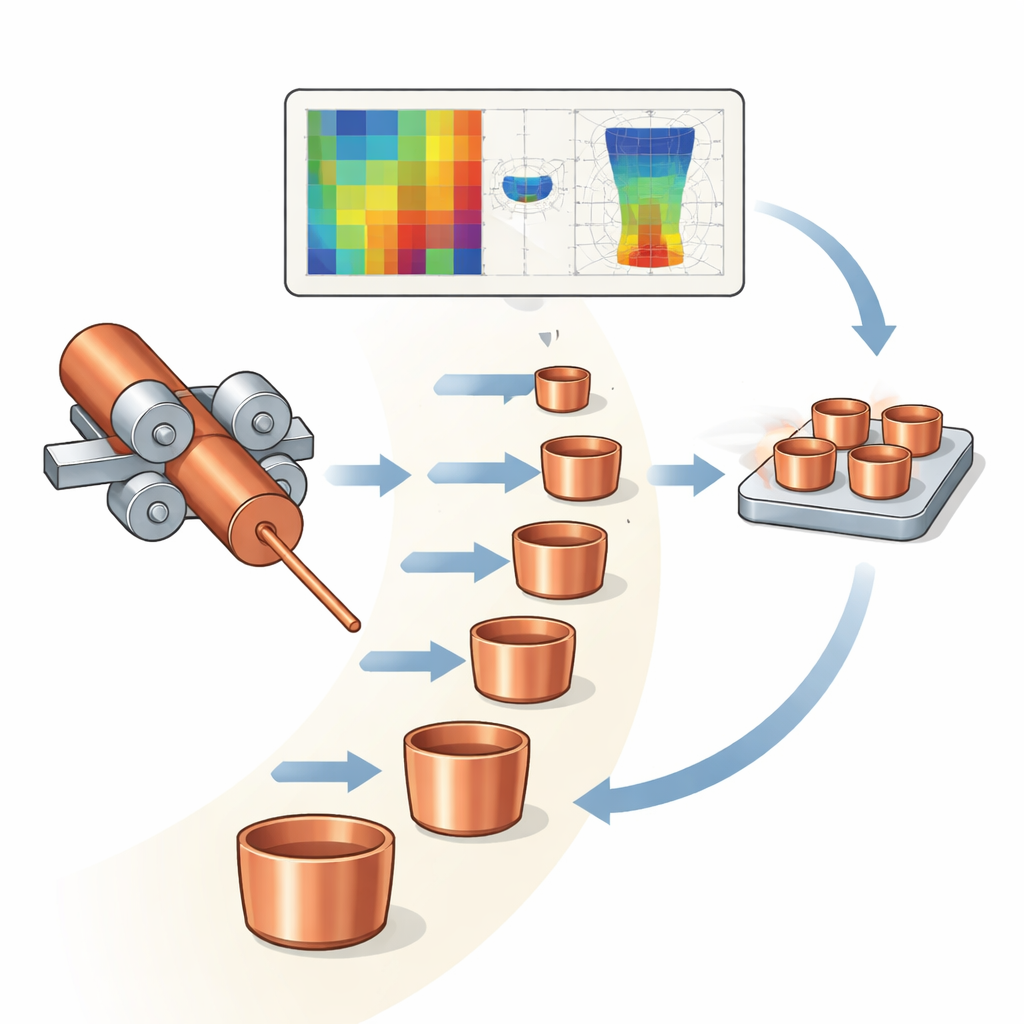
The study begins with ordinary copper rods and turns them into microscopic cups only about a millimeter and a half across. The copper is first passed through heavy rollers to squeeze it down and align its internal grain structure, then gently heat-treated to relieve built-up stress. Small circular blanks are cut and pushed through an eight-stage forming sequence called micro deep drawing, where a punch forces the metal into a die to create a cup shape. Each stage gradually shrinks and lengthens the cup so the material can flow without tearing or wrinkling, eventually producing tall, slender micro-cups suited for sensitive applications.
Using Virtual Trials Instead of Guesswork
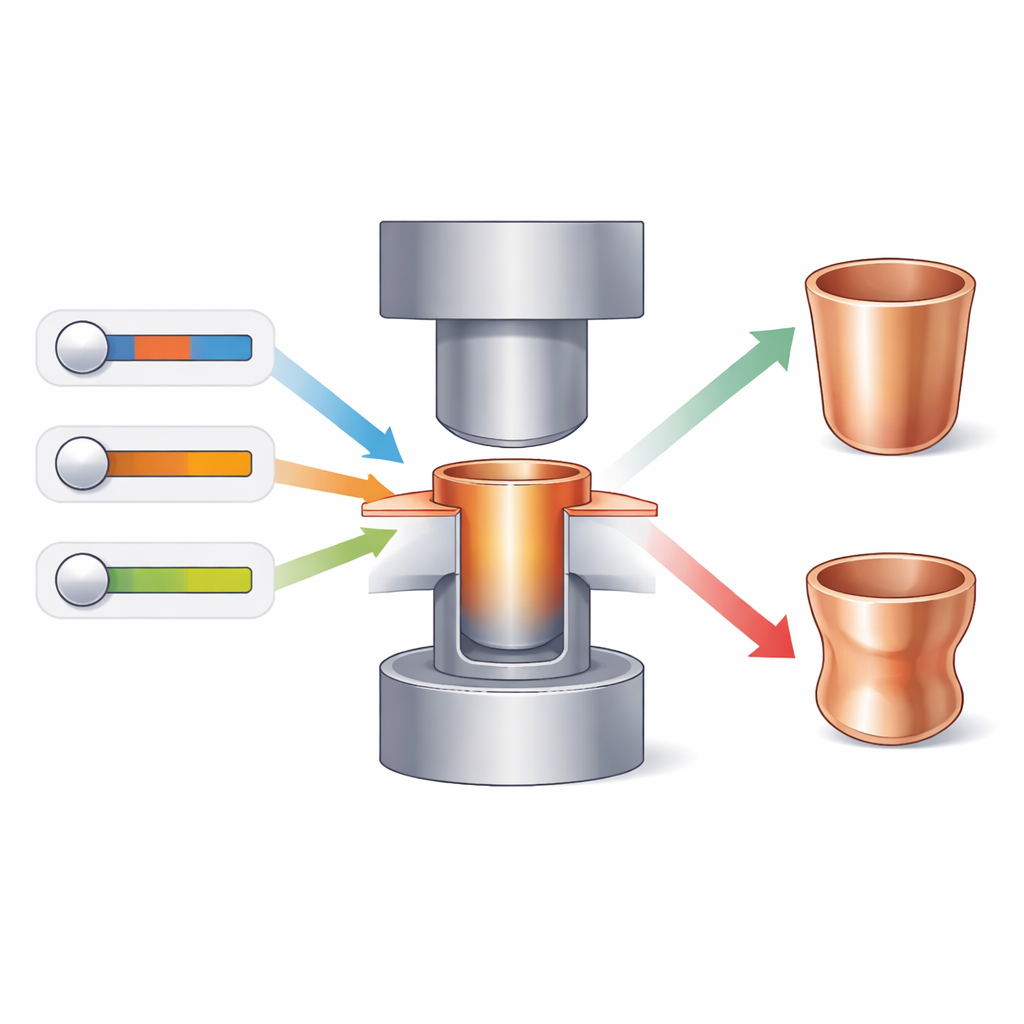
Instead of relying on trial and error in the workshop, the researchers use detailed computer simulations to model every step of the forming process. With finite element analysis, they track how the copper stretches, thins, and springs back once the tools are removed. The simulations focus on four key measures: how much force the tools must apply, how much the cup “relaxes” or springs back, how safely the metal deforms before failure, and how much the walls thin. By adjusting parameters such as the gap between punch and die, the curvature of the punch, the ratio of blank size to punch size, and the choice of dry lubricant, the team can explore many combinations virtually and see which ones promise strong, accurate cups with minimal defects.
Letting a Smart Ranking System Choose the Best Settings
Because improving one measure can worsen another—for example, lowering forming force might increase thinning—the team turns to an intuitionistic fuzzy MARCOS method, a sophisticated way to rank options when several goals conflict and expert opinions are uncertain. This approach treats each set of process settings as an “alternative” and compares it simultaneously to an ideal case and a worst-case reference. Expert judgments about what matters most are expressed as graded levels of importance with built-in hesitation, allowing the method to handle vague or incomplete information. It then computes how close each alternative comes to the ideal balance of low force, low springback, high formability, and controlled thinning, and produces a stable ranking of the best candidates.
Putting the Predictions to the Test
Once the computer model and ranking system identify promising settings, the researchers verify them in the lab. They form real micro-cups from rolled, recrystallized copper and examine them in detail. High‑resolution imaging reveals how the grains inside the metal reshape, while surface measurements track roughness, wall thickness, and dimensional accuracy. Additional tests measure hardness, how much the cups spring back, and how close the forming strains come to failure limits. The best-ranked configuration—tight clearance, a moderately rounded punch, a modest drawing step, and graphite as the dry lubricant—produces cups with smoother surfaces, more uniform walls, very small dimensional deviations, and lower forming forces than other tested conditions. Statistical checks show that the simulation’s predictions closely match what happens in reality.
Why This Matters for Cleaner, Smarter Manufacturing
For a non-specialist, the key message is that the study demonstrates a practical recipe for making tiny metal parts more reliably while wasting less material and energy. By combining realistic virtual experiments with a careful ranking method that can juggle many design goals and uncertainties, the researchers identify forming conditions that consistently yield strong, precise micro-cups. Although the work focuses on one copper alloy and a limited range of shapes, the same strategy—simulate widely, then let a smart decision system select the best compromise—could guide the design of many other micro-manufacturing processes. This moves industry away from costly trial-and-error and toward more sustainable, data-driven production of the miniature components that underpin modern technology.
Citation: Sivam, S.P.S.S., Kesavan, S. & Ajiboye, T.K. Development of ranking alternatives of micro-cup production from directionally rolled copper rods using the Intuitionistic Fuzzy MARCOS method. Sci Rep 16, 9585 (2026). https://doi.org/10.1038/s41598-025-29817-2
Keywords: micro deep drawing, finite element simulation, fuzzy decision making, copper micro-cups, sustainable micro-manufacturing