Clear Sky Science · en
A 1-bit electrically reconfigurable metasurface stirrer (ERMS) for improved reverberation chambers
Smarter Rooms for Testing Wireless Gear
Before a new smartphone, Wi-Fi router, or car radar reaches the market, engineers test it in special metal rooms that mimic the complex jumble of radio waves in real life. This paper introduces a new way to "stir" those waves inside such rooms using a thin, electronically controlled wall instead of heavy rotating metal paddles. The result is more accurate tests at lower frequencies, in a larger usable volume, with a simpler and more flexible setup—something anyone who relies on wireless devices has a stake in, even if they never see these hidden test chambers.
Why These Metal Rooms Matter
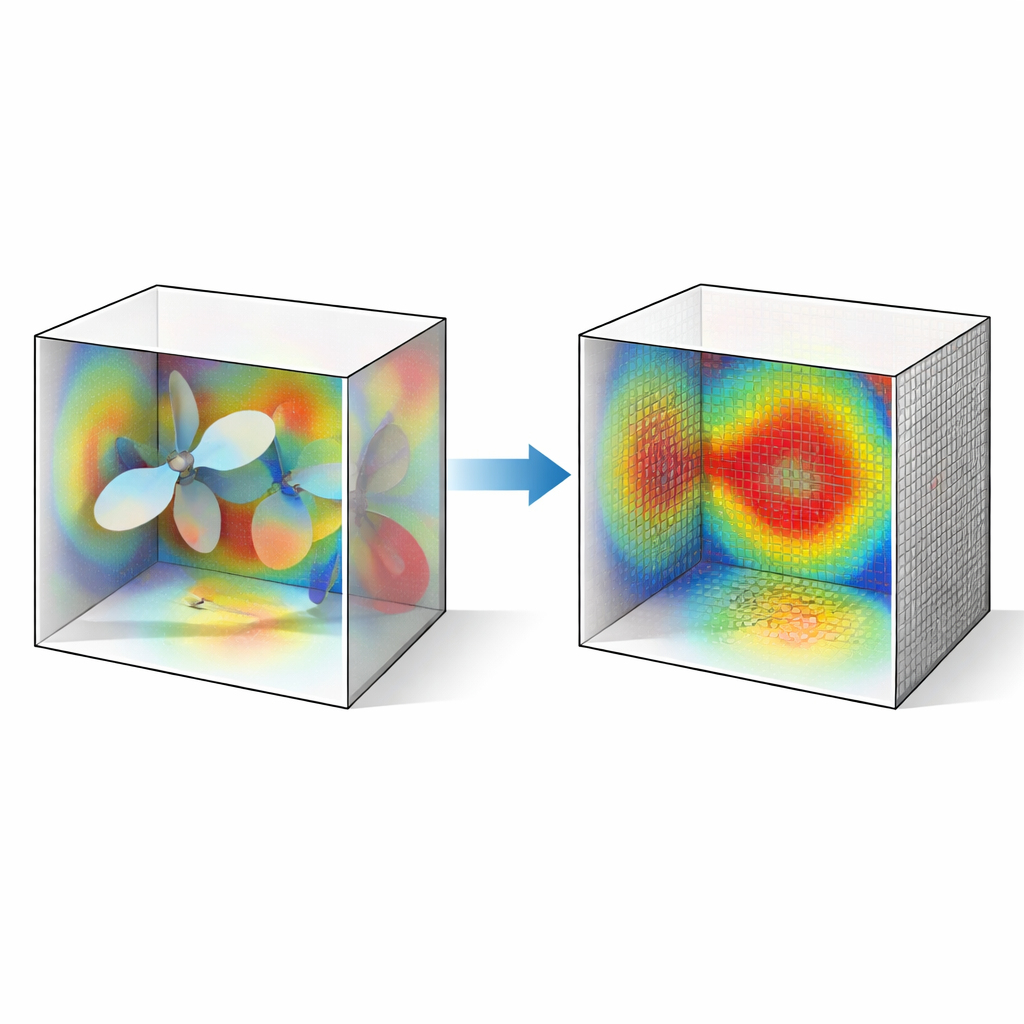
The test rooms in question are called reverberation chambers. They are sealed metal boxes where radio waves bounce around many times, creating a rich, echoing environment. To make measurements meaningful, three things must be right: the waves should be spread out evenly in space (good field uniformity), the room should work from as low a frequency as possible (low starting frequency), and there should be plenty of usable space inside where devices can sit (large working volume). Traditional chambers rely on big mechanical "stirrers"—metal paddles or panels that rotate and reshape the wave patterns—to achieve this. But those stirrers take up space, limit how low in frequency the room can be used, and add cost and complexity.
A Thin, Electronic Wall Instead of Heavy Paddles
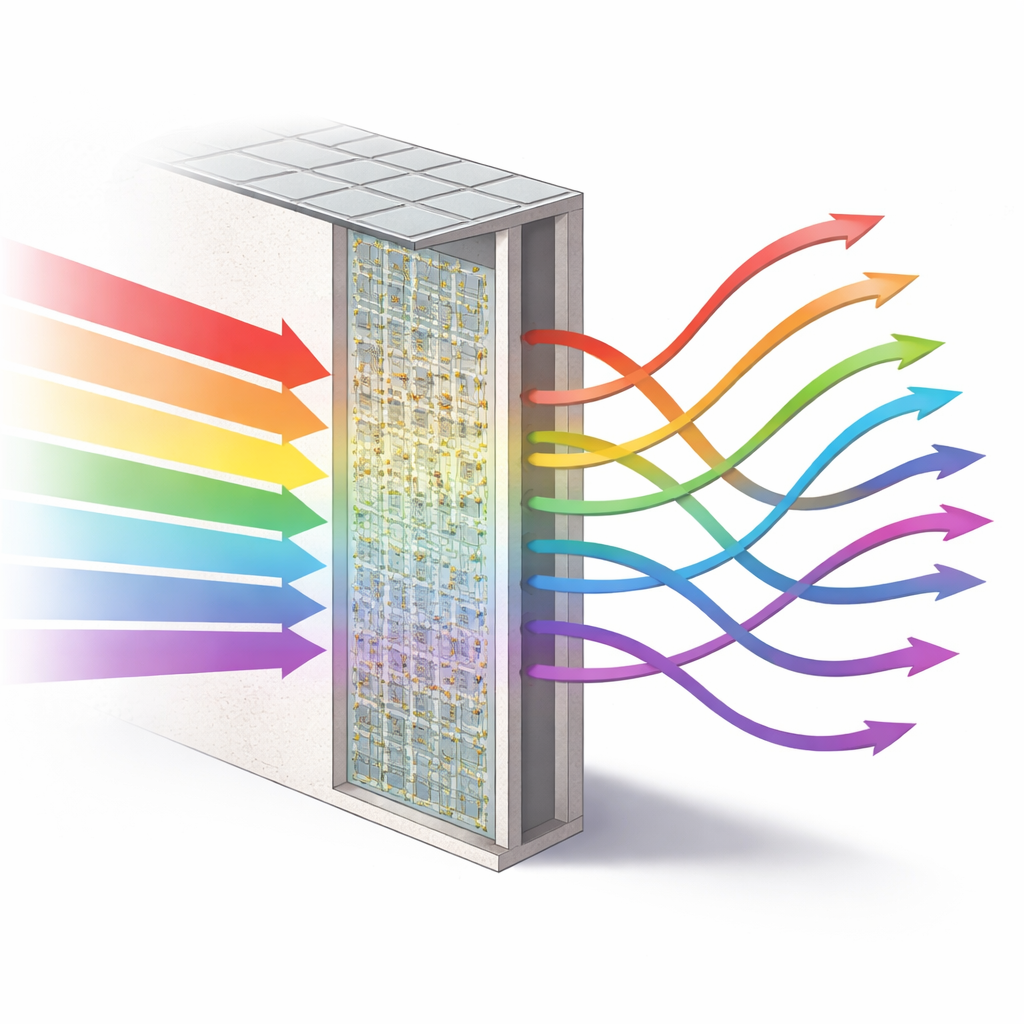
The authors propose replacing those moving paddles with a flat electronic wall called an electrically reconfigurable metasurface stirrer. Visually, it looks like a grid of metallic tiles mounted on one chamber wall. Hidden inside each tile are tiny components called varactor diodes, which can change how the tile reflects radio waves when a control voltage is applied. By grouping the tiles into two types that reflect waves with different phase—essentially changing the "timing" of the reflected ripples—the system can rapidly create many distinct wave patterns without any mechanical motion. In the prototype, 88 tiles are arranged over a panel roughly 1.2 by 1.65 meters, and a simple on/off, or "1‑bit," control scheme is enough to shuffle the patterns.
How Mixing Many Wave Patterns Smooths Things Out
The key physical idea is surprisingly intuitive: if you repeatedly add up many wave patterns whose peaks and valleys are shifted randomly relative to one another, the overall result becomes smoother and more even. The authors show, both in simple simulations and full chamber tests, that as more independent patterns are created, the variation in measured field strength from point to point shrinks. Their metasurface wall does this by randomly assigning the two reflection states to its tiles at each stirring step, generating a large set of distinct ripple patterns inside the room. Crucially, this is done while keeping the strength of the fields high enough for realistic testing—something that can be difficult with older designs that lose energy at certain resonant frequencies.
Measured Gains in Space and Frequency
To judge how well the new wall performs, the team installed it in a standard-sized reverberation chamber and compared it directly with the usual rotating metal stirrers and diffusers. They measured the radio field at eight points around a central test volume over many stirring steps and across frequencies from 300 to 930 megahertz. With the conventional hardware, the lowest frequency where the chamber met the international uniformity standard was about 420 megahertz. With only the thin metasurface wall and no moving paddles, that threshold dropped to about 325 megahertz—a significant extension downwards in frequency. At the same time, the volume of space where the fields stayed acceptably uniform nearly tripled, from 0.68 cubic meters to 1.94 cubic meters, making room for larger or multiple devices under test.
What This Means for Future Wireless Testing
In plain terms, the study shows that a smart, electronically tunable wall can do the job of bulky moving metal paddles, and do it better. The new stirrer makes more of the chamber usable and pushes its operating range to lower frequencies, all while simplifying the mechanical design. Because the metasurface approach is thin, modular, and controlled by simple electronics, it can be extended to higher frequencies by adding smaller tiles tuned for different bands. For industry and research labs, this promises more flexible, compact, and cost-effective test facilities that keep pace with the growing variety of wireless devices we depend on every day.
Citation: Kim, Y., Kim, S., Park, S. et al. A 1-bit electrically reconfigurable metasurface stirrer (ERMS) for improved reverberation chambers. Sci Rep 16, 9584 (2026). https://doi.org/10.1038/s41598-025-29555-5
Keywords: reverberation chamber, metasurface, electrical stirrer, electromagnetic testing, wireless devices