Clear Sky Science · en
Field application and diffusion law of grouting slurry in floor aquifer of a coal mine
Why stopping mine floods matters
Deep underground coal mines do not just dig through rock—they also cut across hidden rivers trapped under pressure. If that water suddenly breaks into tunnels, it can flood equipment, threaten lives, and shut down energy supplies. This study explores how to better plug the cracks beneath a coal seam using carefully designed cement mixtures, so that pressurized groundwater stays put and miners can work safely.
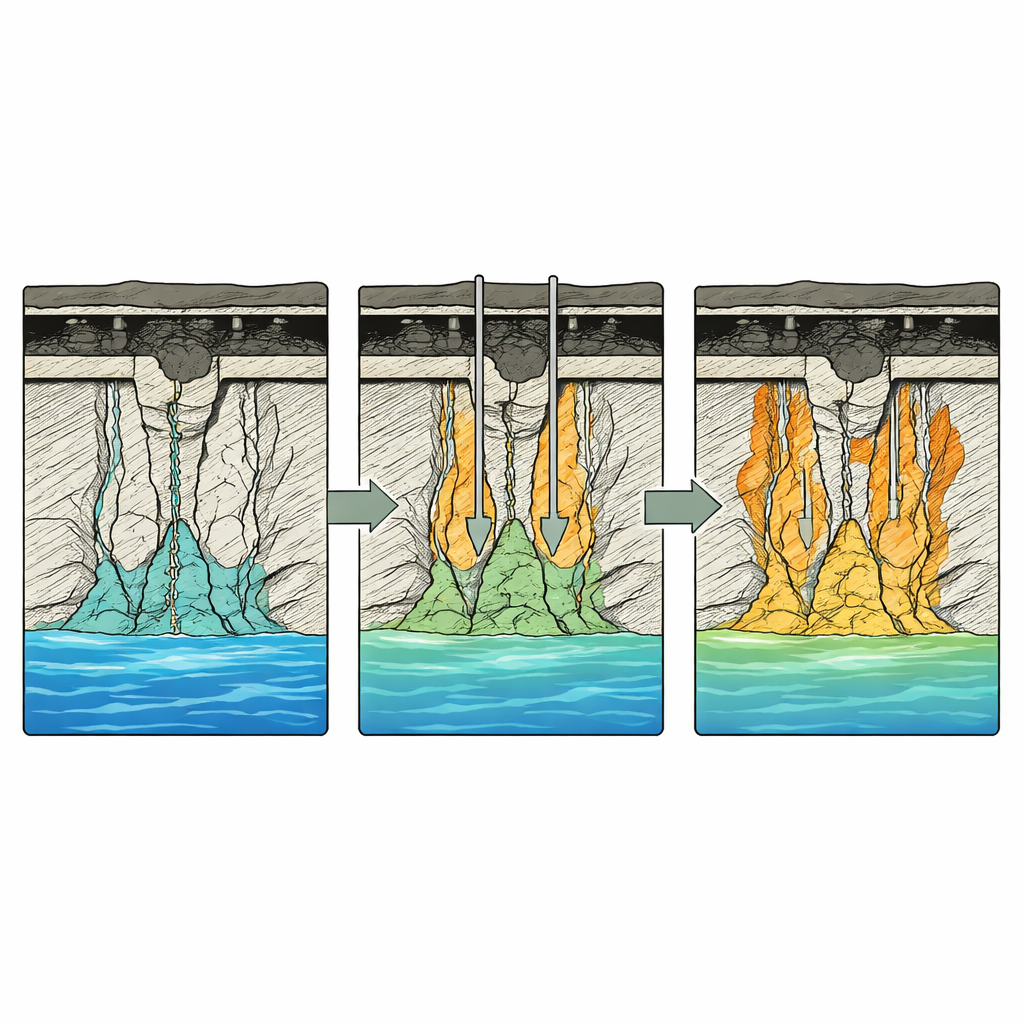
Plugging hidden cracks with liquid rock
To control water inrush from floor aquifers, engineers often inject a pumpable “slurry” made from cement or cement mixed with clay into the rock. This liquid seeps into fine cracks and pores and then hardens into a solid barrier. The authors focused on two practical questions: how to choose the best recipe for the slurry, and how that slurry actually spreads through fractured rock under strong water pressure. They tested pure cement mixtures and cement–clay mixtures in the lab, then used computer simulations and a real coal mine to see how these mixes behave underground.
Finding the right recipe
In the laboratory, the team mixed dozens of small batches that differed in density and in the amount of water, cement, and clay. They measured five key properties that matter in the field: how easily the slurry flows, how much extra water leaks out of it, how much solid “stone” remains after hardening, how long it takes to set, and how strong the hardened blocks become. Denser mixes generally flowed more slowly but formed more solid and stronger stone, while lighter mixes released more water and took longer to harden. Balancing these trade-offs, the researchers selected one pure cement mix and one cement–clay mix as optimal: both kept water leakage low, filled cracks well, and gained enough strength without setting so fast that workers would run out of time to inject it.
How slurry spreads in cracked rock
Next, the team built a detailed computer model of a rock mass containing both a crushed zone full of many small fractures and a larger main crack that can carry water. They simulated pumping the chosen cement–clay slurry into this system while accounting for fluid flow and rock deformation. The simulations showed that higher pumping pressure drives the slurry farther and more quickly, but its pressure steadily drops with distance until it nearly matches the natural water pressure. Wider cracks and more porous rock let the slurry travel faster and fill a larger region; in some cases, once enough slurry has accumulated, it suddenly “blows through” into the main crack, rapidly extending the sealed zone before the flow gradually slows and stabilizes.
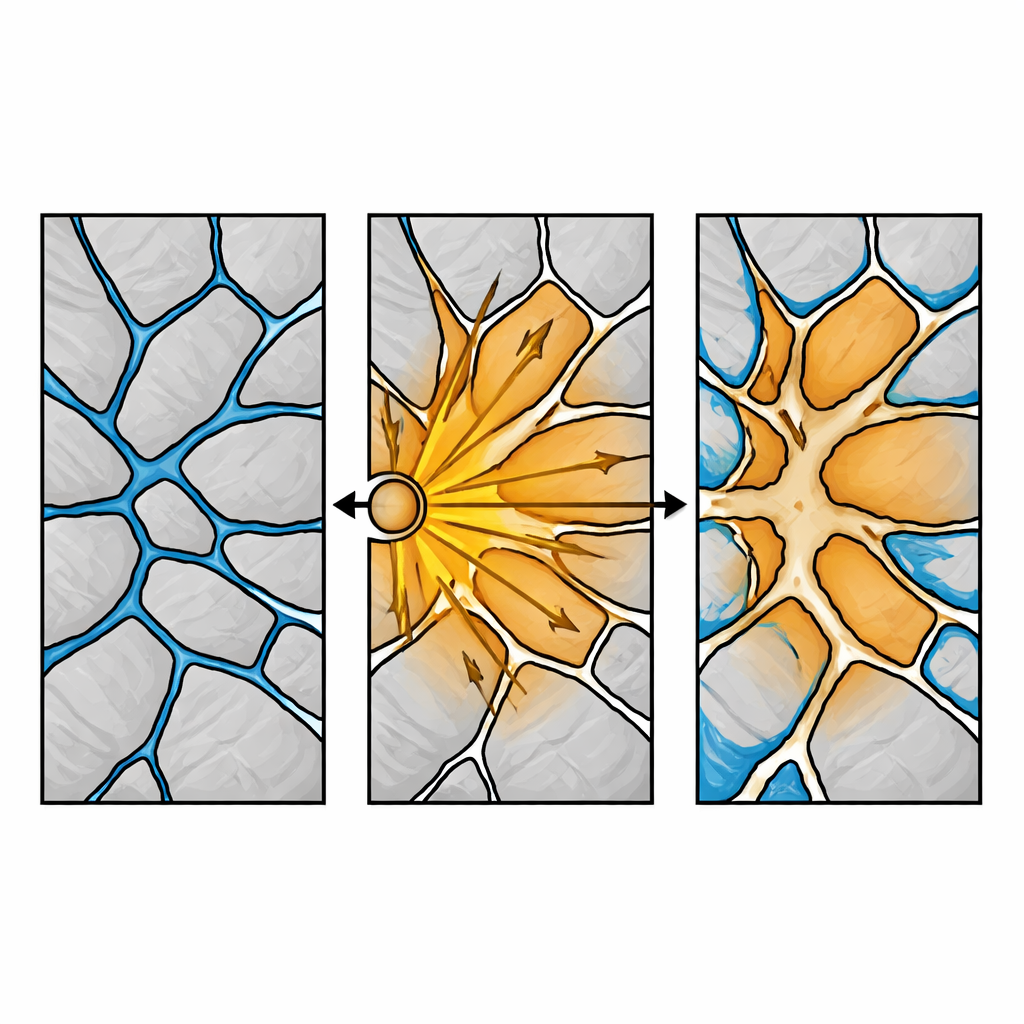
Putting the method to work underground
The researchers then applied their optimized slurry in a Chinese coal mine where the floor lies above a water-rich limestone layer about 140 meters below the surface. They drilled three groups of injection holes and pumped in more than 100,000 tons of the cement–clay mixture under carefully controlled pressures. By tracking how much slurry each hole absorbed and how the rock accepted water during follow-up pressure tests, they confirmed that the cracks and channels in the most dangerous areas had been effectively filled. Later holes needed less slurry, indicating that earlier injections had already strengthened and sealed much of the fracture network.
What this means for safer mining
For non-specialists, the key message is that mine flooding from pressurized groundwater is not just bad luck—it depends strongly on how water can move through invisible cracks under the workings. This study shows that by tuning the “liquid rock” mixture and understanding how it flows under pressure, engineers can design grouting plans that seal those cracks more reliably and at lower risk. The combination of lab tests, physics-based simulations, and full-scale mine trials points toward more predictable, science-guided ways to keep deep coal mining dry and safe.
Citation: Zhengzheng, C., Fangxu, G., Tao, R. et al. Field application and diffusion law of grouting slurry in floor aquifer of a coal mine. Sci Rep 16, 8329 (2026). https://doi.org/10.1038/s41598-025-28535-z
Keywords: coal mine water control, grouting slurry, floor aquifer, fractured rock sealing, numerical simulation