Clear Sky Science · en
A comprehensive framework for evaluating bridge project rework through earned value management (EVM) and building information modeling (BIM)
Why fixing mistakes on bridges matters
Every large bridge project is a race against time and budget. When errors are discovered late, crews must redo work—tear out concrete, reorder steel, reschedule teams—which can cost millions and delay traffic for weeks or months. This study explores how a digital technology called Building Information Modeling (BIM), combined with a project tracking method known as Earned Value Management (EVM), can sharply cut down on this kind of wasteful rework and help deliver bridges faster and more affordably.

What goes wrong when bridges are built
Rework—having to repeat tasks because of errors or changes—has long plagued construction. Earlier research shows that do‑overs can eat up 5–20% of the total cost of major civil projects. On bridges, that means crews fixing design mismatches, relocating utilities, or rebuilding sections that do not fit together as planned. These setbacks do not just raise bills; they delay opening dates and disrupt everyday travel. The authors argue that to cut rework meaningfully, project teams must understand where and why it happens, and then monitor its impact on both money and time in a structured way.
How digital models change the game
BIM turns a traditional stack of 2D drawings into a shared, data‑rich 3D model of the bridge and its components. In more advanced uses, schedules (4D) and costs (5D) are linked directly to the model. This allows engineers, contractors, and owners to explore how the bridge will be built, step by step, long before work begins on site. Clashes—like a column that collides with a beam, or reinforcement that cannot be placed as drawn—can be detected on screen rather than in concrete. The study also uses EVM, a well‑known project‑control method, to translate these digital simulations into clear performance scores that show whether a project is ahead or behind on cost and schedule.
What the survey of real bridges revealed
The researchers gathered data from 253 bridge projects worldwide, 41 that used BIM and 212 that did not. They created four simple indicators: how much of the total budget and total duration was lost to rework, and how strongly rework pulled down cost and schedule performance. Statistical tests showed that BIM‑enabled projects consistently had lower rework‑related cost and time impacts, especially on larger, more complex bridges (over 15 million in value). For example, projects without BIM were far more likely to suffer cost and time overruns, while BIM projects showed noticeably better cost and schedule performance scores. Although these results show correlation rather than guaranteed cause‑and‑effect, they suggest that BIM helps teams catch problems earlier and coordinate more smoothly.
A close look at one Egyptian bridge
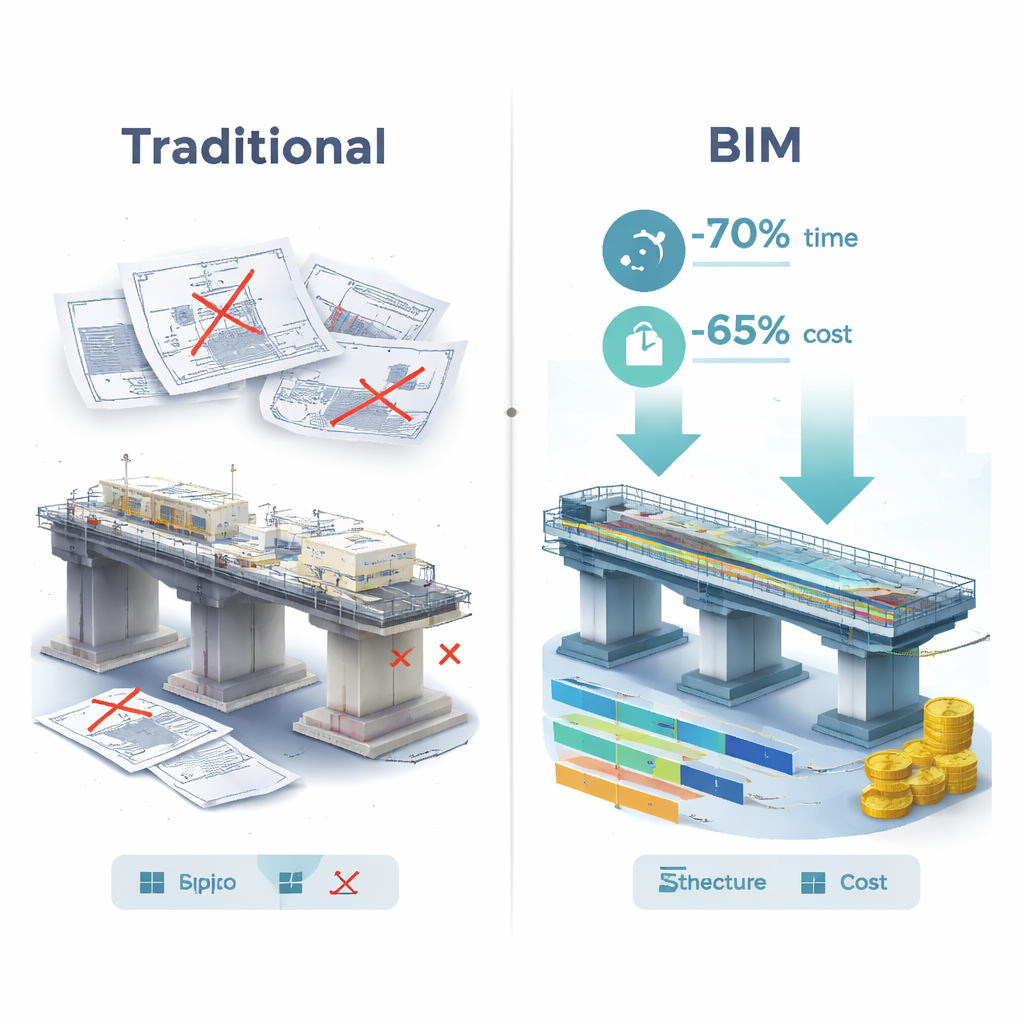
To see how this plays out in detail, the authors examined the King Salman Axis Bridge over the Al‑Zumar Canal in Egypt. Built using conventional 2D methods, the project finished 76 days late and more than 27 million Egyptian pounds over budget because of design errors and miscoordination. The team then rebuilt the project virtually using BIM tools (Revit, Navisworks, and Microsoft Project). In the simulation, early detection of design flaws and clashes cut the delay linked to rework from 76 days to 17—about a 78% reduction—and trimmed rework costs from 27 million to roughly 7 million, a saving of about 74%. When these improvements were evaluated with EVM metrics, both schedule and cost efficiency scores improved significantly in the BIM scenario.
Why the findings matter—and their limits
Across the survey and the detailed case study, BIM use was associated with reductions in time wasted on rework of roughly 70–85% and cost savings of about 65–75% in the examined bridge projects. The authors caution that these numbers depend on local conditions, such as how well BIM is implemented, staff training, and broader management practices; BIM is not a magic button. Still, the work shows that when digital models are tightly linked to schedules, costs, and performance tracking, bridge builders can spot mistakes earlier, make better decisions, and keep projects closer to their promised budgets and opening dates. For the public, that means safer infrastructure delivered more reliably and with less disruption.
Citation: Elseufy, S.M., Hussein, A. & Badawy, M. A comprehensive framework for evaluating bridge project rework through earned value management (EVM) and building information modeling (BIM). Sci Rep 16, 7197 (2026). https://doi.org/10.1038/s41598-025-27546-0
Keywords: bridge construction, building information modeling, rework reduction, project cost and schedule, earned value management