Clear Sky Science · en
Research on a fuzzy programming model and algorithm for berth allocation considering time-varying water depth
Why timing the tides matters for big ships
Modern container ships are getting larger and heavier, but ports are built in places where the sea level rises and falls with the tides. That means a ship that is safe to enter a harbor at one hour might scrape the bottom just a few hours later. This paper asks a very practical question: how can ports decide which ship uses which berth, and when, so that vessels get in and out quickly, even though water depth and operating conditions are constantly changing and partly uncertain?
Busy docks and limited parking spots
A container terminal’s berths are like parking spots along a pier where ships tie up to load and unload. If berths are used well, ships spend less time waiting offshore, cargo moves faster, and the port earns more money. But in reality, many things get in the way of perfect planning: storms, equipment breakdowns, incomplete information from shipping companies, and above all, the changing height of the sea. Large ships with deep drafts can only come alongside when the water is deep enough along a given stretch of quay, and their own draft changes as containers are loaded and discharged. The authors focus on this very realistic setting: a continuous stretch of shoreline where ships can berth at any point, under a tide that makes water depth rise and fall throughout the day.
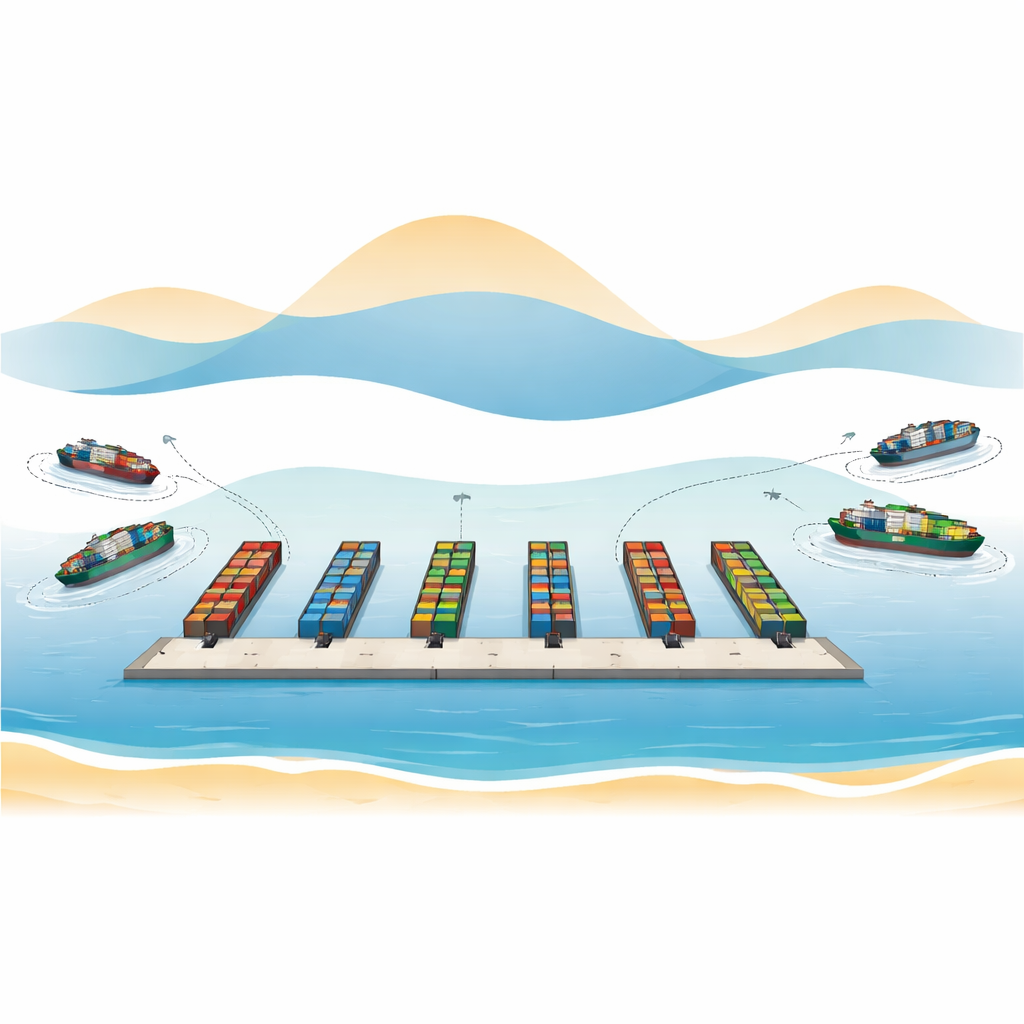
Turning a messy world into a solvable plan
To cope with this complexity, the researchers build a mathematical model that treats berth allocation as a giant scheduling puzzle. Time is broken into short steps, and each possible combination of ship, berth, and start time is either used or not. The goal is to minimize the total time ships spend in port, weighted by their importance or cost. A key twist is how uncertainty is handled. Instead of assuming exact probabilities for factors like ship draft, they use a technique called fuzzy programming. Here, uncertain quantities are described not by sharp numbers but by ranges with degrees of credibility. The model then insists that each ship’s draft requirement is met with at least a chosen level of confidence, while still trying to keep overall time in port as low as possible.
Smart search instead of brute force
Because the number of possible berth-time-ship combinations explodes as the port gets busier, it is impossible to simply test them all. The team therefore turns to two nature-inspired search methods: a genetic algorithm and a simulated annealing algorithm. Both start from an initial guess for how ships might be sequenced on each berth, then gradually improve that guess. The genetic algorithm mimics evolution by encoding every complete plan as a string, then repeatedly selecting, mixing, and mutating these strings to favor better solutions. Simulated annealing, by contrast, imitates the cooling of metal: it occasionally accepts worse solutions early on to escape dead ends, but becomes pickier as it “cools.” The authors also compare these heuristic methods with a commercial exact solver (CPLEX) that can find mathematically optimal answers for smaller cases.
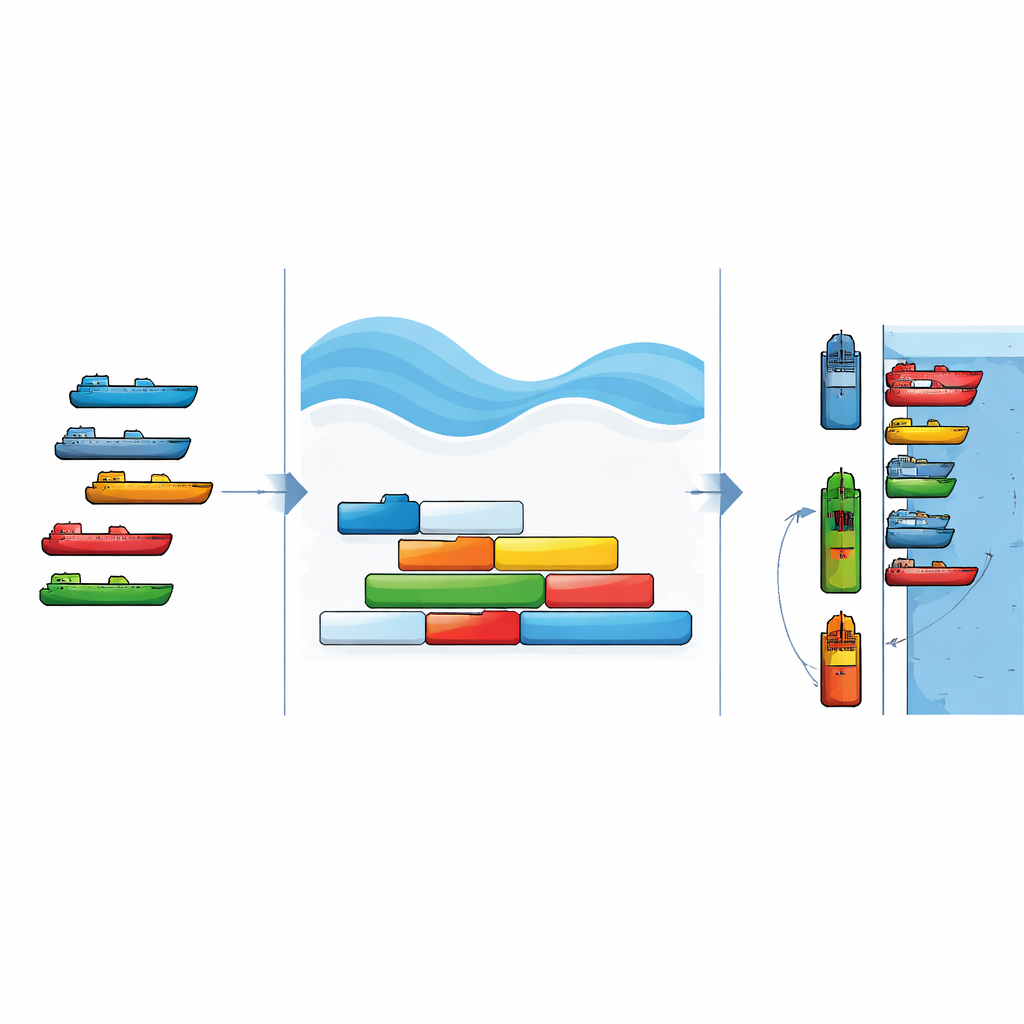
What the tests reveal about performance
The researchers generate a range of realistic test scenarios with different numbers of ships and berths, and then run all three approaches. For small problems, the exact solver quickly finds the best solution, and both genetic and simulated annealing methods match it. As the number of ships and berths grows, the exact solver slows down or fails to finish in reasonable time, while the heuristics still produce high-quality plans. In medium-sized cases, their solutions are within a few percent of the best-known answers. In the largest cases, the genetic algorithm often finds better solutions than the exact solver can reach before timing out and does so in shorter time than simulated annealing. A sensitivity study that gradually tightens the required confidence in meeting draft limits shows that the total time cost increases only slightly and the detailed berth plans hardly change, suggesting the model is stable and robust.
What this means for real ports
In simple terms, the study shows that it is possible to design berth schedules that respect the rise and fall of the tide and the fuzziness of real-world data, without bringing port planning to a standstill. By combining a tide-aware model with fuzzy treatment of uncertain drafts and fast search algorithms, dispatchers can generate berth plans that are both efficient and conservative enough to be trusted when conditions shift. The work points toward smarter, more automated tools that could help ports handle larger ships, reduce waiting times and fuel use, and ultimately move toward more reliable and sustainable maritime logistics.
Citation: Liu, D., Li, B., Li, M. et al. Research on a fuzzy programming model and algorithm for berth allocation considering time-varying water depth. Sci Rep 16, 9580 (2026). https://doi.org/10.1038/s41598-025-27537-1
Keywords: berth allocation, tidal ports, fuzzy optimization, genetic algorithms, maritime logistics