Clear Sky Science · en
Description of a collaborative sperm whale birth and shifts in coda vocal styles during key events
A Rare Glimpse into Life’s Beginning at Sea
Most of us will never witness the moment a giant ocean animal is born. This study offers an unusually close look at exactly that: the birth of a sperm whale calf in the wild. Using drones, underwater microphones, and cameras, scientists followed a tightly knit whale family off Dominica as they worked together to bring a newborn to the surface and surrounded it with sound and care. The result is a rare window into how these deep-diving whales give birth, protect their young, and communicate during one of the most critical moments in a calf’s life.
A Whale Family Comes Together
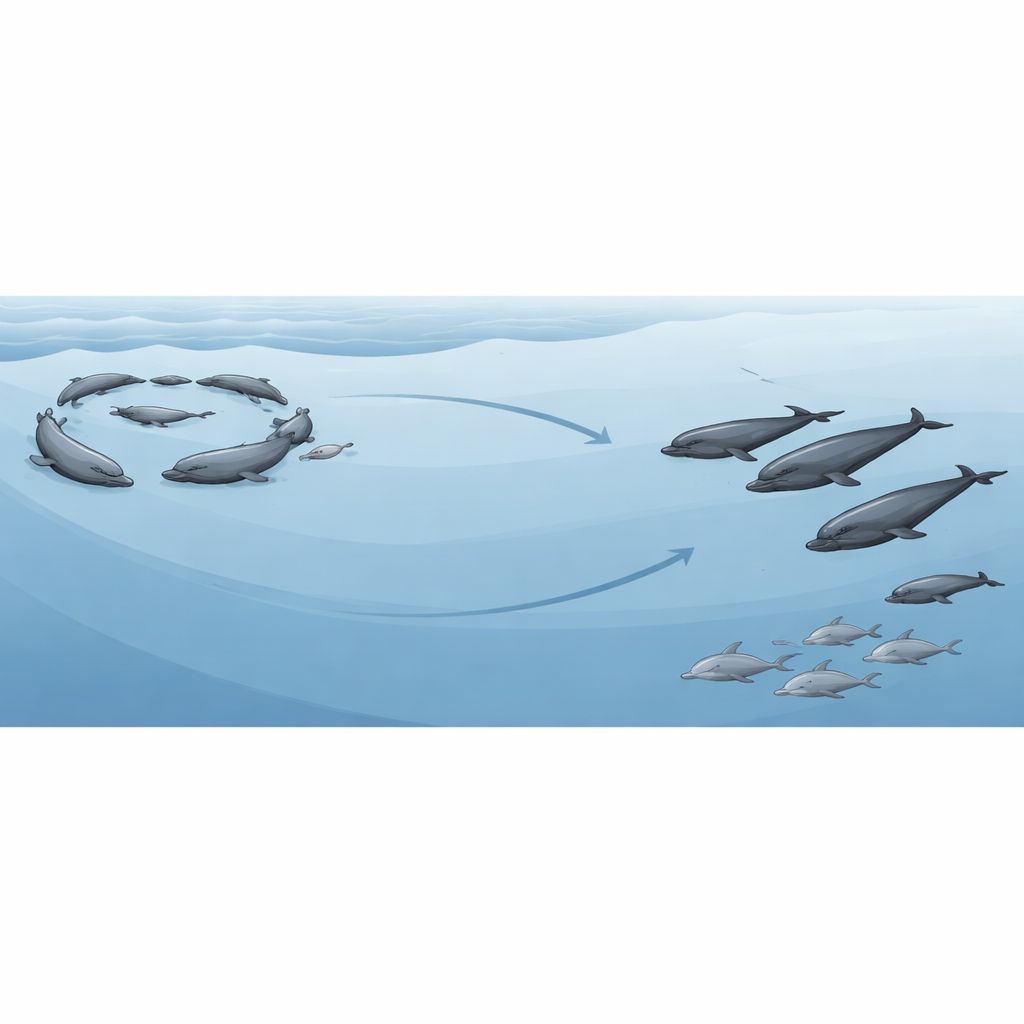
The researchers encountered an 11-member sperm whale family, known as Unit A, already gathered in a tight group at the surface. This unit has been followed for decades, so many family relationships were known in detail—grandmothers, mothers, aunts, older siblings, and even a teenage uncle were present. Shortly after the team began recording, they saw the flukes of a calf emerging from its mother, Rounder. Over the next 34 minutes, they documented the birth from the first visible tail to the calf’s full delivery, timing each step and linking it with the whales’ movements and sounds.
A Dramatic Birth at the Surface
During the birth, adult females repeatedly dove beneath the mother, sometimes rolling belly-up with their heads pointed toward her underside, possibly checking on or assisting the delivery. Blood and waste soon colored the surrounding water, and then, in a final roll, Rounder expelled the calf tail-first. Within less than two minutes, the newborn surfaced beside its mother’s head and took its first clear breath. The calf’s tail was still folded and its body appeared floppy, a reminder that newborn sperm whales are heavier than water and not yet strong swimmers. At this stage, sinking would be a real danger without help.
Lifting, Guarding, and Guiding the Newborn
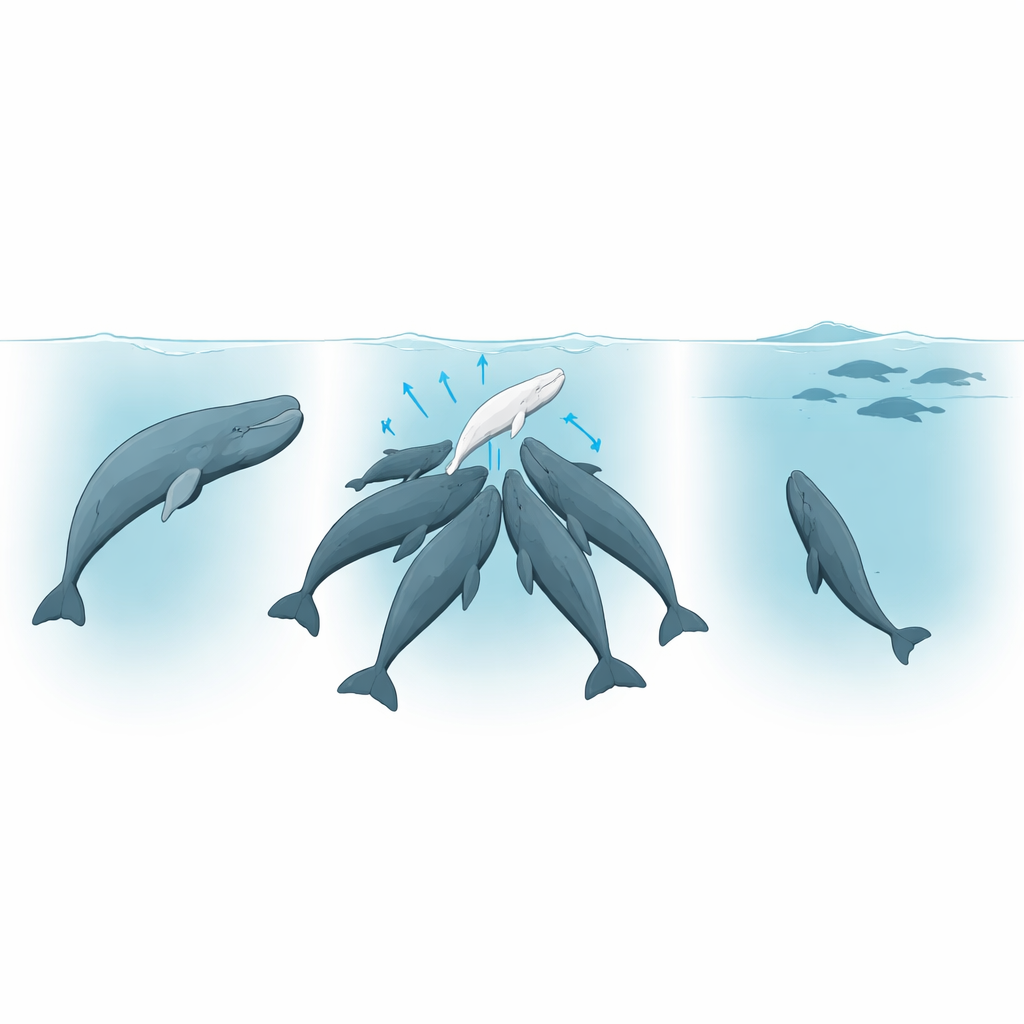
What followed was an intense burst of social activity. Adults and juveniles pressed close, rubbing their heads along the calf, squeezing it gently between their bodies, and repeatedly pushing it upward. At times, the newborn was lifted almost completely out of the water, resting across the heads and backs of several whales. The group stayed tightly packed for about 20 minutes, then gradually loosened while keeping the calf near the surface. Throughout, at least one adult always positioned itself between the newborn and any nearby visitors, including short-finned pilot whales and a large school of Fraser’s dolphins that circled the scene.
Voices Raised for a New Arrival
The team also recorded over 5,700 patterns of clicks known as “codas,” which sperm whales use to communicate. They found that certain familiar click patterns, previously linked to the whales’ social identity, dominated during the birth. Another type of coda, thought to mark this particular family unit, was also common. Using statistical tools, the researchers showed that the style of these click sequences changed sharply around key moments—just before and during the birth, and again when pilot whales approached afterward. In other words, the whales did not just move differently during these events; they also “spoke” differently, as if coordinating care and protection through sound.
An Ancient Habit of Helping Hands
To place this event in a broader context, the scientists compared it with the few existing reports of births in other whale and dolphin species. Many show mothers pushing newborns to the surface, and a smaller set describe several group members helping together, much like the sperm whales in this study. By mapping these behaviors onto the family tree of whales, the authors suggest that helping lift newborns may be an ancient habit that arose tens of millions of years ago, especially in highly social, deep-diving species where a weak calf could drown quickly without support.
What This Birth Tells Us
This single, well-documented birth paints a vivid picture of sperm whales as deeply social caregivers. A coordinated group of related females—and even a young male in transition out of the family—worked together to keep the calf afloat, shield it from curious neighbors, and surround it with sound. The study hints that such teamwork and rich vocal exchanges may be essential for successful births in the open ocean. It also underscores how much we still do not know: whether these sounds help organize the group, whether calves born into more supportive families fare better, and how widespread such cooperation is across whale species. For now, this rare observation brings us closer to understanding how some of the largest animals on Earth begin their lives, suspended between deep water below and the life-giving air above.
Citation: Aluma, Y., Baron, Z., Barrett, R. et al. Description of a collaborative sperm whale birth and shifts in coda vocal styles during key events. Sci Rep 16, 9206 (2026). https://doi.org/10.1038/s41598-025-27438-3
Keywords: sperm whale birth, whale communication, cetacean social behavior, marine mammal parenting, ocean wildlife