Clear Sky Science · en
Impact of processing parameters on the interfacial bonding and properties of recycled LCS/WC–Co bilayers developed through powder metallurgy
Turning Waste Metal into Tough New Tools
Modern industry relies on cutting and drilling tools that must be both extremely hard and resistant to breaking. At the same time, factories generate mountains of metal shavings that usually end up as low‑value scrap. This study explores how to convert those waste steel chips into the foundation of a new two‑layer material that pairs recycled steel with an ultra‑hard coating, potentially giving manufacturers longer‑lasting tools while cutting both costs and waste.
Building a Two‑Layer Metal Sandwich
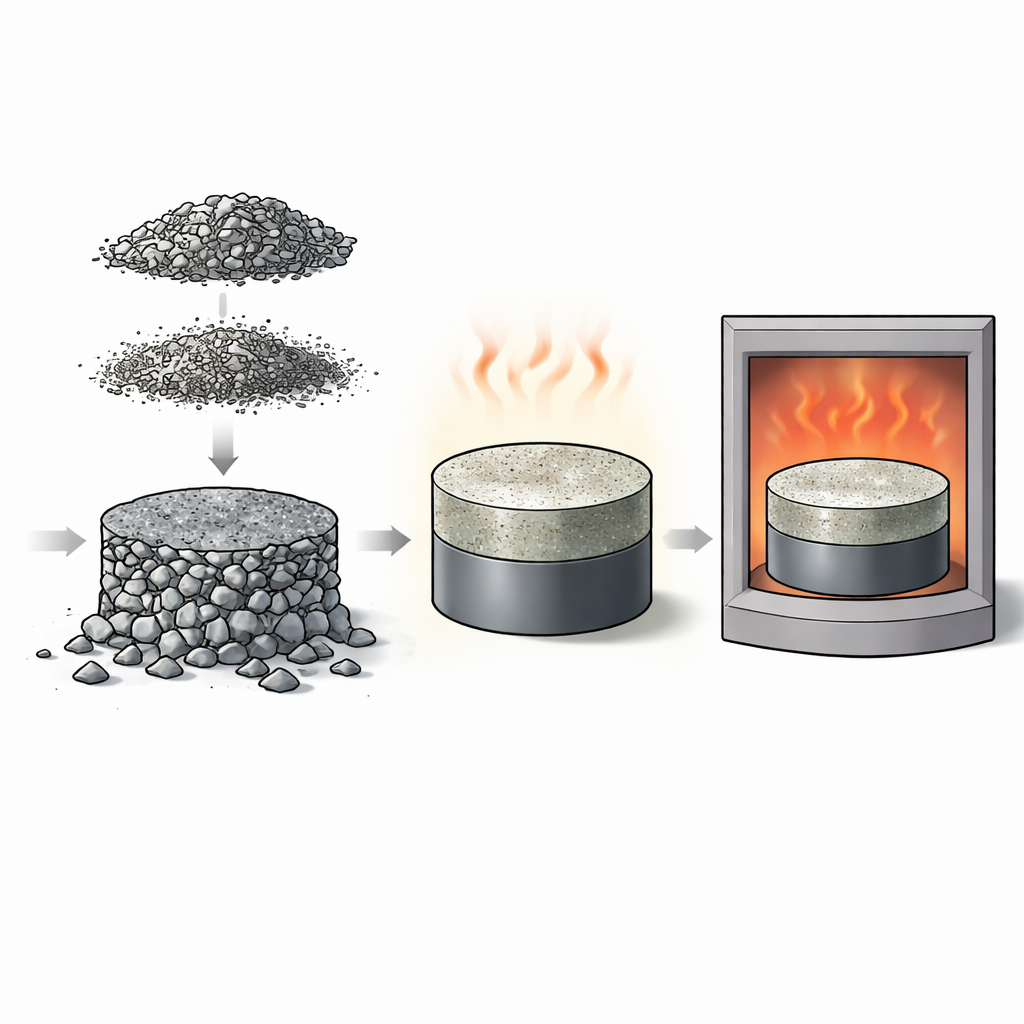
The researchers set out to create a kind of "metal sandwich" made of a tough base and a very hard top layer. The base is recycled low‑carbon steel, recovered from machining chips produced by computer‑controlled cutting equipment. The top layer is a cemented carbide known as WC–Co, widely used in drill bits and cutting inserts because it stays hard and wear‑resistant even at high temperatures. By joining these two layers into a single compact piece, the team hoped to combine the toughness of steel with the cutting ability of carbide, while relying on cheap, recycled feedstock for the bulk of the material.
Shaping and Heating Powders into Solid Parts
Instead of melting metals, the team used powder metallurgy, a method where fine powders are pressed into shape and then heated until they bond. They first cleaned and ground the waste steel chips into powders of different grain sizes, and prepared matching powders of WC–Co. These powders were stacked in a die so that the steel formed the lower layer and the carbide formed the upper layer. The stack was pressed at different forces to create green compacts, which were then heated in a controlled way between 1260 °C and 1340 °C. During heating, a thin liquid zone forms around the cobalt in the carbide layer, helping it flow slightly and knit together with the steel.
Finding the Sweet Spot for Strong Bonds
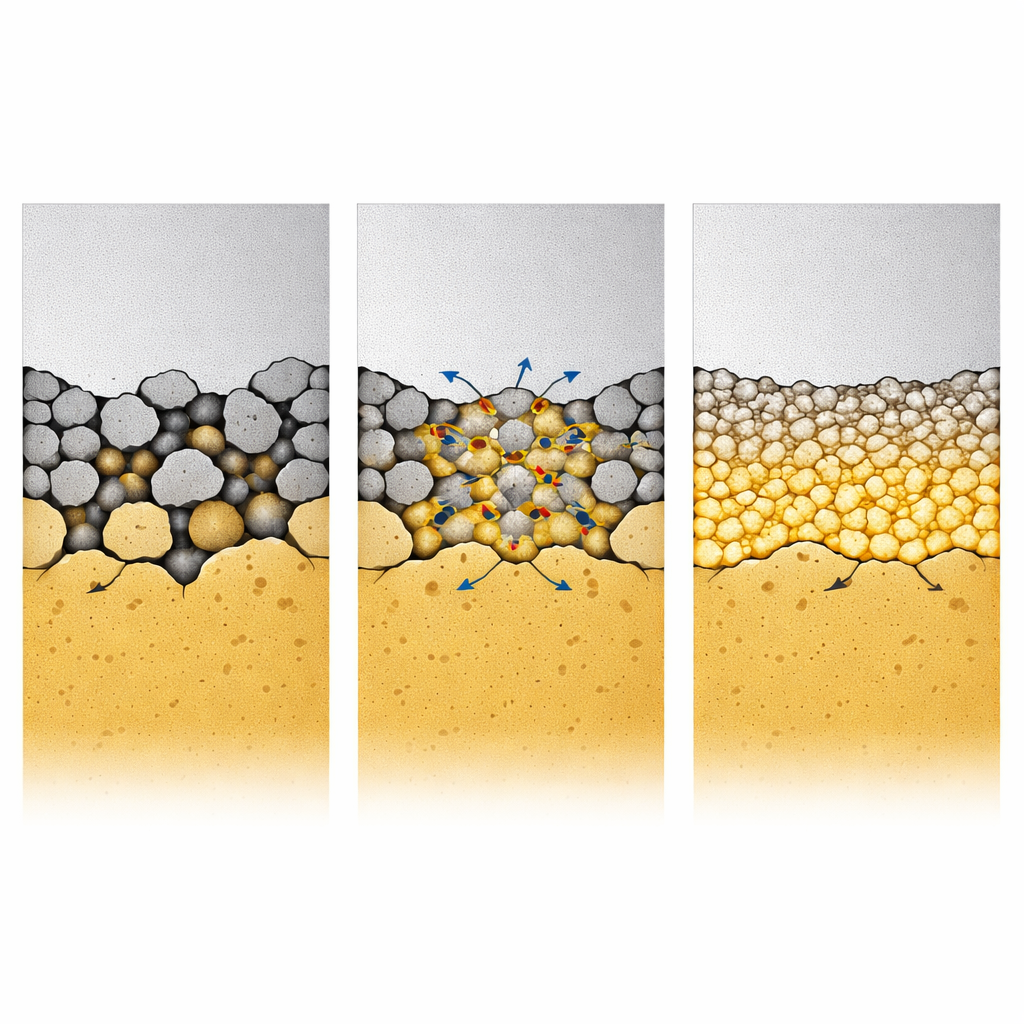
A central challenge was that steel and carbide expand, shrink, and densify at different rates when heated and cooled. If the temperature is too low, the powders do not fully pack together, leaving pores and weak spots; if it is too high, the mismatch in shrinkage can tear the layers apart. By systematically changing the grain size, pressing force, and sintering temperature, and then measuring density, internal voids, and dimensional changes, the researchers identified a narrow operating window. At 1300 °C, using the finest powders (about 25 micrometers) and the highest compaction pressure (313 megapascals), the two layers shrank in a more compatible way, closing pores and producing a dense part with minimal gaps or cracks at the interface.
Peering into the Invisible Join
To see what was happening where steel meets carbide, the team used optical and electron microscopes, X‑ray diffraction, and X‑ray microanalysis. At the best settings, they observed a thin, continuous transition band free of visible voids. Chemical analysis showed that iron atoms from the steel wandered into the carbide layer, while cobalt from the carbide migrated into the steel. These atomic exchanges created new mixed phases that act like microscopic glue between the layers. The hardness gradually increased from the steel side to the carbide side, indicating a smooth mechanical gradient rather than an abrupt, fragile boundary.
How Strong and Hard the New Material Becomes
Mechanical tests compressed disk‑shaped samples across their diameter until the two layers peeled apart. Under the optimal processing conditions, the layered material withstood high loads before the interface failed, corresponding to a compressive bond strength of about 209 megapascals and a tensile bond strength of about 44 megapascals. Surface hardness on the steel side rose from around 110 to roughly 150 Vickers units due to interaction with the carbide, while the carbide layer retained a very high hardness near 660 Vickers units, sufficient for demanding wear applications. Although some hardness is sacrificed in the carbide as it reacts with iron, the overall balance of hardness and toughness improves.
What This Means for Real‑World Tools
In everyday terms, the researchers have shown how to turn discarded steel chips and standard carbide powder into a firmly bonded, two‑layer component using relatively simple pressing and heating steps. By fine‑tuning grain size, pressing pressure, and sintering temperature, they achieved a crack‑free join strong enough to rival or exceed many previously reported metal–carbide combinations. This approach could help tool makers and other industries produce durable, wear‑resistant parts while lowering material costs and giving metal waste a second, more valuable life.
Citation: Abdelhaleem, M., El-Daly, A., Elkady, O. et al. Impact of processing parameters on the interfacial bonding and properties of recycled LCS/WC–Co bilayers developed through powder metallurgy. Sci Rep 16, 9223 (2026). https://doi.org/10.1038/s41598-025-26946-6
Keywords: recycled steel, powder metallurgy, cemented carbide, bilayer composites, tool materials