Clear Sky Science · en
Investigating the impact of different growth temperatures on the photoelectrochemical, and optical properties of zinc oxide nanorod for electrical and optoelectronic applications
Why Tiny Rods of Zinc Matter for Future Gadgets
Many of the devices we rely on—from solar panels to phone screens—depend on materials that can move electric charges efficiently while letting light pass through. This study looks at a simple, low-cost way to grow tiny “forests” of zinc oxide nanorods on glass and shows how something as basic as the growth temperature can dramatically tune their structure and performance. By understanding how to make these rods more orderly and conductive, engineers can design cheaper and more efficient optoelectronic devices.
Building Crystal Forests on Glass
The researchers focused on zinc oxide, a material that is abundant, non-toxic, transparent, and already used in sunscreens and electronics. Instead of using expensive, high-vacuum techniques, they relied on a hydrothermal process—essentially a controlled hot-water bath. Glass coated with a conducting layer (called FTO) was cleaned and then placed in a sealed Teflon-lined container filled with a solution containing zinc and a strong base. This container was heated at temperatures between 100 °C and 140 °C for many hours, allowing countless tiny zinc oxide rods to grow upright on the glass surface like a microscopic field of grass. 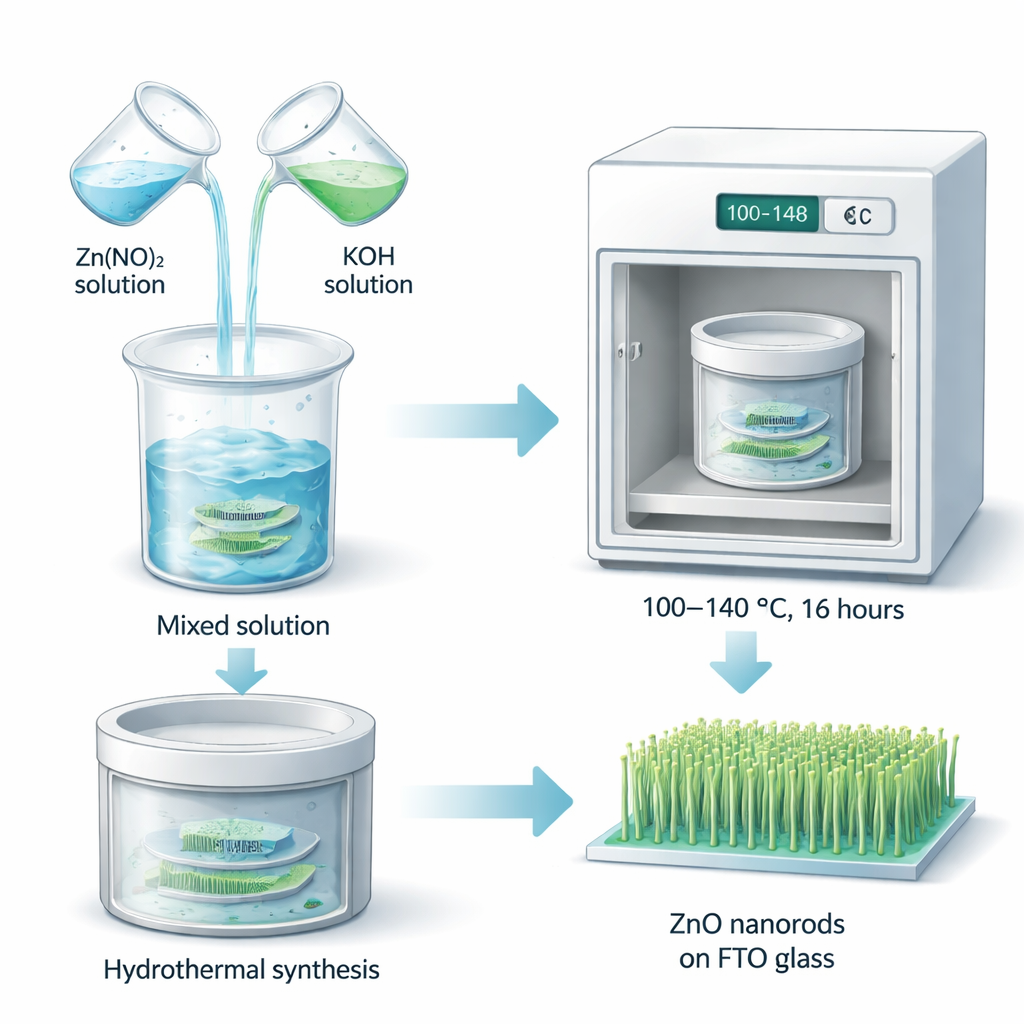
How Heat Shapes the Nano Landscape
A suite of powerful microscopes and diffraction techniques showed that all the samples formed the same basic hexagonal crystal structure, known as the wurtzite phase. However, the details changed markedly with temperature. At the lowest temperatures, the nanorods were short, unevenly spaced, and did not fully cover the glass. As the growth temperature increased, the rods became thicker, longer, and more uniformly aligned perpendicular to the surface. At 140 °C, they formed dense, flower-like arrangements with the highest crystal quality and the fewest structural defects. These improvements were confirmed by sharper X-ray diffraction peaks, smoother cross-sections, and consistent measurements from both scanning and transmission electron microscopes.
Tuning Light Absorption and Emission
The team also examined how these nanorod films interact with light. Using ultraviolet–visible spectroscopy, they found that all samples strongly absorbed ultraviolet light around 382 nanometers, but the exact energy of the “band gap” shifted with temperature. As the rods grew larger and better ordered, the band gap gradually narrowed—from about 3.86 electron volts at 100 °C down to about 3.16–3.09 electron volts at 140 °C. This means the material became slightly easier to excite with light, a useful trait for solar and sensing applications. Photoluminescence measurements, which track how the material re-emits light, showed two main colors: a near-ultraviolet glow linked to its basic crystal structure, and a greenish glow tied to defects. With higher growth temperature, the defect-related emission weakened, indicating fewer imperfections and a cleaner crystal lattice.
From Better Crystals to Better Electricity
To test how well these films handle electric charges, the researchers carried out a series of electrochemical and electrical measurements. When illuminated in a liquid electrolyte, all samples showed a positive photocurrent, confirming that the zinc oxide nanorods behave as n-type semiconductors—materials where electrons are the main charge carriers. The photocurrent rose sharply with growth temperature, from less than 0.001 ampere per square centimeter at 100 °C to about 0.026 at 140 °C, showing that hotter growth leads to far more efficient charge generation and collection. Dark current–voltage curves showed diode-like behavior, with the 140 °C sample conducting the most current. Mott–Schottky and impedance tests further revealed that higher growth temperatures produce much higher carrier concentrations, more negative flat-band potentials, and lower charge-transfer resistance, all signs of easier electron flow and fewer barriers at interfaces. 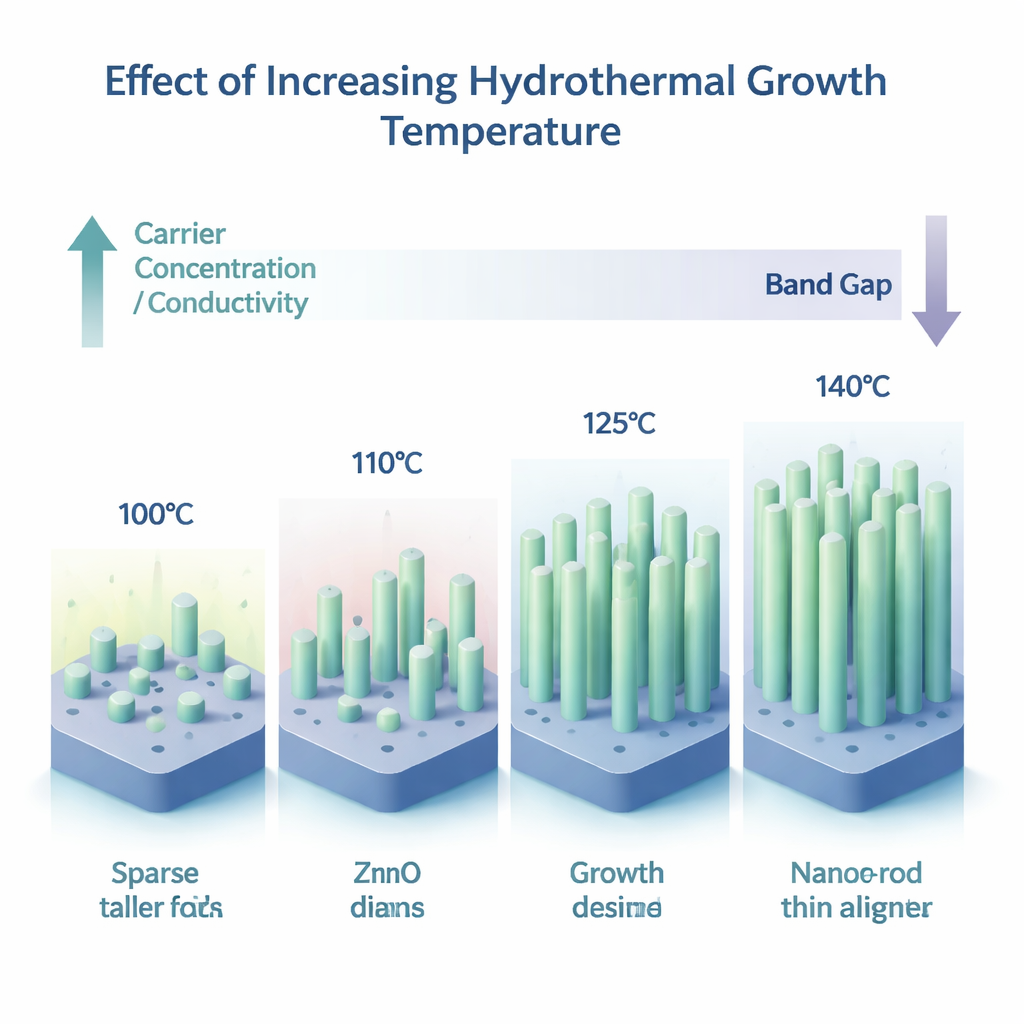
What This Means for Future Solar Cells
For a non-specialist, the key message is that by simply adjusting the growth temperature in a relatively cheap, water-based process, scientists can “dial in” the structure and performance of zinc oxide nanorod films. The sample grown at 140 °C combined the best traits: highly ordered crystals, strong and tunable light absorption, reduced defects, and excellent electrical conductivity. These features make it an especially promising “electron highway” layer in solar cells and other light-based electronics, potentially leading to more affordable and efficient devices built from abundant, environmentally friendly materials.
Citation: Kubas, M., Salah, H.Y., El‑Shaer, A. et al. Investigating the impact of different growth temperatures on the photoelectrochemical, and optical properties of zinc oxide nanorod for electrical and optoelectronic applications. Sci Rep 16, 7491 (2026). https://doi.org/10.1038/s41598-025-26341-1
Keywords: zinc oxide nanorods, hydrothermal growth, optoelectronic devices, solar cells, photoelectrochemistry