Clear Sky Science · en
Nonlinear seepage mechanical model and bifurcation analysis for fluid-solid coupling in fractured rock mass
Why hidden water in cracked rocks matters
Far below our feet, water moves through broken layers of rock in mines, tunnels, and oil and gas reservoirs. How that water pushes on the rock — and how the rock pushes back — can quietly set the stage for sudden floods, collapses, or earthquakes. This paper develops a new way to describe and predict that two-way interaction between water flow and rock deformation in fractured rock masses, revealing why such systems can look calm for a long time and then fail abruptly.
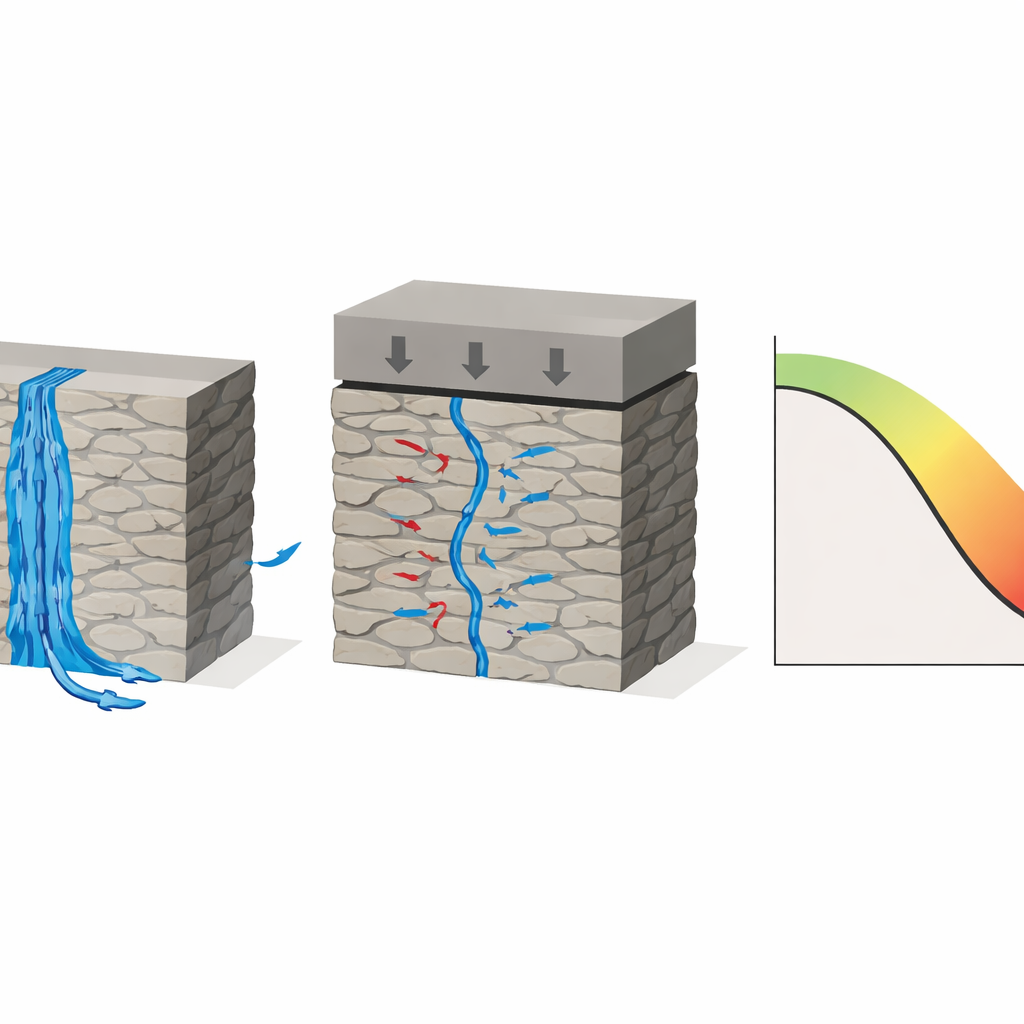
Water weaving through broken stone
In many underground projects, the rock mass is not solid like a brick but more like a cracked sponge: countless fractures and gaps form pathways for water. External pressure from overlying rock and internal pressure from water inside pores are constantly reshaping these pathways. As the rock is squeezed, pores shrink or close; as water pressure rises, they can reopen or widen. This ongoing reshaping changes how easily water can move, which in turn feeds back on the rock. The authors argue that to understand disasters such as mine water inrush or reservoir leakage, we must treat this as a dynamic, coupled system rather than a static snapshot.
Building a coupled picture of rock and water
The study starts by extending a classic concept in soil mechanics called “effective stress,” which describes how much of the total pressure is actually carried by the solid skeleton. The authors rewrite this idea to explicitly include porosity — the fraction of the rock volume taken up by voids — so that changes in pore space are directly linked to how stress is shared between rock and water. They then combine this with equations that describe how a slightly deformable rock responds elastically to stress and with a more realistic, nonlinear description of water flow through fractures that goes beyond the simple Darcy’s law used in many engineering models.
From smooth flow to sudden change
With this framework, the authors focus on a one‑dimensional case of water seeping vertically through a layer of broken rock. They derive a pair of nonlinear equations that track how water pressure and flow rate evolve over time and space, while porosity adjusts as the rock compacts. Solving these equations shows that under certain conditions the system does not have a single steady behavior: instead, it displays what mathematicians call a saddle‑node bifurcation. In plain terms, as a key flow parameter changes, a previously stable state can split into one safe and one dangerous branch, or disappear entirely, causing the system to jump suddenly from gentle seepage to runaway flow.
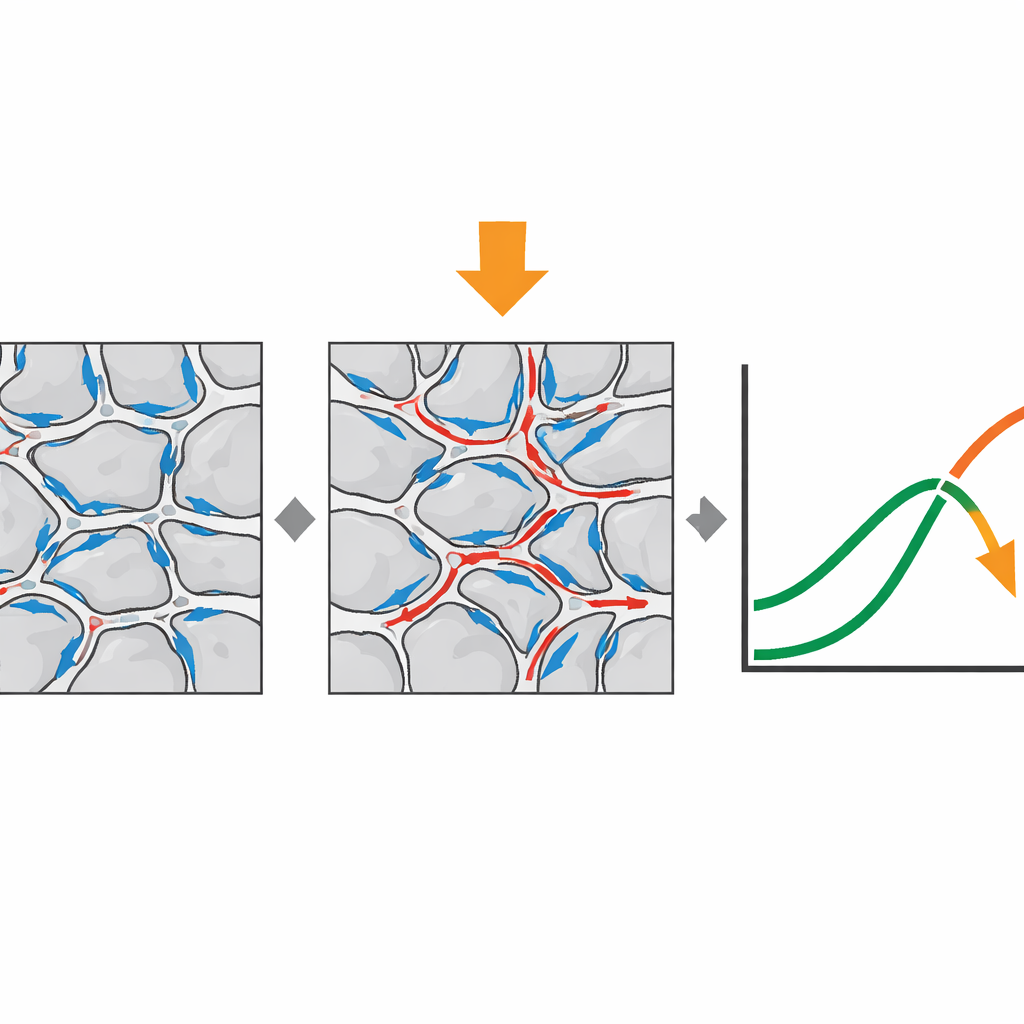
Slow squeezing and delayed stability
The authors then examine how things change when the stress at the boundaries — for example, due to gradual loading from mining above — varies over long times. Numerical simulations show that when this external stress changes slowly, the coupled rock–water system also takes much longer to settle into a steady state. Water pressure, flow rate, and rock volume strain creep toward stability instead of quickly leveling off. This delay occurs because the rock skeleton must keep readjusting its pore structure while energy is continually pumped into the system by the changing load, stretching out the path to equilibrium.
Warning signs before a flood
To connect the theory with reality, the study compares its predictions to an actual case of water gushing from a fault in a coal mine. As mining approached the fault, a parameter reflecting how strongly the flow deviated from simple Darcy behavior shifted into a critical range where two flow states could coexist: one stable and one unstable. Field measurements showed the water velocity starting to fluctuate between two distinct levels before eventually surging upward in a rapid, catastrophic increase, just as the model’s bifurcation diagram would suggest. These fluctuations, the authors argue, are a clearer and earlier warning sign of impending water inrush than traditional safety indicators that treat the system as linear and steady.
What this means for underground safety
Overall, the paper shows that fractured rock saturated with water behaves more like a complex, nonlinear system than a simple pipe. Small shifts in stress or flow conditions can push it across critical thresholds where its behavior changes qualitatively, not just in size. By explicitly linking rock deformation, pore structure, and nonlinear flow, the new model can capture multiple possible steady states, sudden transitions between them, and strong sensitivity to initial conditions. For engineers designing mines, tunnels, and reservoirs, this means that monitoring how flow and deformation evolve over time — and watching for telltale double‑stable fluctuations — could provide earlier, more reliable warnings of hidden instabilities before they erupt into full‑blown disasters.
Citation: Zhengzheng, C., Mengqi, X., Tao, R. et al. Nonlinear seepage mechanical model and bifurcation analysis for fluid-solid coupling in fractured rock mass. Sci Rep 16, 9578 (2026). https://doi.org/10.1038/s41598-025-25823-6
Keywords: fractured rock, groundwater seepage, fluid–solid coupling, nonlinear dynamics, mine water inrush