Clear Sky Science · en
ChatBCI, a P300 speller BCI with context-driven word prediction leveraging large language models, from concept to evaluation
Giving a Voice to Thoughts
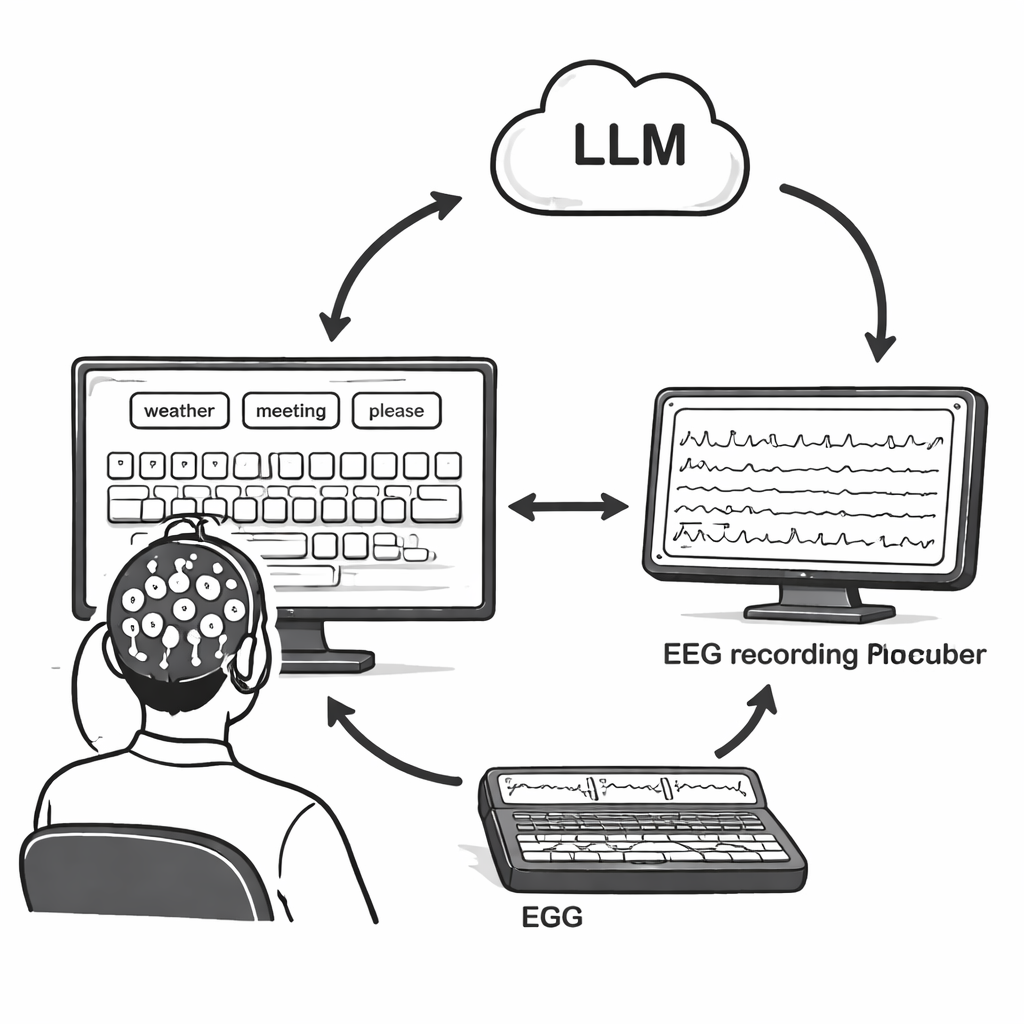
For people who cannot speak or move easily, communicating even a simple request can be slow and exhausting. This study presents ChatBCI, a brain–computer interface that lets users spell words on a screen using only their brain signals, while a powerful language model (similar to ChatGPT) predicts what they want to say next. By blending brain signals with smart word prediction, the system aims to make communication faster, less tiring, and closer to everyday conversation.
How the Brain Talks to a Computer
ChatBCI builds on a well-known approach called a P300 speller. In this setup, a grid of letters and function keys flashes on a computer screen. When a user silently focuses on the letter they want, their brain produces a brief, telltale signal about 300 milliseconds after that letter’s row or column flashes. Electrodes on an EEG cap record these tiny voltage changes, and software detects which row and column produced the strongest response, revealing the intended key. Traditionally, users must choose every letter one by one, which is accurate but painfully slow and mentally demanding for long sentences.
Adding Smart Word Prediction
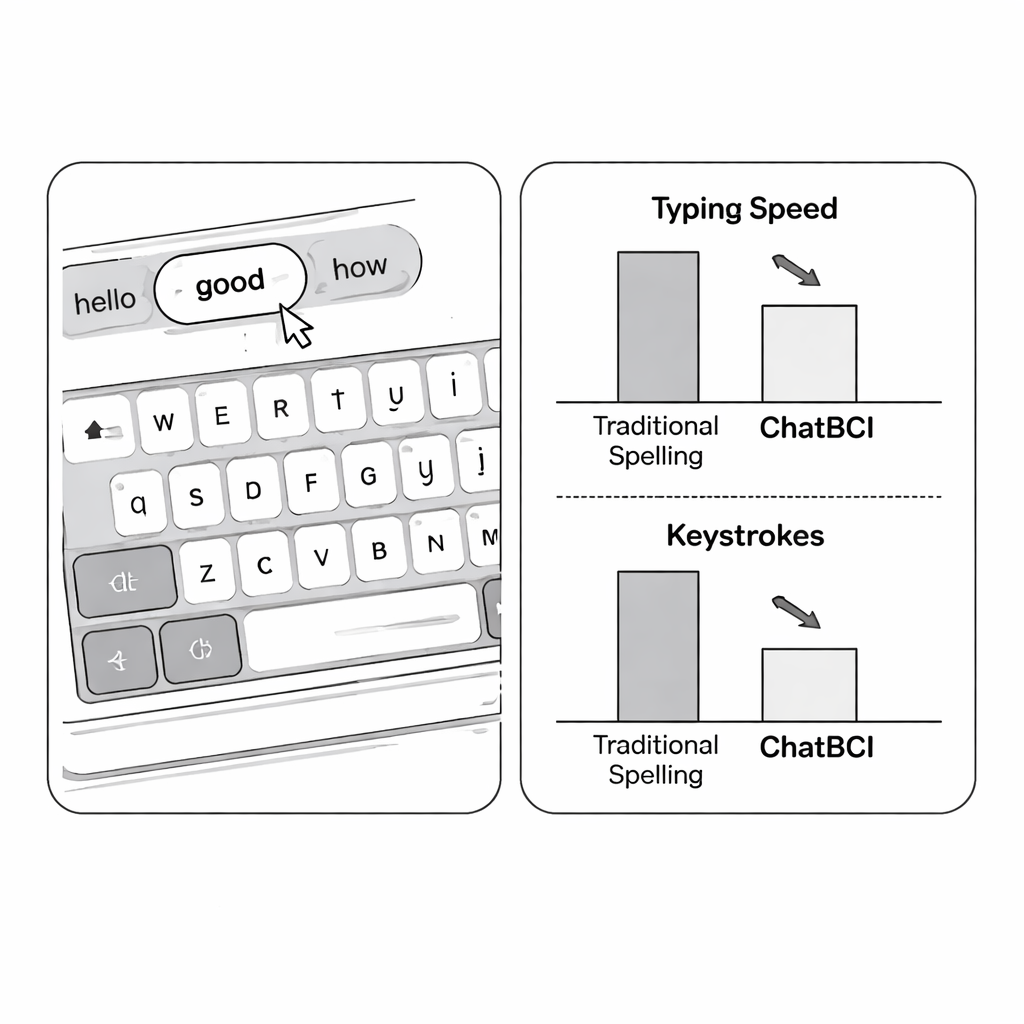
The innovation in ChatBCI is to plug a large language model directly into this spelling process. The on-screen keyboard still shows letters, but now it also displays ten word suggestions down the sides—candidates provided in real time by an online GPT‑3.5 model. As soon as the user spells part of a word or a short phrase, the partial sentence is sent as text to the language model. A carefully crafted prompt tells the model to return a compact list of likely next words or completions. The system parses this response and turns each suggested word into a selectable key on the keyboard. Selecting one of these suggestions instantly inserts the whole word (or even a short phrase) and adds a space, so the user can build sentences much more quickly than by choosing letters one at a time.
Putting ChatBCI to the Test
Seven volunteers tested ChatBCI in several stages. First, their individual brain patterns were recorded while they focused on known keys, allowing the system to train a classifier that recognizes the P300 signal. Then they completed two realistic text-entry tasks. In a copy-spelling task, each person chose a picture, invented a meaningful sentence about it (such as a request for water or a restroom), and then spelled that sentence in two ways: once using ChatBCI with word suggestions and once using a traditional letter‑by‑letter mode with suggestions turned off. In a second, improvisation task, they were asked to freely compose their own sentence starting with a chosen letter, encouraged to rely as much as possible on the suggested words rather than spelling everything from scratch.
Faster Messages, Fewer Keystrokes
The results showed clear benefits from combining brain signals with language prediction. In the copy-spelling task, using ChatBCI cut the average time to write a sentence from about 28 minutes to roughly 10 minutes—a 62% reduction—while also more than doubling the rate of correctly typed characters per minute. The number of keystrokes needed dropped by about half, and accuracy improved: users almost always ended up with perfectly spelled sentences when using ChatBCI. To capture how much work the system saves, the authors used a “keystroke savings” measure and a new “keystroke savings deficit ratio,” which compare performance to idealized systems that could always guess the right word after one or two actions. In the free-form improvisation task, ChatBCI achieved around 81% keystroke savings on average, sometimes even beating the theoretical limits because the language model occasionally suggested multi-word phrases that could be inserted with a single selection.
What This Means for Real-World Communication
For everyday users—especially those with severe movement or speech limitations—the key outcome is simple: ChatBCI lets people say more with fewer mental efforts and in far less time. By outsourcing language prediction to a remote large language model, the system avoids the need for local training or large dictionaries, yet still adapts to whatever sentence the user wants to create. While further work is needed in clinical populations and to address privacy, cost, and reliability of cloud-based language models, this study shows that pairing brain interfaces with modern language technology can transform slow, letter‑by‑letter spelling into a more natural, phrase‑level conversation tool.
Citation: Hong, J., Wang, W. & Najafizadeh, L. ChatBCI, a P300 speller BCI with context-driven word prediction leveraging large language models, from concept to evaluation. Sci Rep 16, 6379 (2026). https://doi.org/10.1038/s41598-025-25660-7
Keywords: brain-computer interface, P300 speller, assistive communication, word prediction, large language models