Clear Sky Science · en
Method for classification of UAV flight control RF signals based on multi-scale divergence entropy and optimized neural networks
Why spotting hidden drones matters
Small drones are now cheap, capable, and everywhere—from aerial photography and package delivery to battlefield scouting. But the same technology that enables helpful applications can also be misused for spying, smuggling, or disrupting airports and critical infrastructure. Authorities need ways to detect and identify drones quickly and reliably, even when they are far away or flying low between buildings. This paper presents a new method that listens to the invisible radio conversation between a drone and its controller to recognize which model is in the air, and does so with unusually high accuracy even in very noisy conditions.
The problem with today’s drone-spotting tools
Current drone detection systems rely on radar, cameras, infrared sensors, or microphones. Each has serious drawbacks. Radar struggles with very small, slow targets and can be confused by ground clutter. Optical and infrared cameras depend on clear weather and good visibility, and their performance drops in fog, rain, or darkness. Acoustic methods are cheap but only work over short distances and are easily drowned out by background noise. Vision-based deep learning can classify known drone types, but it demands vast labeled datasets and can fail when it encounters new models or adversarial conditions. These weaknesses leave gaps in airspace security, especially in crowded urban or low-altitude environments.
Listening to the drone’s radio chatter
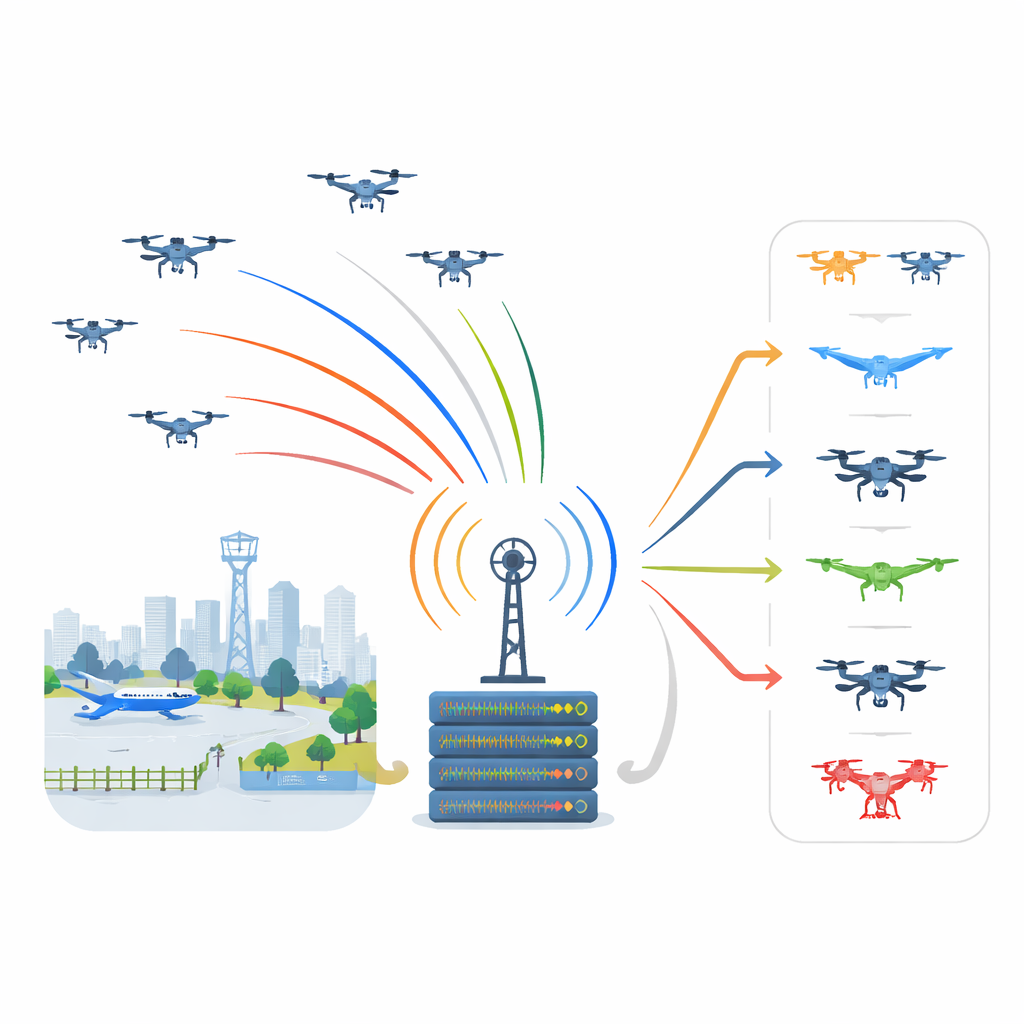
Instead of watching or hearing the drone itself, the authors focus on its radio frequency (RF) control signals—the link between the drone and its remote controller. These signals can pass through obstacles, work in all weather, and often be picked up earlier and farther away than the drone can be seen. However, simply measuring signal strength or basic spectra is not enough to distinguish between different drone models in a crowded electromagnetic environment. The team uses a concept called multiscale dispersion entropy, which, in simple terms, tracks how unpredictable and complex the signal is when viewed over several different time windows. By applying this to four channels of the RF data (two per antenna path), they compress each signal into a 12-number “fingerprint” that captures how that particular drone’s control link behaves.
A smart search for the best neural network
Once they have these compact fingerprints, the authors feed them into a lightweight neural network that decides which of six popular DJI drone models produced the signal. A key innovation lies in how they tune this neural network. Instead of manually guessing the internal settings or relying only on standard gradient descent, they use an optimization approach inspired by the behavior of lemmings in nature. This “artificial lemming algorithm” imagines a population of candidate networks as animals that migrate, dig tunnels, forage, and flee predators, exploring the space of possible weight settings and network sizes. Over many iterations, this process zeroes in on a configuration that minimizes classification error, avoiding the traps of local optima that often slow or cripple traditional training.

Putting the method to the test
The researchers evaluated their system on DroneRFa, a large open dataset of real drone RF signals. They focused on six widely used DJI platforms whose radio hardware is similar, making the classification problem more challenging. From each signal they extracted 10,000 samples, computed the multiscale entropy features for all four channels, and used these 12 features as input to the optimized neural network. The new method reached a classification accuracy of 97.2%, outperforming several popular alternatives that also combine neural networks with different optimization schemes (genetic algorithms, particle swarm, and grey wolf methods) by roughly 5–7 percentage points. Just as important, their system converged much faster, reaching 90% accuracy after only 65 training iterations, and required relatively few parameters—making it suitable for real-time, edge deployment.
Staying accurate in a noisy world
Real-world RF environments are messy: Wi‑Fi, Bluetooth, and countless other devices share the airwaves. To probe robustness, the authors deliberately added strong artificial noise to the drone signals, reducing the signal-to-noise ratio step by step down to a level where the signal is as strong as the noise itself. Competing feature sets based on audio-inspired coefficients, simple spectra, or constellation diagrams all suffered steep drops in accuracy under such conditions. In contrast, the multiscale entropy features degraded only gently, and the system still correctly identified drones 90% of the time at the harshest noise level tested. Statistical analyses showed that these features do a better job of separating different drone types while keeping each type internally consistent, which explains their resilience.
What this means for safer skies
In everyday terms, the authors have built a “radio fingerprinting” tool that can listen to the hidden control link of a drone, summarize it into a small set of numbers, and use an efficiently tuned neural network to say which model is flying—even when the airwaves are crowded and noisy. Compared with existing methods, their approach is more accurate, faster to train, and lightweight enough to run on modest hardware. This makes it an appealing building block for future low-altitude traffic management systems and security installations around airports, borders, and sensitive sites. While the current study targets six specific models, the underlying ideas—rich multiscale signal descriptions paired with smart optimization of simple neural networks—could be extended to broader fleets of drones and other wireless devices, tightening our grip on an increasingly busy sky.
Citation: Liu, B., Liu, J., Shi, M. et al. Method for classification of UAV flight control RF signals based on multi-scale divergence entropy and optimized neural networks. Sci Rep 16, 8420 (2026). https://doi.org/10.1038/s41598-025-25498-z
Keywords: drone detection, radio frequency signals, wireless fingerprinting, neural network optimization, airspace security