Clear Sky Science · en
AC measurements and magnetic properties of magnesium ferrite and its composites with reduced graphene oxide (rGO) and polypyrrole (PPy)
Why these tiny mixes matter
As our gadgets get smaller and our power demands grow, engineers are hunting for materials that can store more energy in less space and respond quickly in electronic circuits. This study looks at a new mix of three ingredients—a magnetic ceramic, a conducting plastic, and sheets of graphene-like carbon—to see whether combining them can create better building blocks for future sensors, inductors, and energy-storage devices such as supercapacitors. 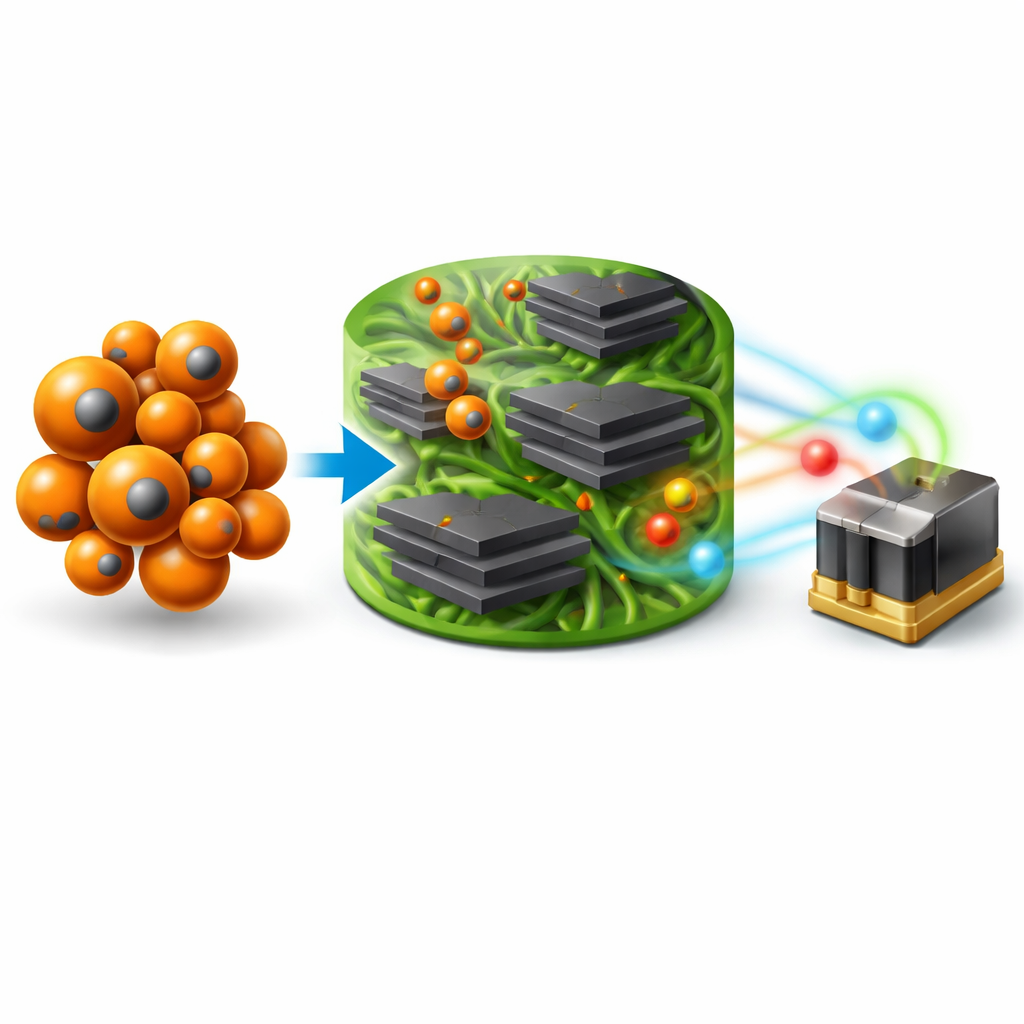
The three-part recipe
The core of the work is magnesium ferrite, a well-known magnetic ceramic made of magnesium, iron, and oxygen. On its own, this material already finds use in transformer cores and small electronic coils because it is magnetic but does not waste much energy as heat. The researchers combined this ceramic with reduced graphene oxide, a form of graphene that conducts electricity and comes in thin, crumpled sheets, and with polypyrrole, a lightweight conducting plastic. They prepared four samples: pure magnesium ferrite; ferrite with graphene; ferrite with polypyrrole; and a three-part blend containing ferrite plus both graphene and polypyrrole.
Checking the structure at the nanoscale
Before testing the electrical behavior, the team had to be sure that all three ingredients mixed properly. Using X-ray diffraction, they confirmed that the ferrite kept its orderly crystal structure in every sample, with only tiny changes in the spacing of atoms. Electron microscopes revealed that the ferrite formed nanoparticles tens of nanometers across, spread fairly evenly among the graphene sheets and polypyrrole regions. Chemical analysis showed the expected amounts of magnesium, iron, carbon, nitrogen, and oxygen. Infrared measurements hinted at direct interactions between the rings of the polypyrrole chains and the flat graphene surfaces, a kind of stacking that helps electrons move from one component to the other.
Balancing magnetism and electricity
Adding non-magnetic graphene and polypyrrole diluted the magnetic part of the material, so the overall magnetization dropped. However, the resistance to being demagnetized—the coercive field—stayed almost the same, at values that are useful for magnetic sensors and data-storage elements. At the same time, the electrical behavior changed dramatically. When an alternating voltage was applied over a wide range of frequencies and temperatures, all samples behaved like semiconductors, but the composites conducted better than pure ferrite. The three-part blend, containing both graphene and polypyrrole, showed the largest boost in AC conductivity—about six and a half times higher than the pure ceramic—because electrons and other charge carriers could hop more easily across the intertwined networks. 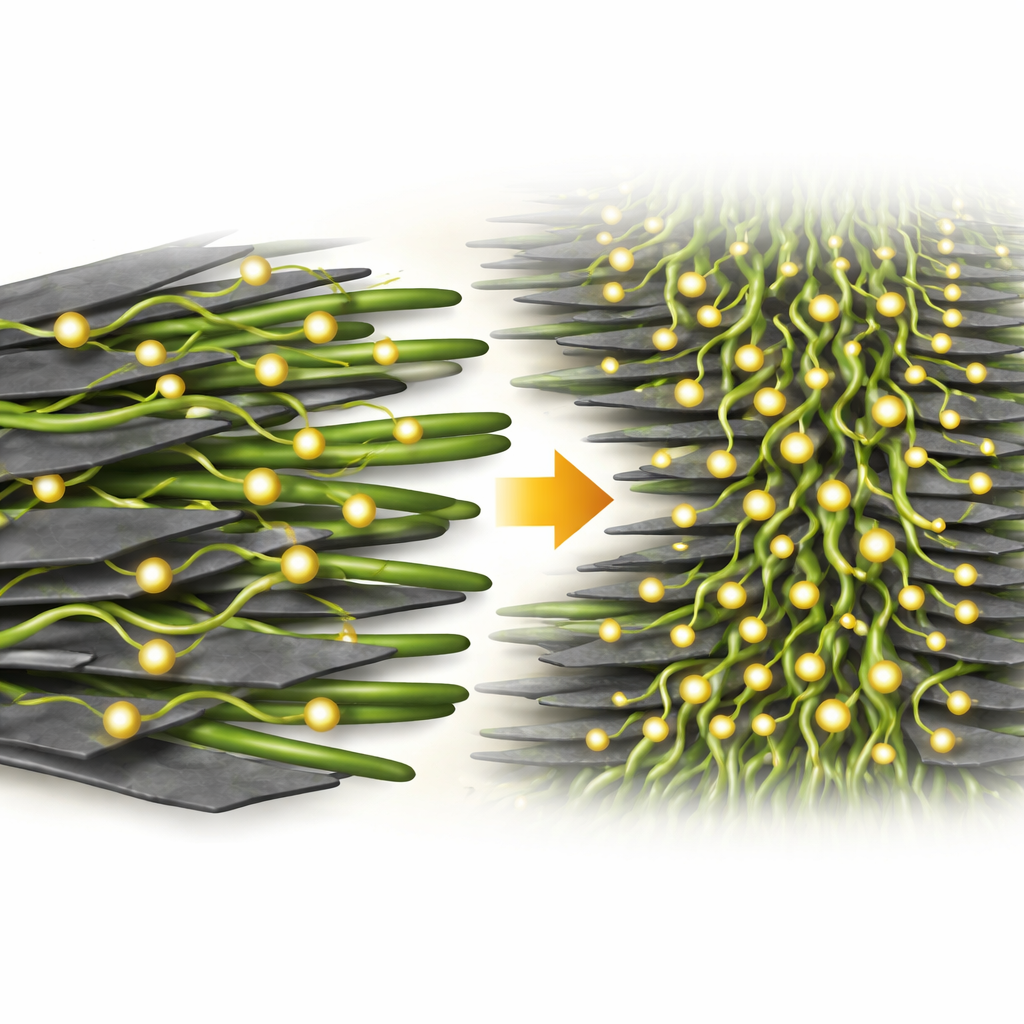
How the mix stores electric energy
The team also measured how well each sample stores electric charge, a property captured by the dielectric constant. At low frequencies the charge tends to pile up at the boundaries between regions that conduct differently, a process known as interfacial polarization. The presence of graphene sheets and polypyrrole strands increases the number and area of such boundaries and creates extra pathways for charges to gather and rearrange. As a result, the dielectric constant of the three-part composite reached about 220, more than five times that of pure magnesium ferrite. Impedance measurements, which probe how the material resists and temporarily stores electrical energy, showed that the composite had lower overall opposition to current flow and relaxation features consistent with these enhanced interfaces.
What this means for future devices
In simple terms, by weaving together a magnetic ceramic with conducting carbon sheets and a conducting plastic, the researchers created a material that is still magnetically useful but far better at conducting and storing electrical energy. The combination of moderate, stable magnetic response, much higher electrical conductivity, and a greatly increased ability to hold charge makes the three-part composite a promising candidate for roles where quick bursts of energy and compact design are important—such as sensors, inductors in miniaturized circuits, and next-generation supercapacitors. The work shows how carefully engineered nano-scale mixtures can outperform their individual ingredients by exploiting the interactions at their shared boundaries.
Citation: Ibrahim, B., El Shater, R.E., Saafan, S.A. et al. AC measurements and magnetic properties of magnesium ferrite and its composites with reduced graphene oxide (rGO) and polypyrrole (PPy). Sci Rep 16, 9344 (2026). https://doi.org/10.1038/s41598-025-23763-9
Keywords: magnesium ferrite, graphene composites, polypyrrole, dielectric materials, supercapacitors