Clear Sky Science · en
A dynamic risk prediction framework of lane-changing behavior based on driving intention recognition on icy and snowy surfaces
Why winter lane changes matter
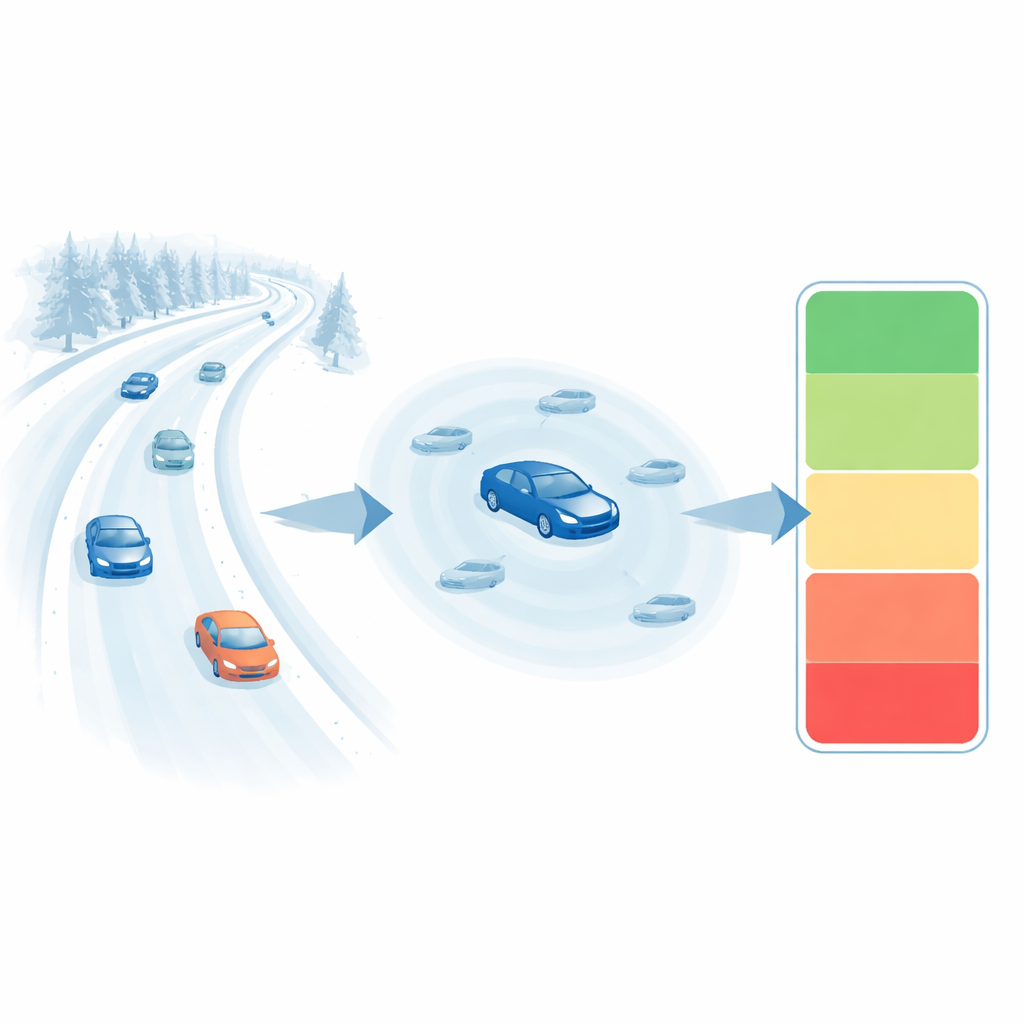
For anyone who has gripped the wheel a little tighter on a snowy highway, lane changes can feel like the scariest part of winter driving. Slippery pavement, longer stopping distances, and nervous reactions all raise the chance that a simple move to pass a slower car could end badly. This study explores how to predict the danger of a lane change several seconds before it happens, using not just what the car is doing on the road, but also how the driver looks and reacts inside the vehicle. The goal is to give future cars and driver-assistance systems enough warning to prevent crashes on icy and snowy roads.
Looking closely at winter driving
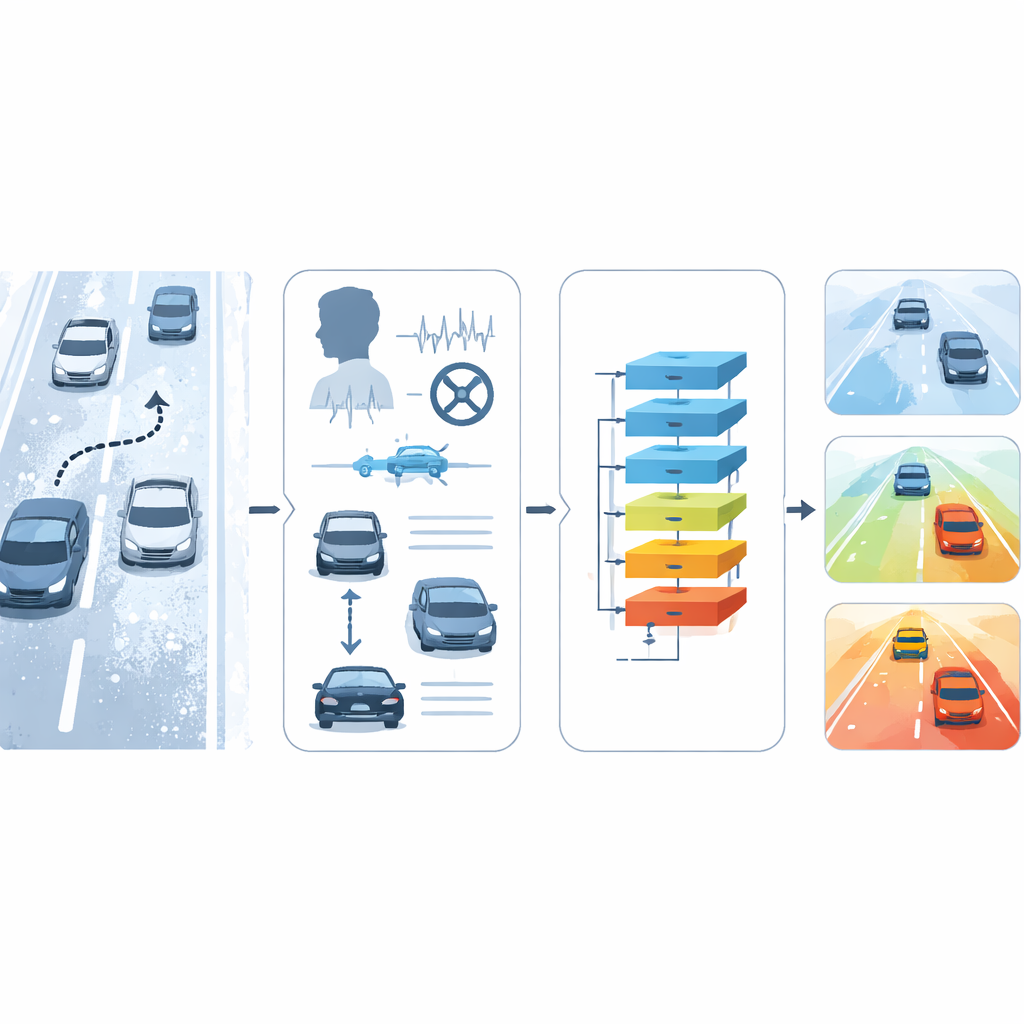
To safely study risky situations, the researchers built a highly realistic driving simulator instead of sending people onto real icy highways. Volunteers sat in a full car cabin mounted on a motion platform, facing a wide curved screen that recreated a real Chinese expressway in both normal and snow-covered conditions. The virtual highway had moderate traffic, with surrounding cars and trucks moving naturally. At the same time, three kinds of data were recorded at high speed: the motion of the vehicles on the road, the driver’s eye and head movements, and body signals such as heart and skin activity. This rich mix of information captured not only where the car was and how fast it moved, but also how tense, focused, and active the driver was while preparing to change lanes.
From driver intention to early warning
One key insight in this work is that danger does not begin when the car actually starts drifting into the next lane. It begins when the driver first thinks about making the move. On icy roads, this “intention period” was found to last about 6.1 seconds on average—over a third longer than on dry pavement—because drivers need more time to check mirrors, judge gaps, and build up confidence. The team used an advanced kind of recurrent neural network to recognize this hidden intention from time‑series data. By feeding in steering behavior, eye movements, body signals, and the motion of nearby cars, their Multi‑BiLSTM model could tell whether the driver was preparing a left lane change, right lane change, or simply staying in the lane, with accuracy around 96–98% even under winter conditions.
Turning complex motion into a risk score
Recognizing intention is only half the story; the other half is judging how risky that intended lane change will be. The researchers combined two ideas that capture danger in different ways. One describes how soon two vehicles would collide if they kept their current speeds and paths, while the other compares the distance needed to stop safely with the distance actually available, taking into account the reduced grip of ice and snow. These measures, reflecting both timing and spacing, were turned into probabilities of exposure and severity and then fused into a single lane‑changing risk index. Instead of choosing human‑made cutoffs, the team let a clustering algorithm group millions of simulated moments into three natural bands: low, medium, and high risk. Most situations were low risk, but icy roads produced far more medium‑ and high‑risk events than normal roads.
Smart models for split‑second decisions
To predict which risk band a lane change would fall into, the authors trained a fast, tree‑based machine‑learning model called LightGBM. It used only a carefully selected set of features from the driver’s intention period—such as steering activity, body stress signals, vehicle motion, and distances to surrounding cars—along with the precomputed risk label from the later execution of the maneuver. When compared with other popular methods like random forests, support vector machines, and XGBoost, the LightGBM model came out on top. It correctly classified winter lane‑change risk about 97.5% of the time and was especially good at avoiding the most dangerous mistake: calling a truly high‑risk maneuver “low risk.” The model’s design also allows engineers to see which factors most strongly push a situation toward danger, helping to keep the system transparent.
What this means for safer winter roads
In plain terms, this study shows that cars can be taught to “sense” not only how slippery the road is and how close other vehicles are, but also when a driver is about to make a move and whether that move is likely to be safe. By combining early intention recognition with a detailed view of risk, the proposed framework could power future driver‑assistance systems that warn drivers, adjust speed, or even delay a lane change when conditions look bad. Although the work is based on simulator data and focuses on highway scenarios with a limited number of nearby vehicles, it lays important groundwork for intelligent vehicles and connected cars that help each other navigate icy and snowy roads with fewer surprises and fewer crashes.
Citation: Zhao, W., Du, X., Wang, Z. et al. A dynamic risk prediction framework of lane-changing behavior based on driving intention recognition on icy and snowy surfaces. Sci Rep 16, 9572 (2026). https://doi.org/10.1038/s41598-025-21369-9
Keywords: winter driving safety, lane change risk, driver intention, intelligent vehicles, machine learning in traffic