Clear Sky Science · en
Research on the drilling pipe health monitoring and intelligent life prediction management platform
Why the Lifespan of Hidden Steel Matters
Every modern society depends on oil and gas pulled from deep beneath the ground, and the steel pipes that do this work are pushed to their limits. If a drill pipe fails a few kilometers below the surface, it can halt production, cost millions of dollars, and even endanger workers and the environment. This study shows how combining smart sensors, data networks, and computer modeling can watch over these pipes in real time, predict when they are likely to fail, and help operators replace them just in time instead of too late or too early.
From Guesswork to Measured Care
Until recently, many drilling crews managed drill pipes using a mix of rule-of-thumb schedules and paper records. Pipes were inspected by eye, logged by hand, and often retired in large groups, even if some were still in good shape. This approach struggles to catch small, early cracks that grow with each turn of the pipe, and it can lead either to dangerous overuse or to throwing away expensive steel long before its true end of life. As oilfields become more automated and data-driven, there is a strong push to treat each pipe as an individual asset with its own health record.
A Digital Nervous System for Drill Pipes
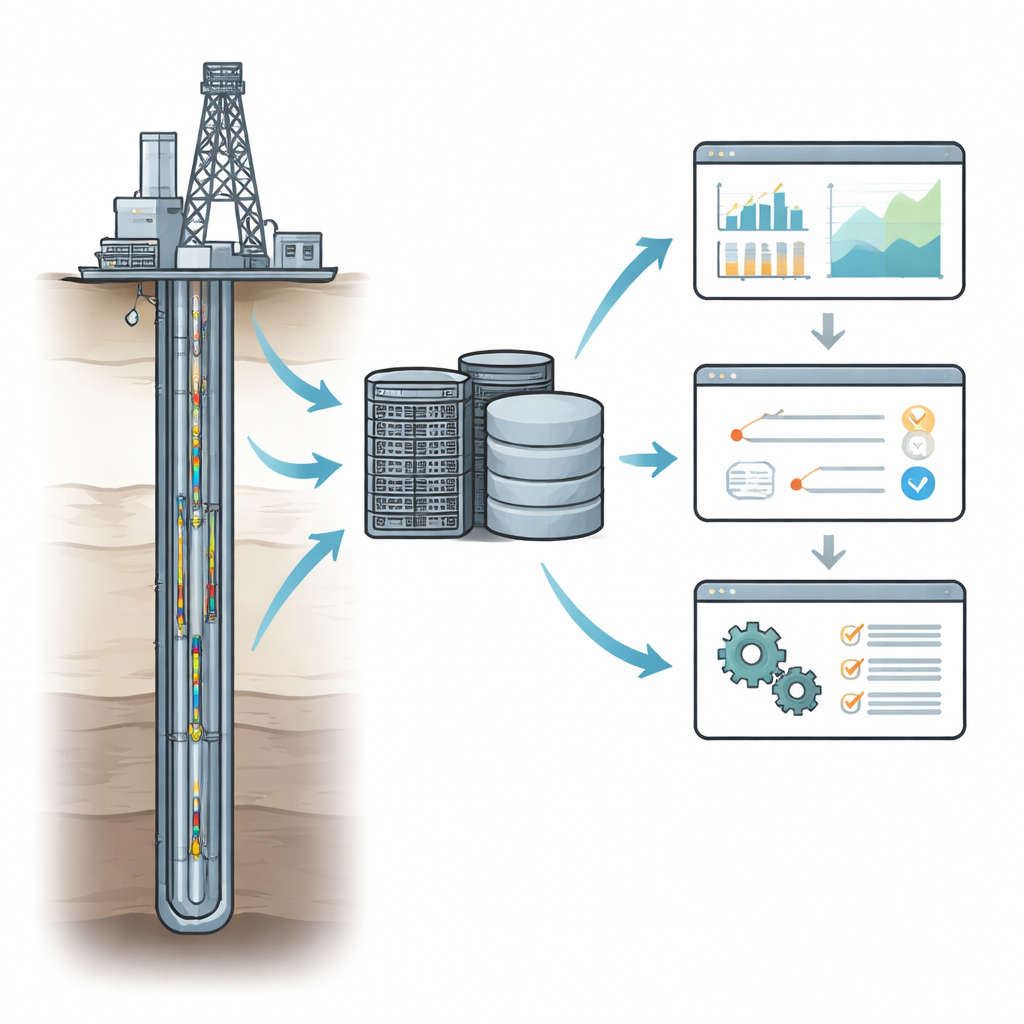
The authors designed a complete management platform that turns drill pipes into traceable, data-rich objects. Each pipe carries a special radio tag that survives harsh, metallic downhole conditions. These tags are installed in carefully machined recesses at the threaded end of the pipe so they can be read reliably without weakening the steel. When pipes move in and out of the well, fixed and handheld readers automatically scan their tags, recording which pipe is in use, when, and under what conditions. At the same time, a network of sensors tracks temperature, pressure, vibration, torque, and other forces. All of this information flows through a structured system: a sensing layer gathers data, a storage layer organizes it in mixed databases, and an analysis layer turns it into health assessments and life predictions.
How the System Foresees Wear and Tear
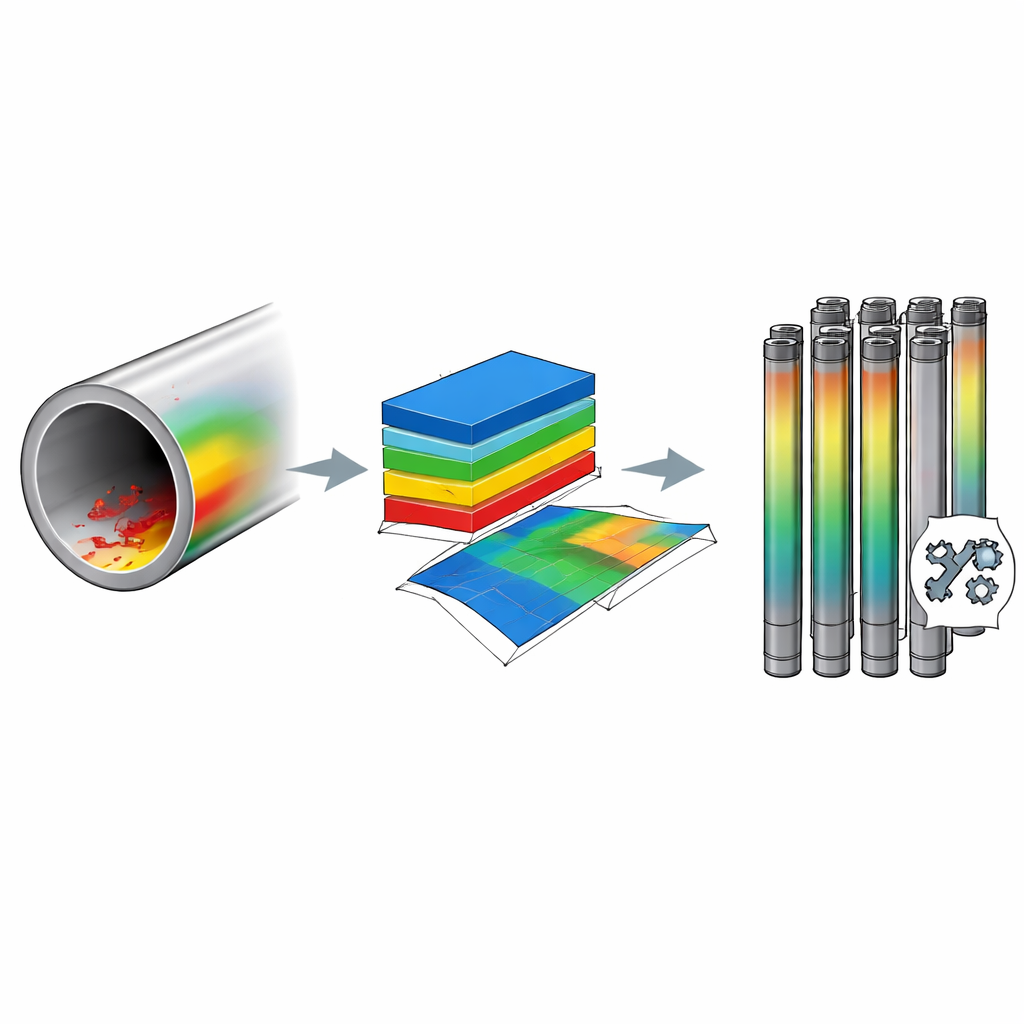
To move beyond simple counting of hours or turns, the team built a detailed mechanical picture of how drill pipes are stressed in real wells. Using finite element simulations, they modeled bending, tension, radial pressure, and twisting, paying special attention to threaded joints where cracks are most likely to start. They then applied fracture and fatigue theories to estimate how tiny flaws grow under repeated loading, and how factors like drilling pressure and rotation speed shorten life. These simulation results form a reference library of stress and fatigue behavior under many operating scenarios. The platform continuously matches live field data, tagged to each individual pipe, with the closest simulation cases, and fuses them using a fatigue damage model that accumulates wear over time.
Putting Smart Tracking to the Test
The researchers tested the system in real drilling operations. They evaluated how reliably the radio tags could be read while pipes moved up and down the well and found that recognition rates for tagged drill pipes exceeded 95 percent, with some variation between downhole and uphole stages. By feeding the resulting histories into their fatigue model, they compared predicted remaining life with experimental measurements from multi-condition tests. The new approach tracked reality closely, with a high statistical match and much lower prediction errors than older empirical formulas, showing that detailed stress modeling plus real-time usage data can capture the subtle ways pipes age in the field.
Smarter Pipes, Safer Wells
In practical terms, this platform lets operators know which specific pipes are nearing exhaustion and which can safely keep working. Instead of retiring entire strings as a batch, they can remove only the high-risk pieces, lowering costs while cutting the chance of sudden breakage deep underground. Beyond oil and gas, the same idea—combining rugged identification tags, continuous monitoring, and physics-based life prediction—could be applied to aircraft parts, rail components, and wind turbine shafts. The core message is simple: when heavy-duty hardware can report how it is really feeling, industries can move from reactive repairs to planned, preventive care.
Citation: Gao, X., Wu, X., Li, Q. et al. Research on the drilling pipe health monitoring and intelligent life prediction management platform. Sci Rep 16, 10981 (2026). https://doi.org/10.1038/s41598-025-19808-8
Keywords: drill pipe monitoring, RFID tracking, fatigue life prediction, oilfield digitalization, predictive maintenance