Clear Sky Science · en
Optimization of scours downstream of conduit aerators
Why moving water can quietly dig big holes
Whenever water is released from dams, treatment plants, or fish farms, it does more than simply flow downstream. Fast jets of water can gouge deep holes in the riverbed, threatening structures, habitat, and water quality. At the same time, engineers often want those jets to pull in air to boost oxygen levels for aquatic life. This study explores how to tune pipe-like outlets called conduits so they both mix in plenty of air and avoid digging dangerous holes, using a form of artificial intelligence to search for the best designs.
Fast water, fragile riverbeds
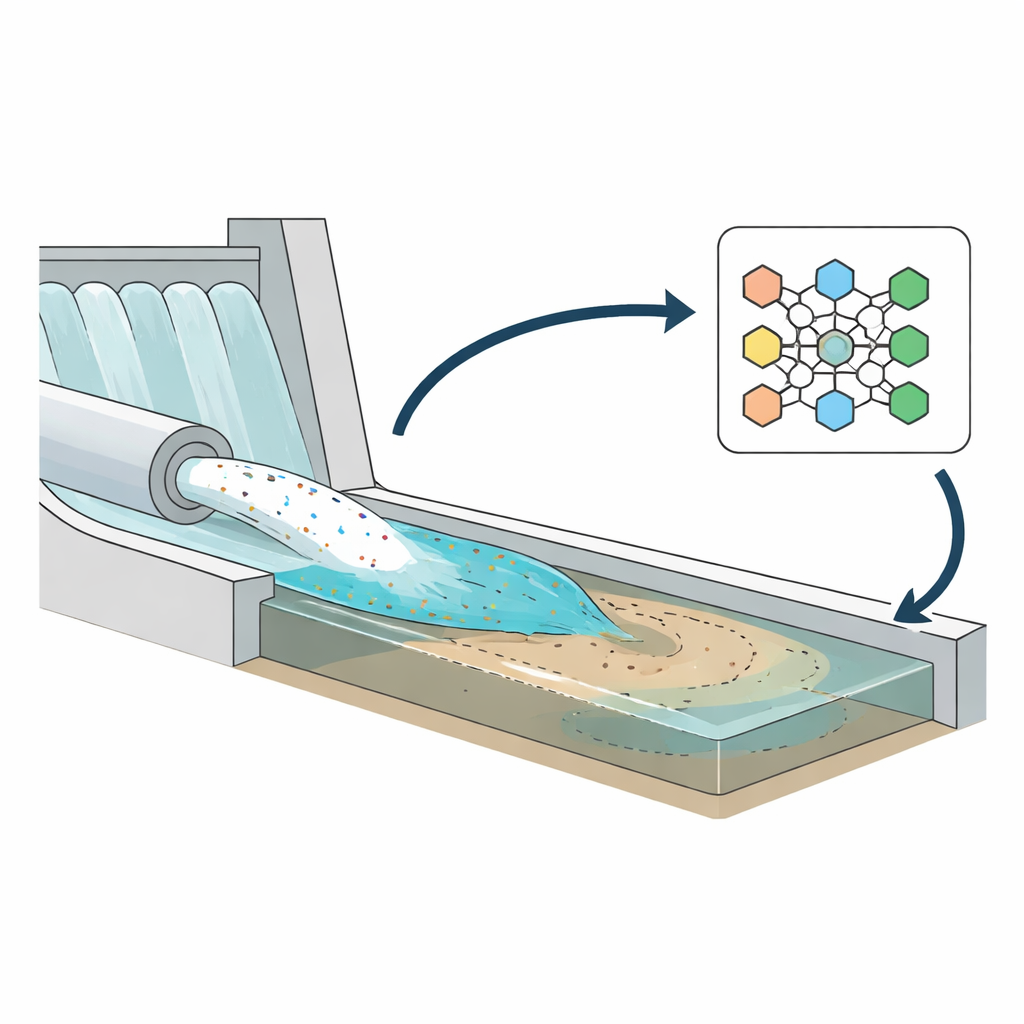
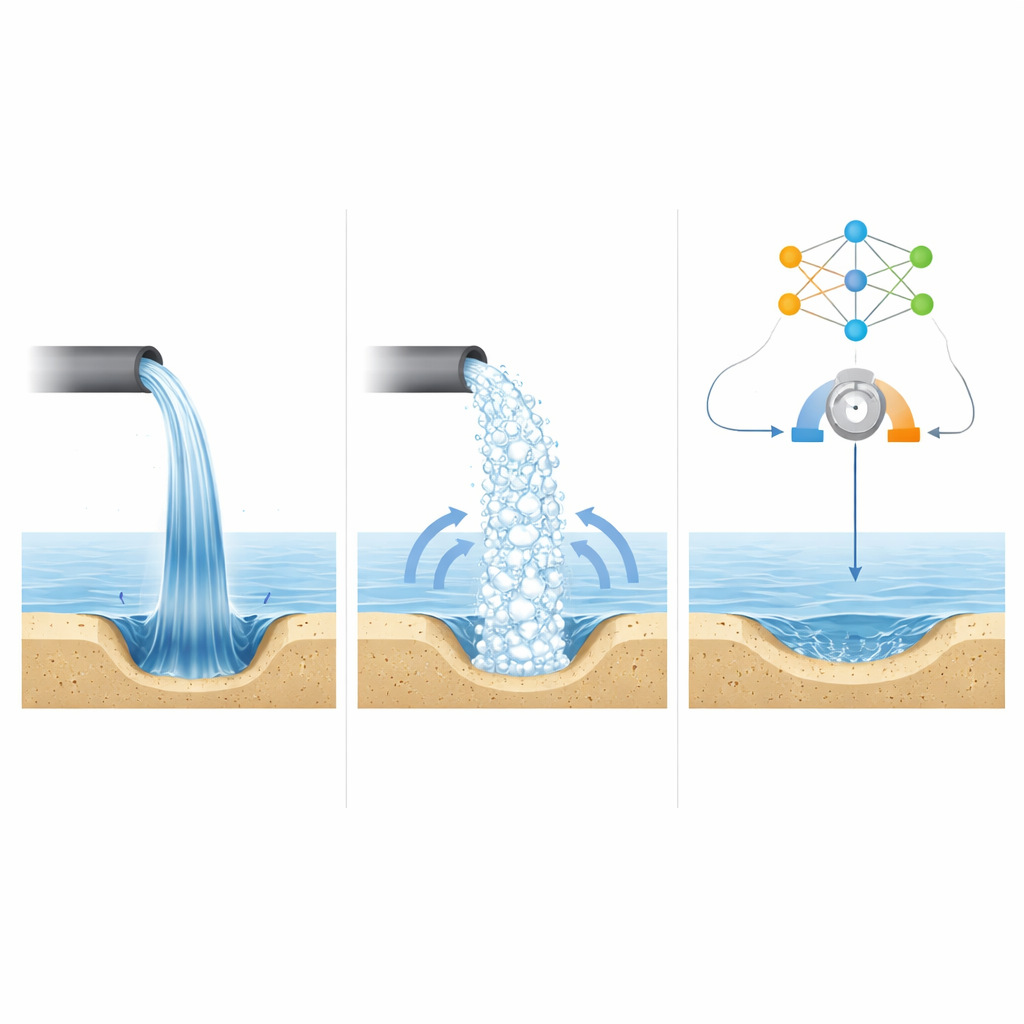
When high dams or pressurized pipes release water, the jet can behave like a high-speed drill. As it slams into the bed downstream, it scours out a hole whose depth and length depend on flow speed, water depth, and the shape of the outlet. Over time, these scour holes can undermine foundations, damage energy-dissipating structures, and disturb sediments that store nutrients or pollutants. Traditional fixes, such as adding big stilling basins or rock armoring, are expensive and not always effective. One promising alternative is to deliberately entrain air into the jet. Clouds of tiny bubbles make the jet more turbulent and less dense, helping it spread out and lose energy before it bites into the bed.
Conduits that pull in air
The researchers focused on pressurized steel conduits that carry water from a reservoir or tank to a downstream pool. A sliding gate at the conduit entrance controls how much water passes through, while one or more small holes near the gate allow atmospheric air to be sucked into the fast-moving flow. As the bubbly jet emerges into the downstream pool, it both transfers oxygen and reshapes the way the jet hits the bed. In a dedicated hydraulic laboratory, the team systematically varied key design features: the water flow rate, conduit length, downstream water depth, size of the air hole, and how far the gate was opened. For each of 110 combinations, they measured how much air was drawn in, how deep the scour hole became, and how far it spread.
Teaching a digital brain to read the flow
Instead of relying only on trial-and-error formulas, the team trained an artificial neural network—a data-driven model inspired by biological neurons—to learn the connections between conduit settings and outcomes. They fed the model the five adjustable inputs and asked it to predict three targets: an aeration index (the ratio of air to water flow), the maximum scour depth, and the horizontal length of the scour hole. The network had several hidden layers, allowing it to capture subtle, nonlinear interactions among variables such as flow rate, water depth, and air-hole size. After training on most of the experiments and checking performance on the remainder, the model reproduced the laboratory results with over 95% accuracy, showing that it had effectively “learned” the hydraulic behavior of the system.
Searching for the sweet spot
Once the neural network reliably mirrored the experiments, it became a fast virtual test bench. The researchers used it in two modes. First, they optimized each outcome separately: looking for settings that maximized air intake, minimized scour depth, or maximized scour length. Then, more realistically, they searched for a compromise that delivered high aeration and long, gentle scour while keeping the hole shallow. The model pointed to a clear sweet spot: moderately high flows, a conduit length around 1.3–1.5 m, a gate opened to about 70%, and an air vent about 9 mm in diameter. Under such conditions, the jet drew in several times more air than water, while the scour hole remained relatively shallow and spread out rather than deep and concentrated.
From lab pipes to real rivers
The study shows that a carefully tuned, air‑drawing conduit can both oxygenate water and protect the riverbed, and that artificial neural networks are powerful tools for finding those settings without endless physical trials. For non-specialists, the takeaway is simple: by letting smart algorithms sift through laboratory data, engineers can design outlets for dams and treatment plants that add life-giving air to the water while quietly reducing the hidden erosion that threatens our infrastructure and waterways.
Citation: Arici, E., Tuna, M.C., Aytac, A. et al. Optimization of scours downstream of conduit aerators. Sci Rep 16, 7820 (2026). https://doi.org/10.1038/s41598-025-19265-3
Keywords: dam hydraulics, aeration, riverbed erosion, artificial neural networks, conduit design