Clear Sky Science · en
Enhanced graph coevolution network for social network analysis using assimilation modified emotional algorithm
Why Emotions in Networks Matter
Social media and online communities are not just webs of connections; they are rivers of emotion. Platforms like Facebook, X, or online forums constantly pulse with joy, anger, fear, and more. Understanding how these feelings spread and cluster can help improve recommendation systems, detect harmful content, or track public mood during crises. This paper introduces a new way to model emotional patterns in social networks, aiming to capture not just who is connected to whom, but how complex emotions flow and settle in online communities. 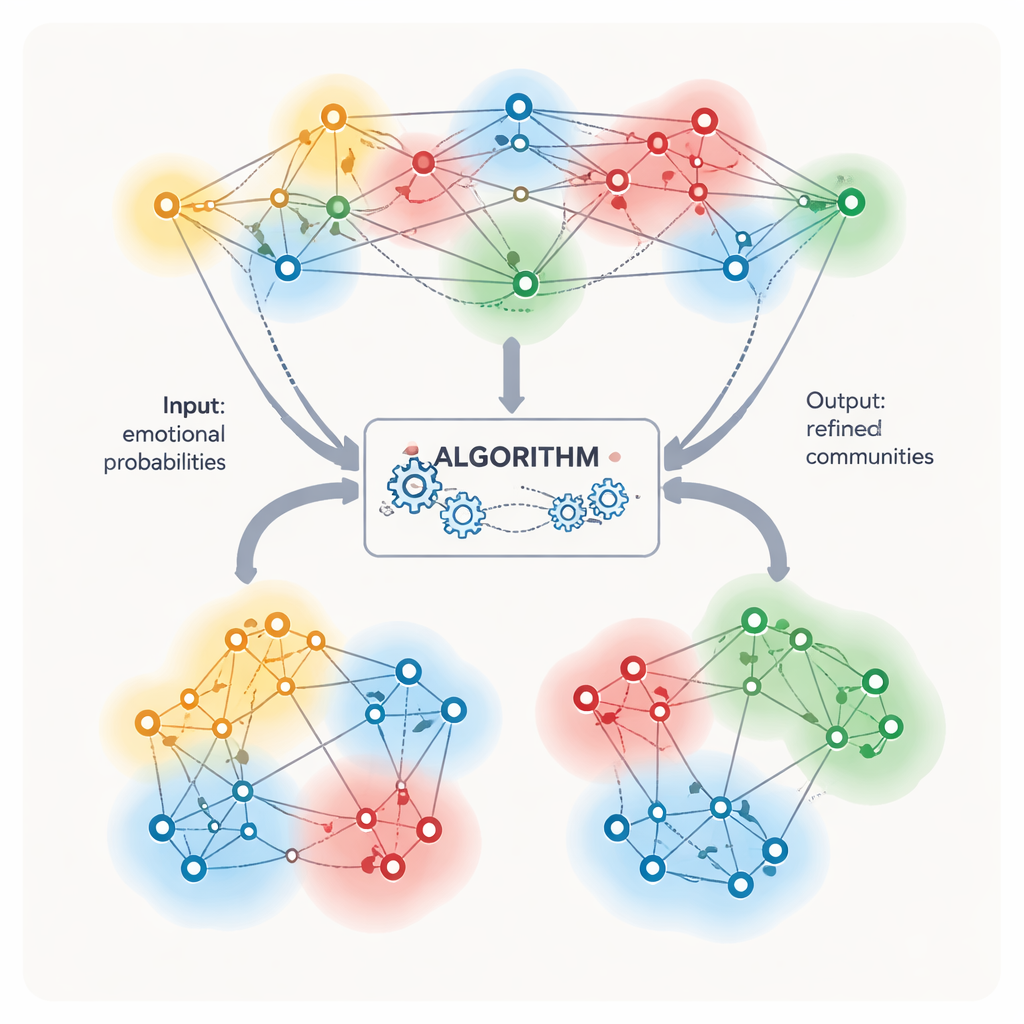
From Simple Labels to Rich Emotional Profiles
Most existing tools for analyzing communities in networks rely on what is called label propagation: a method that infers group membership by letting labels spread from node to node along connections. Traditionally, each person (or node) is assigned a single label, such as “happy” or “sad,” based on which emotion has the highest score from a machine-learning model. This one-label-per-person view throws away valuable nuance. For instance, two users might both be tagged as “happy,” even if one is mildly positive and the other is almost ecstatic. The new Assimilation Modified Emotional (AME) algorithm keeps the full probability mix of emotions for each user instead of collapsing everything into a single tag, preserving subtle differences in emotional tone.
Letting Emotions Evolve Like a Random Walk
AME models emotional changes using a mathematical idea known as a Markov chain, which describes how something moves between states step by step according to probabilities. Here, the “states” are emotional profiles. Within each community in the network, AME selects a few especially influential members and uses their emotional probabilities to build a shared “transition” pattern: how likely emotions are to shift over time as people interact. This process imitates the psychological assimilation effect, where people’s attitudes drift toward those of others around them. Instead of assuming that labels are fixed, AME repeatedly updates each community’s emotional distribution, allowing group mood to stabilize in a way that better reflects real social influence.
Shrinking and Reconnecting the Network
Once emotional influences within each community have been simulated, AME simplifies the network through a procedure called graph coarsening. In everyday terms, this means merging tightly knit parts of the network into more compact, representative units without losing their essential structure. After this compression, AME uses link prediction—estimating which pairs of nodes are likely to be connected—to rebuild connections between these compact communities. The end result is a cleaned-up version of the original network in which communities are more sharply defined and emotional patterns are more consistent, making the structure easier for downstream AI models to learn from.
Putting the Algorithm to the Test
The authors put AME through a series of experiments on both simulated and real social networks. They first used large text datasets of emotional messages, processing them with a pre-trained transformer model to assign emotion probabilities to each message and corresponding network node. Then they compared AME against several well-known community detection methods on three types of graphs: randomly connected networks, networks with a few highly connected hubs, and real-world Facebook and email networks. Across all settings, AME produced communities that were easier for a graph-based neural network to learn from, consistently achieving higher accuracy and lower error than the competing methods. Additional tests showed that keeping full probability distributions and applying graph coarsening each independently improved performance. 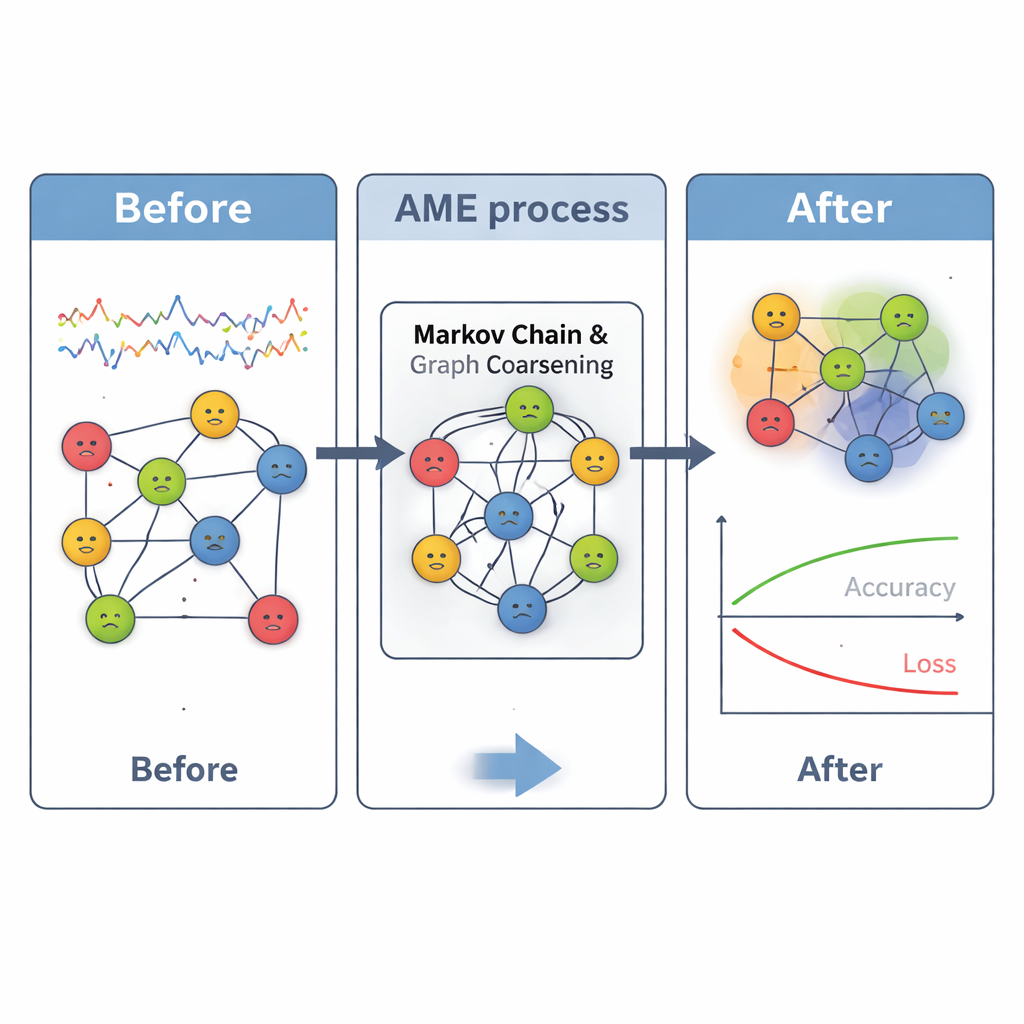
What This Means for Everyday Technology
In plain terms, the AME algorithm offers a smarter way to track and understand emotions as they move through online communities. By keeping emotional nuance instead of flattening people into a single label, and by mimicking how group moods converge over time, it produces cleaner, more informative network structures for AI systems to analyze. This could lead to more sensitive mood-aware tools—for example, systems that better detect rising hostility, identify supportive communities, or adapt content to users’ emotional context. The study’s results suggest that AME can serve as a strong backbone for future emotion-aware AI in social networks and other complex, interconnected systems.
Citation: Li, HH., Chang, PC. & Liao, YH. Enhanced graph coevolution network for social network analysis using assimilation modified emotional algorithm. Sci Rep 16, 7936 (2026). https://doi.org/10.1038/s41598-025-18482-0
Keywords: social network analysis, emotion recognition, graph algorithms, community detection, label propagation