Clear Sky Science · en
The impact of fly ash and slag on the microscopic interface of recycled concrete and its destruction evolution
Turning Building Waste into New Structures
As cities grow and old buildings come down, mountains of broken concrete and industrial waste such as fly ash and slag are piling up. At the same time, making new concrete is one of the biggest sources of carbon emissions in construction. This study asks a simple but pressing question: can we safely turn this waste back into strong, durable concrete, and what happens inside the material when we do? By peering deep into the tiny contact zones between old and new concrete and simulating how cracks grow, the authors show how to blend recycled ingredients without sacrificing performance.
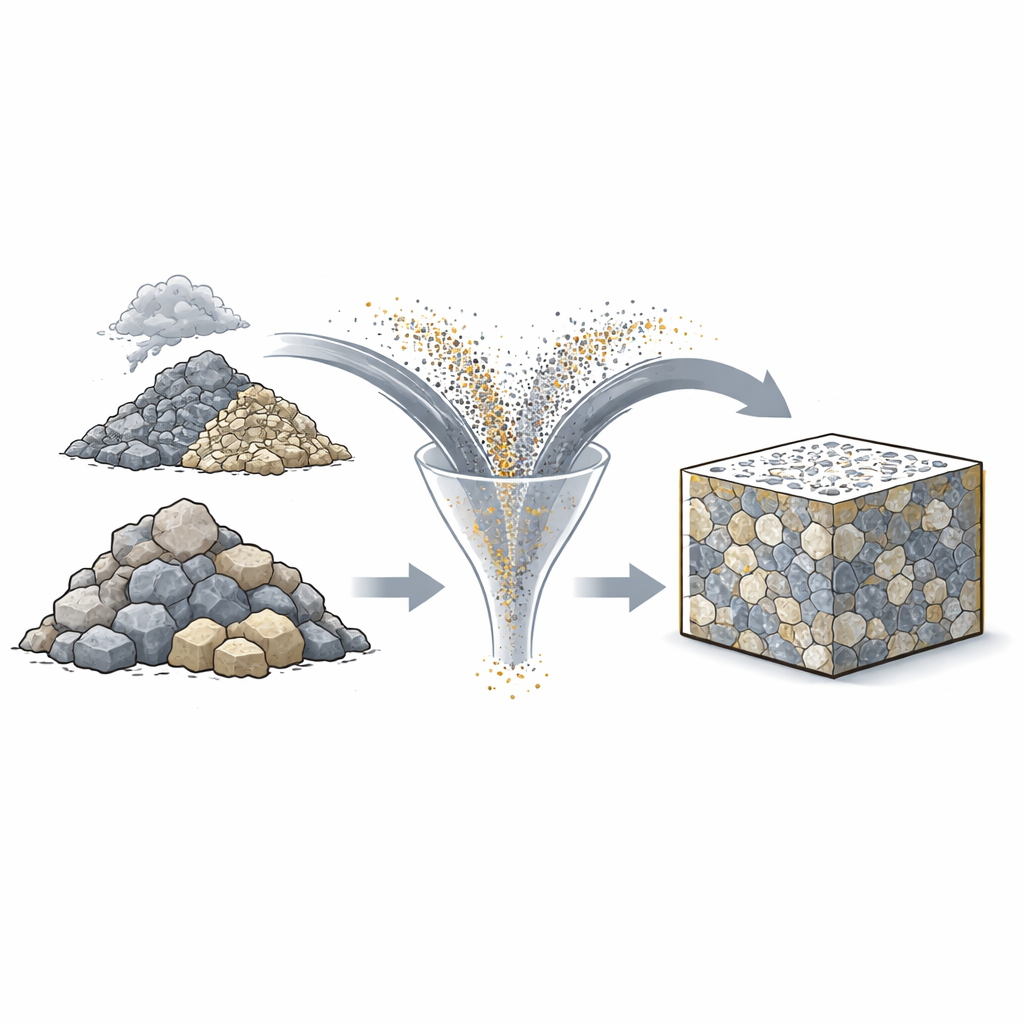
Why the Hidden Boundary Matters
Concrete is not a single solid piece; it is more like a rocky fruitcake, with stones and sand held together by hardened paste. The weakest spots are often the thin layers where stone and paste meet, called interface zones. In recycled concrete, these zones become more complicated because pieces of old concrete already carry their own thin layers of aged paste. When new paste is poured around them, multiple boundaries appear. The study focuses on how these boundary layers behave when natural stone is partly replaced by chunks of old concrete, and when fly ash and slag—powders left over from burning coal and making steel—are mixed into the paste.
Testing Different Recipes for Strength
The researchers created 24 different concrete mixtures by changing three ingredients: the share of recycled chunks, the amount of fly ash, and the amount of slag. All mixes used the same amount of water and sand so any changes in performance could be traced back to these substitutions. They measured how much pressure the concrete cubes could withstand before crushing, and how easily the cylinders split when pulled apart. Overall, more recycled chunks tended to lower strength compared with ordinary concrete. Adding fly ash or slag also reduced strength in many cases, especially at higher doses, because they slowed how fully the paste hardened. Yet there were sweet spots: when 40% of the stone was recycled and 10% was slag, the loss in strength was only about 5%, bringing the material very close to standard concrete.
Looking Inside the Concrete
To understand why some mixtures worked better, the team polished thin slices of the concrete and examined them under microscopes. Images revealed that recycled concrete has more pores and a rougher boundary between stone and paste than ordinary concrete. Around recycled chunks, the thin boundary zones were looser and more porous, with unreacted particles of cement, fly ash, and slag. This open structure weakens the glue that holds everything together. Ordinary concrete made with fresh stone showed a denser, more continuous boundary and smaller pores, explaining its better strength. The study found that both fly ash and slag increased the porosity of these zones, but fly ash did so more strongly than slag.
Watching Cracks Form and Grow
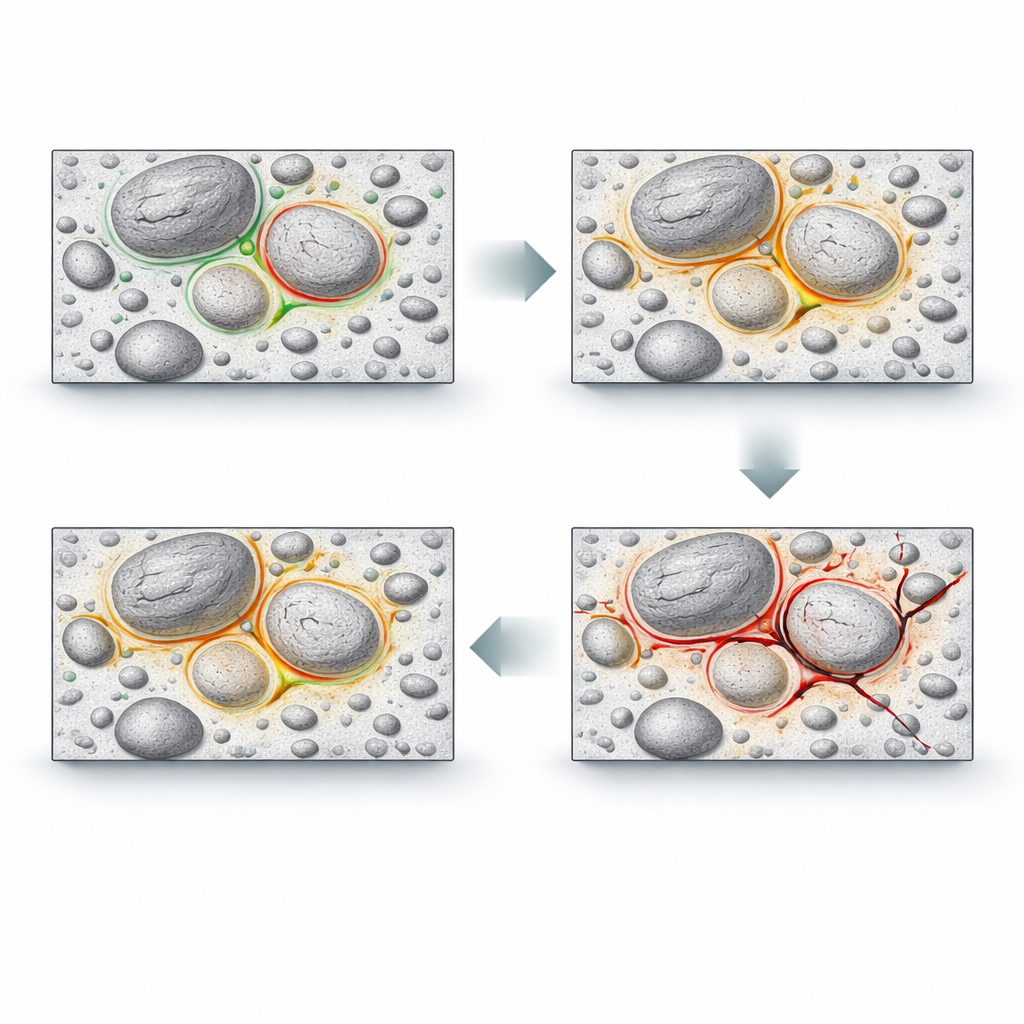
Beyond snapshots, the authors wanted to see how recycled concrete actually breaks. They built a computer model that treats the thin boundary zones as fragile layers that can open and separate under load. When they simulated pressing a concrete block, tiny cracks first appeared in the outer boundary zones where pores were largest. As the load increased, these cracks spread inward and joined up, eventually cutting across the specimen and causing failure. Photographs of real crushed samples matched the model: mixtures with lots of recycled chunks and fly ash developed wide, winding cracks, while mixtures with moderate recycled content and slag showed narrower, straighter cracks, hinting at a tighter internal structure.
What This Means for Greener Buildings
For non-specialists, the key message is reassuring: with a careful choice of ingredients, concrete made from demolition rubble and industrial by-products can come very close to the strength of conventional material. The work shows that the weakest link is the tiny boundary layer around recycled pieces, especially when too much fly ash or slag is added. By keeping recycled stone at moderate levels and using modest slag content, engineers can limit damage in these zones and slow crack growth. This points toward practical recipes for lower-carbon concrete that safely "eats" waste without turning into a brittle material, offering a path to sturdier, more sustainable buildings and roads.
Citation: Chen, C., Wei, Z., Zhang, J. et al. The impact of fly ash and slag on the microscopic interface of recycled concrete and its destruction evolution. Sci Rep 16, 9565 (2026). https://doi.org/10.1038/s41598-025-17035-9
Keywords: recycled concrete, fly ash, slag, interfacial transition zone, sustainable construction