Clear Sky Science · en
An industrial integration framework based on QFD for selecting the optimal electrical poles
Why the poles above our streets matter
Every time you walk under power lines or pass a row of streetlights, you are seeing the result of big decisions about which materials to use for those utility poles. These choices affect how often the lights go out, how safe the streets are during storms, how much maintenance costs taxpayers, and even how much impact we have on the environment. This article explains a new, more systematic way to pick the best type of pole—steel, aluminum, or modern fiber‑reinforced polymer (FRP)—based on what customers and communities actually care about.
From wooden posts to high‑tech supports
Utility poles have evolved over more than a century. Early poles were made of wood, which was easy to work with but vulnerable to rot, insects, and harsh weather. As electric power and telephone services spread, steel and aluminum poles became common because they were stronger and could carry heavier loads. However, these metals require a lot of energy to produce and can corrode over time. More recently, lightweight composite materials such as fiberglass‑based FRP have emerged. These new poles are designed to last longer, resist weather and corrosion, and reduce environmental impact, but they are also newer to the market, so utilities need clear ways to judge whether they are worth the investment.
Turning customer needs into design choices
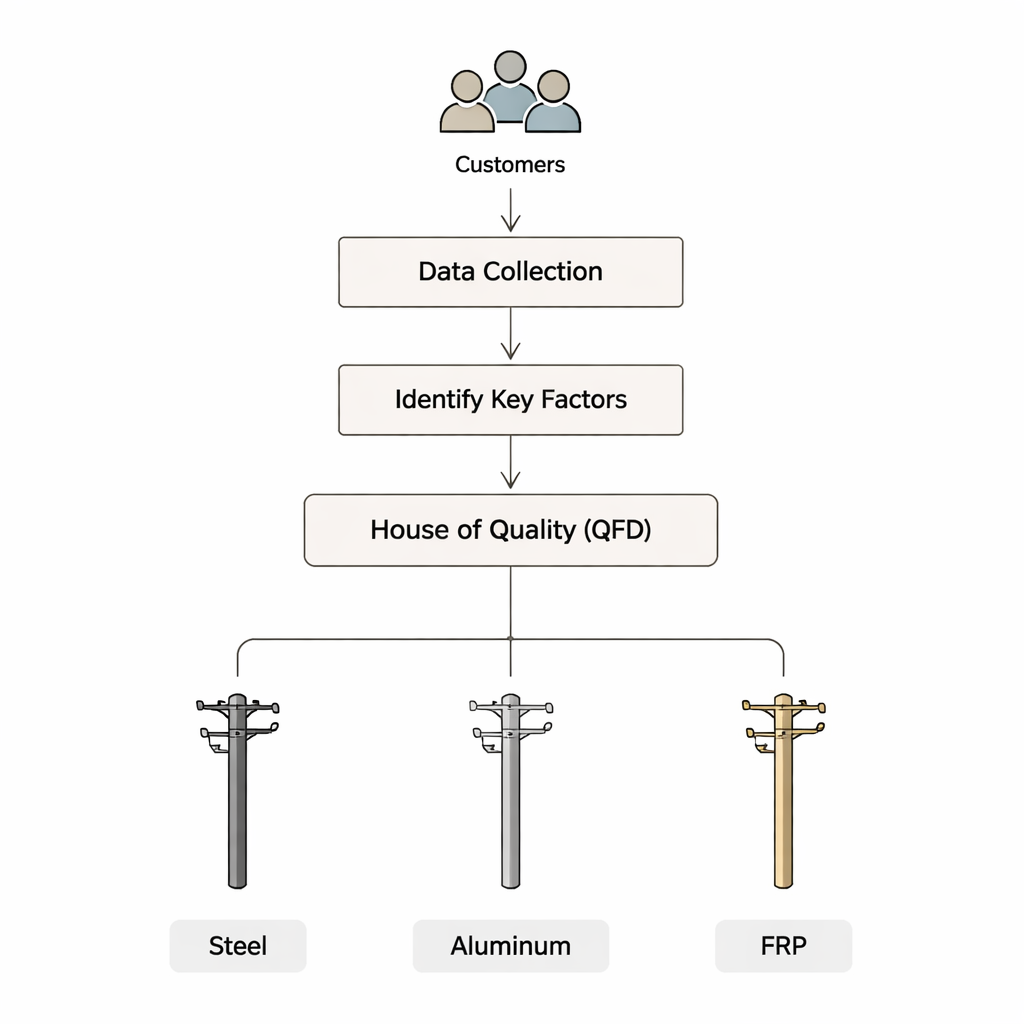
The researchers used a structured planning method called Quality Function Deployment (QFD) to connect what clients want with how poles are designed and chosen. Instead of relying only on engineering calculations or short‑term costs, they gathered the “voice of the customer” through market surveys, focus groups, and interviews with 125 professionals. From this work, they identified ten key performance indicators (KPIs) that matter most in real projects: how long the pole lasts, safety in accidents, total cost, how well its color holds up, resistance to electrical conduction, weight, manufacturing time, ease of transportation, installation method, and ability to resist strong winds. These customer priorities then guided which technical features of the poles should be emphasized.
Building a structured scorecard
Using QFD, the team translated the ten customer concerns into nine technical requirements, such as service life, minimum life‑cycle cost, corrosion resistance, ease of handling, and simplicity of installation. They arranged all of this information in a diagram known as the “House of Quality,” which links each customer want to specific design features. Relationships were rated as weak, moderate, or strong, and each customer requirement was given an importance score. This allowed the researchers to calculate how much each technical feature contributes to overall satisfaction and to see how different features help or conflict with one another. For example, features that increase durability might also affect cost or production time.
Comparing steel, aluminum, and FRP poles
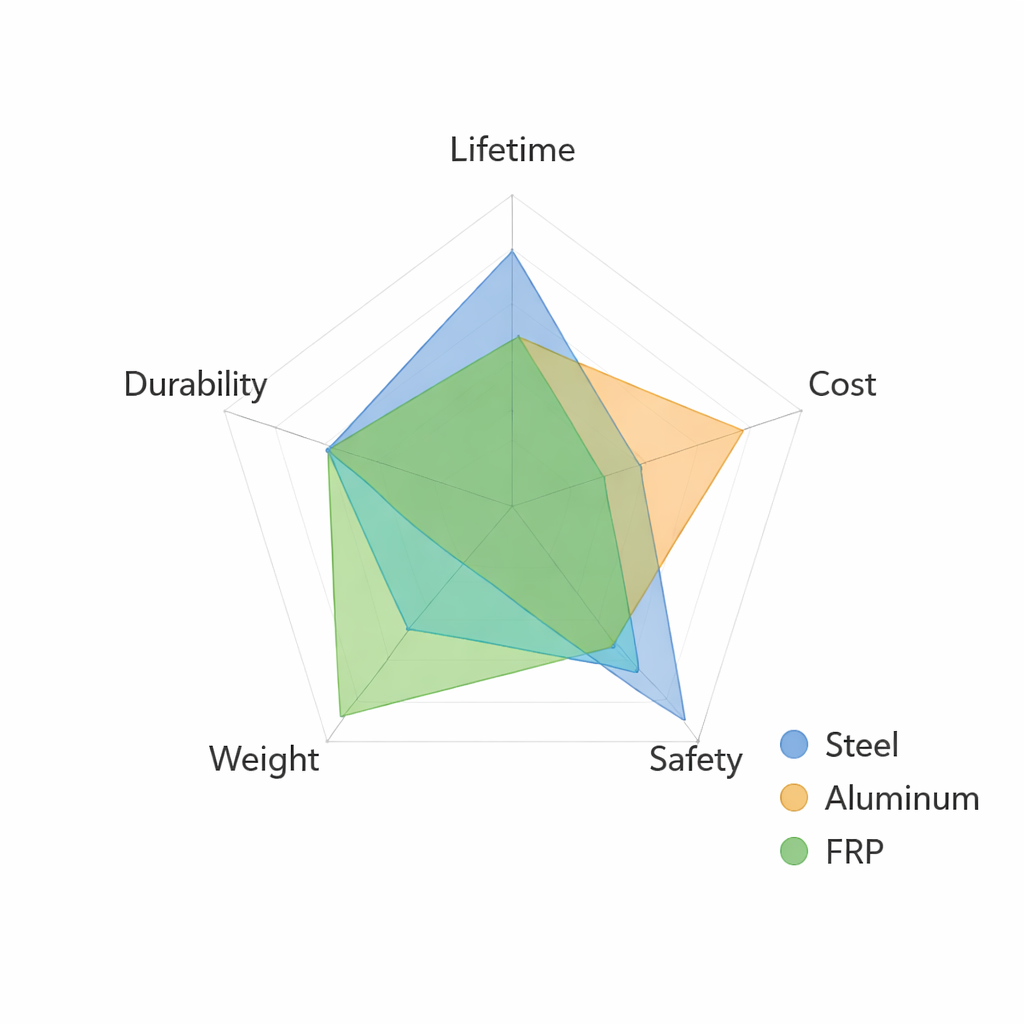
With the scorecard in place, the team compared three pole types—steel, aluminum, and FRP—across all ten KPIs. For each indicator, they rated how well each material performed on a simple scale and then combined these ratings using the importance weights from the QFD analysis. Visual tools such as radar charts and bar charts made it easier to see trade‑offs: steel tended to do well in certain areas like traditional installation methods and wind resistance, aluminum offered moderate performance with lighter weight, and FRP consistently led in lifetime, safety, total cost over the full life cycle, corrosion and color stability, and ease of transport due to its low weight.
What this means for future infrastructure
When all factors were combined, FRP poles achieved the highest overall score—4.12 out of 5—beating aluminum (3.216) and steel (2.872). In simple terms, this means that when you factor in long‑term cost, safety, durability, and handling, FRP poles offer the best overall package for many applications, even if they may be more complex or different to install. The proposed framework does more than just pick a winner, though: it gives engineers, utility managers, and purchasing teams a transparent, repeatable way to justify decisions about pole materials based on clear customer‑focused criteria. Similar methods could be applied to other infrastructure choices, helping cities and utilities build systems that are safer, longer‑lasting, and better aligned with public expectations.
Citation: Awad, Y.A., EL-Fiky, A.M., Hegazy, H. et al. An industrial integration framework based on QFD for selecting the optimal electrical poles. Sci Rep 16, 6724 (2026). https://doi.org/10.1038/s41598-025-12510-9
Keywords: utility poles, material selection, fiber-reinforced polymer, quality function deployment, infrastructure design