Clear Sky Science · en
Sustainability awareness assessment for university-level students in Cairo, Egypt
Why this matters for everyday life
Sustainability can sound like a distant policy word, but it shapes everything from the air we breathe to the jobs tomorrow’s graduates will hold. This study looks at how well university students in Cairo, Egypt—future engineers, architects, business leaders, and teachers—understand sustainability and how that knowledge translates into daily choices. By exploring what young adults know, believe, and actually do, the research offers a window into how a fast-growing city might move toward a greener, fairer future.
What the researchers set out to learn
The authors focused on three simple questions: Do university students in Cairo understand what sustainability means? Are they aware of concrete measures, such as saving water or reducing waste? And do they behave in ways that support a sustainable future? To answer these, they surveyed 524 students from multiple universities and majors over the course of an academic year. The questionnaire collected basic background information—age, gender, level of study, and field—and then asked students to react to statements about campus conditions, water use, nature protection, waste reduction, renewable resources, and disaster preparedness.
How the study was carried out
The team used an online survey and in-person interviews to reach students from a wide spread of faculties, including engineering, architecture, business, and the social sciences. To push respondents to take a stand, the researchers used a four-point agreement scale without a neutral middle option. Behind the scenes, they applied a battery of statistical techniques to the answers. These methods looked for patterns and links between who the students are—such as their age or major—and how they think about sustainability. In essence, the analysis allowed the team to test whether certain groups of students were more likely to agree with statements like “we must reduce all types of waste” or “shifting to renewable resources is required.”
What students know—and what they actually do
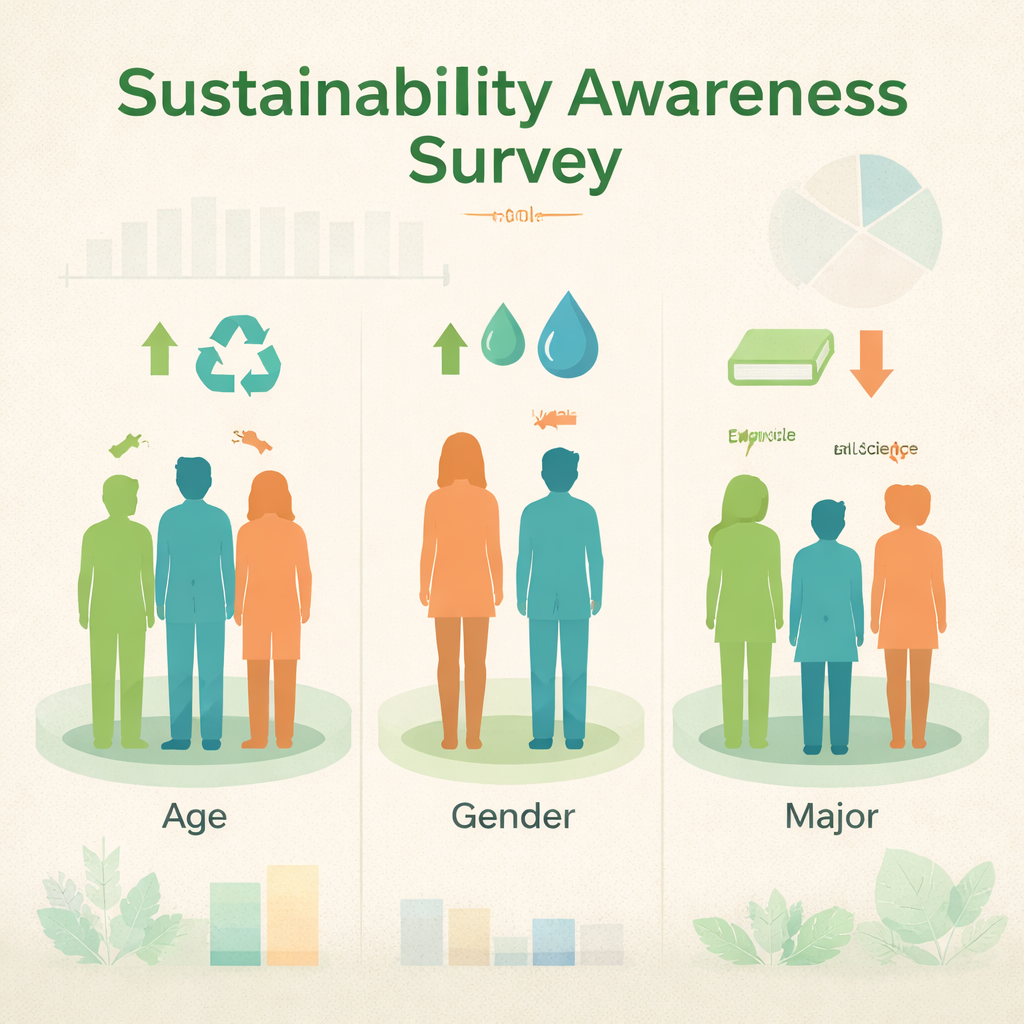
The results reveal a mixed picture. Many students had heard the term “sustainability” and recognized big ideas such as conserving water, protecting nature, and using renewable resources. Yet deeper understanding was often shallow, and practical habits lagged far behind awareness. A large share of students were not engaged in basic actions like recycling, even when they agreed in principle that waste reduction and resource conservation are important. Interestingly, older students tended to show stronger support for sustainable actions, and those studying fields closely linked to the environment or the built city—like architecture and engineering—generally had higher awareness. Gender also played a role: responses suggested that men and women sometimes emphasize different aspects of sustainability, with women often more attuned to issues like water conservation.
The surprise about education level
One of the most striking findings runs counter to common assumptions. Around the world, higher levels of education are often tied to stronger sustainability knowledge. In this Cairo sample, however, students further along in their studies did not always display higher awareness—and in some cases seemed less engaged than younger peers. The researchers suggest several reasons. Advanced courses may be highly specialized and rarely touch on sustainability, especially in non-environmental majors. Senior students can also become more skeptical of simple “green” slogans if they feel their courses do not back them up with real-world examples. At the same time, the relatively better performance of younger cohorts might reflect recent educational reforms and new attention to sustainability within Egypt’s long-term Vision 2030 plan.
What needs to change
To a layperson, the study’s message is straightforward: young people in Cairo care about sustainability, but their knowledge is uneven and their actions do not yet match their intentions. The authors argue that change cannot rest on students alone. Universities should weave sustainability into required courses for all majors, not just the obviously “green” ones, and support student-led projects that make saving water, cutting waste, and protecting campus green spaces part of everyday life. Governments and city authorities can reinforce these efforts by improving infrastructure and public information. If schools, officials, and communities work together, the gap between knowing and doing can narrow—helping today’s students become tomorrow’s problem-solvers for a more sustainable Cairo.
Citation: Teama, T., Deifalla, A., Dawoud, S.A. et al. Sustainability awareness assessment for university-level students in Cairo, Egypt. Sci Rep 16, 7723 (2026). https://doi.org/10.1038/s41598-025-08575-1
Keywords: sustainability awareness, university students, Cairo, environmental education, youth behavior