Clear Sky Science · en
Determination of the parameters of a material constitutive relation using the surrogate model along with dynamic indentation test
Why hitting metal with a tiny hammer matters
From cars and airplanes to protective gear, modern products rely on metals that can survive sudden hits, blasts, or crashes. Engineers need to know exactly how these materials behave when they are struck quickly and heated up, but the usual laboratory methods for measuring this are expensive, slow, and technically demanding. This study shows how a simple, point‑like impact test—similar in spirit to a hardness test—combined with smart computer modeling can replace much more complex equipment while still revealing how a metal responds under extreme conditions.
A simpler way to probe tough conditions
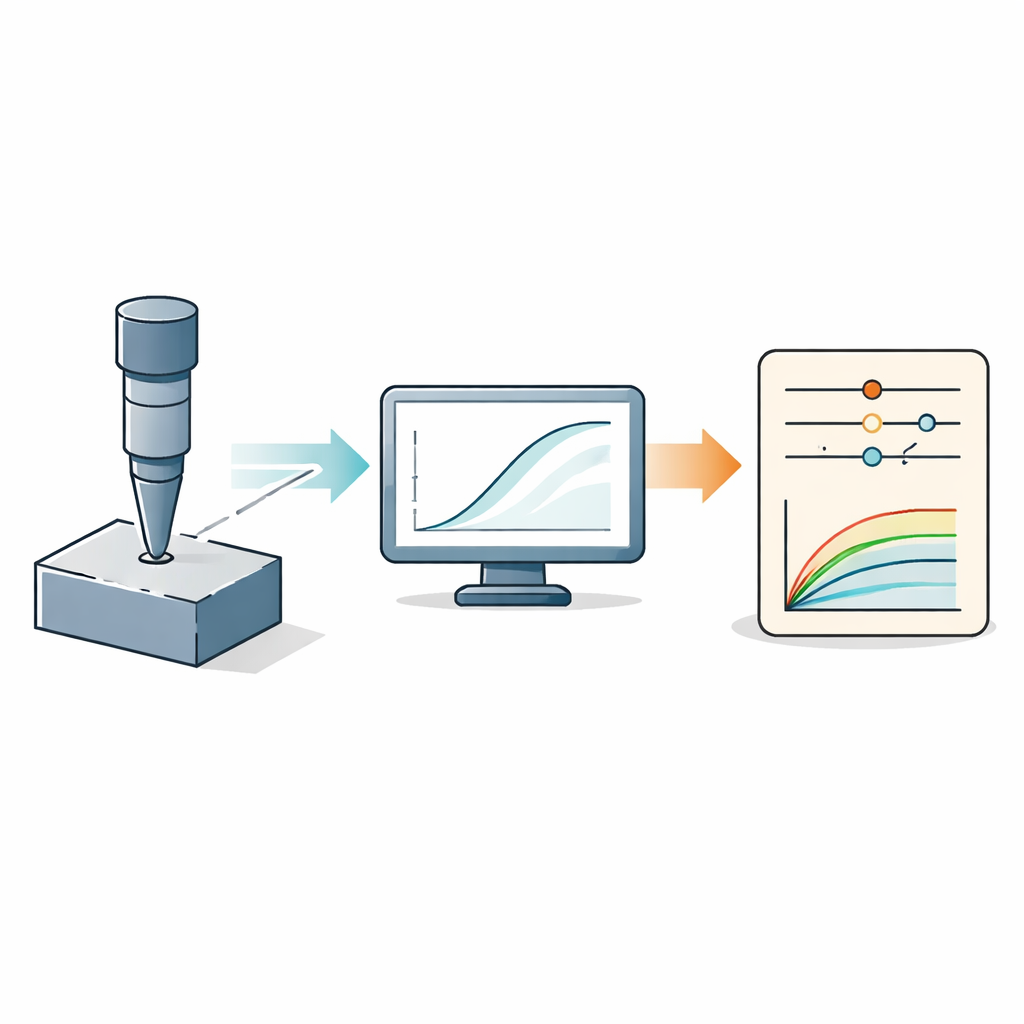
When a metal is hit very fast, its resistance to deformation depends not only on how much it is squeezed, but also on how quickly and how hot it becomes. Physicists capture this behavior in mathematical formulas called material models, which contain several numerical constants that must be measured. Traditionally, those constants come from specialized high‑speed tests using a device called a Split Hopkinson Pressure Bar, which fires stress waves through metal samples and demands careful alignment, calibration, and costly hardware. The authors set out to bypass this complexity by using dynamic indentation instead: firing a small striker that drives a pointed indenter into the surface of a steel sample and recording how the force changes as the indenter sinks in.
From impact imprint to hidden material rules
In their custom test setup, a gas‑powered launcher fires a steel striker, which transfers its energy through a projectile to a conical indenter touching the sample. Sensors beneath the specimen measure the impact force over time, while a displacement sensor tracks how deep the indenter penetrates. Combining these signals yields a load‑depth curve that characterizes how the surface pushes back during the brief impact. The team performed such tests on a steel alloy at four different impact speeds and four temperatures, spanning conditions from room temperature to 200 °C and from moderate to very high rates of deformation. These curves serve as the experimental fingerprints that the material model must reproduce.
Letting simulations and surrogate models do the heavy lifting
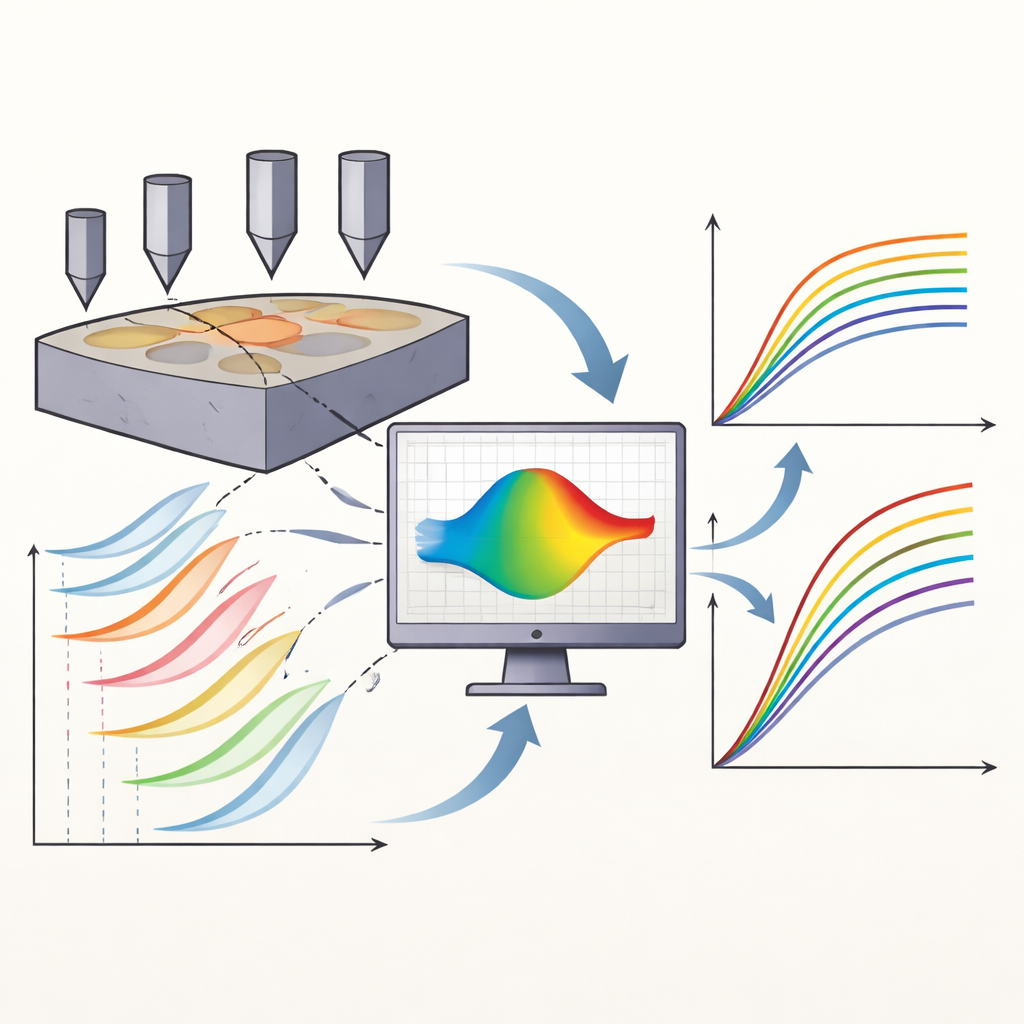
To link these fingerprints to the underlying material rules, the researchers built a detailed computer simulation of the indentation process using a standard engineering code. In the simulation, they assumed the metal follows the Zerilli–Armstrong model, a widely used formula for metals under impact that includes the effects of strain, strain rate, and temperature. The catch is that this model contains several unknown constants. Instead of testing every possible combination directly—which would require an enormous number of simulations—they turned to surrogate modeling. First, they sampled 36 different sets of possible constants and ran simulations for each, measuring how far the simulated load‑depth curve deviated from the real one. Then they used these results to train a surrogate: an inexpensive mathematical stand‑in that approximates how the error depends on the model constants. A particle‑swarm optimization algorithm then searched this surrogate landscape to find the set of constants that best matches the experiments.
Checking against traditional tests and other smart tools
To verify that this streamlined approach really works, the authors compared their findings to independent data from conventional Hopkinson bar experiments on the same steel at the same impact rates and temperatures. Using the optimized Zerilli–Armstrong constants, they predicted full stress–strain curves and found that these closely matched the Hopkinson measurements. They also repeated the exercise using two other strategies: a more conventional optimization based on a quadratic formula combined with a genetic algorithm, and an artificial neural network trained to predict the constants. The surrogate model and the genetic‑algorithm method produced nearly identical material constants and very similar errors, while the neural network also performed well but showed slightly larger and more scattered discrepancies.
What this means for real‑world testing
In plain terms, the study demonstrates that a relatively simple impact indentation test, coupled with numerical simulation and a surrogate‑based optimizer, can reliably recover how a ductile metal responds to fast loading and heat—information that once demanded specialized wave‑based equipment. The method needs only small samples, can in principle be applied directly on real components, and handles a wide range of loading rates and temperatures. For engineers, this offers a faster and cheaper route to build accurate digital models of metals used in vehicles, structures, and protective systems, paving the way for safer designs without the burden of elaborate high‑speed test setups.
Citation: Majzoobi, G.H., Pourolajal, S. Determination of the parameters of a material constitutive relation using the surrogate model along with dynamic indentation test. Sci Rep 16, 9269 (2026). https://doi.org/10.1038/s41598-025-06192-6
Keywords: dynamic indentation, surrogate modeling, high strain rate metals, material characterization, stress–strain behavior