Clear Sky Science · en
Optimization and prediction of peak temperature in friction stir welding of Al 6061 T6 using statistical and machine learning techniques
Why keeping welds cool matters
From airplanes to electric cars, many machines rely on aluminum parts that must be joined without weakening them. Friction stir welding is a popular way to do this, because it stirs pieces together without fully melting the metal. But if the process runs too hot, the aluminum can soften, lose strength or even melt. This paper explores how to predict and control the highest temperatures reached during welding of a common alloy, Al 6061 T6, using computer simulation, smart statistics and machine learning so that manufacturers can get strong, consistent joints while avoiding thermal damage.
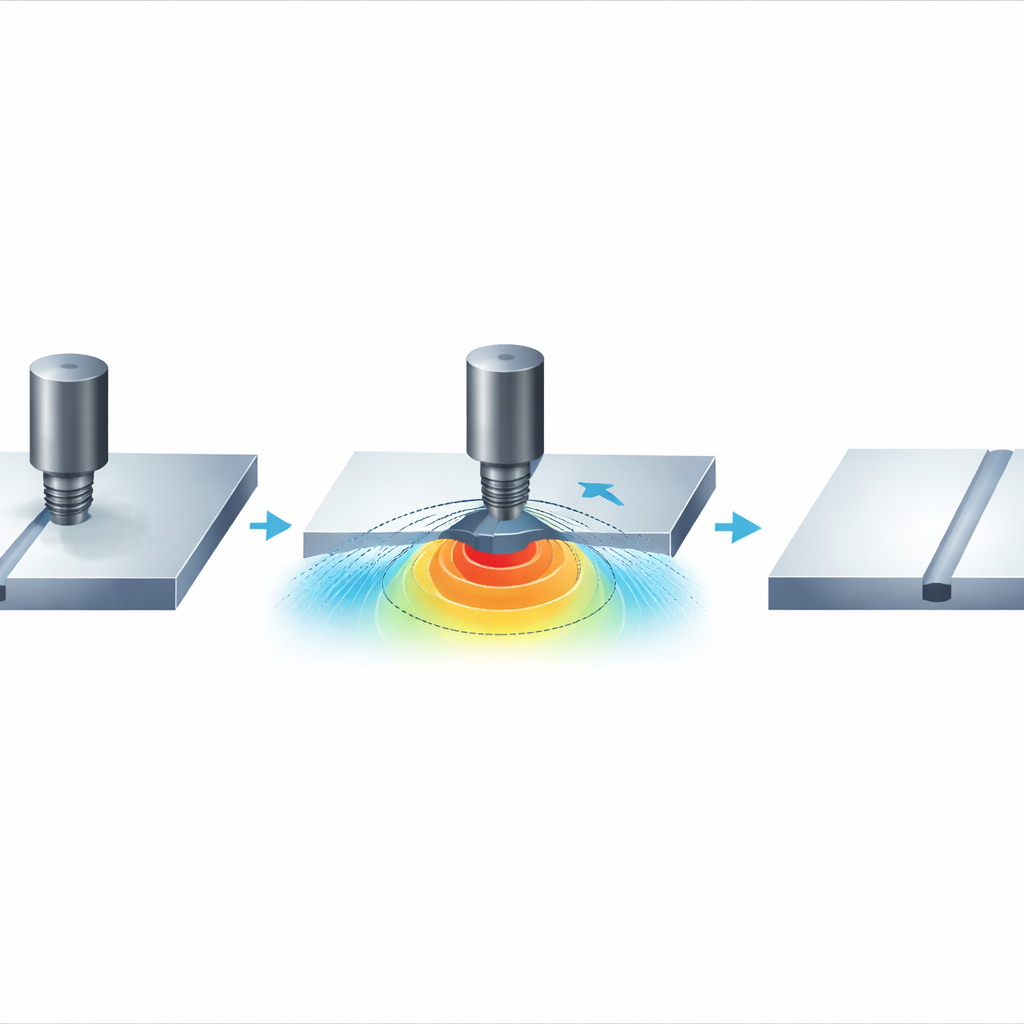
How this solid-state weld works
In friction stir welding, a rotating tool shaped like a short pin with a wide shoulder is pressed into the joint between two plates and moved along the seam. Friction and plastic stirring heat and soften the metal so it mixes and forges together without turning into liquid. For Al 6061 T6, this temperature “sweet spot” lies below the melting point but high enough to allow good mixing. If the peak temperature approaches or exceeds about four-fifths of the melting temperature, the alloy’s hardening particles can coarsen or the metal can begin to melt, leading to softer zones and poorer mechanical performance. Controlling peak temperature is therefore essential for both safety and durability.
Testing many knobs at once
The researchers focused on seven knobs that welders can turn: tool material, pin diameter, shoulder diameter, rotational speed, travel speed, axial force pressing the tool down, and the friction between tool and plate. Instead of running thousands of trials, they used a Taguchi design, a statistical shortcut that selects a carefully chosen set of 32 combinations to reveal which knobs matter most. For each combination, they built a three-dimensional computer model in COMSOL to simulate heat generation from the rotating tool and how that heat spreads through the aluminum plate and backing fixture. They then compared a subset of these simulations with experiments on a modified milling machine, using thermocouples to measure temperatures at different points around the weld. The simulated and measured peak temperatures matched within about 7%, giving confidence that the model captured the real thermal behavior.
Finding the main culprits behind overheating
With the simulation data in hand, the team applied statistical tools to sort out which process parameters had the greatest effect on peak temperature. Using Taguchi analysis and analysis of variance, they found clear leaders: axial force and tool rotational speed. Higher rotational speed and greater downforce generate much more frictional heating and plastic deformation, driving peak temperatures upward; in some simulated cases, the weld zone temperature exceeded 600 °C, higher than the melting point range considered safe for this alloy. Changes in pin and shoulder size had a secondary effect by altering contact area, while the choice of tool material and small variations in friction coefficient had comparatively minor influence. These results suggest that careful control of speed and force is the most effective way to keep welds below damaging temperatures.
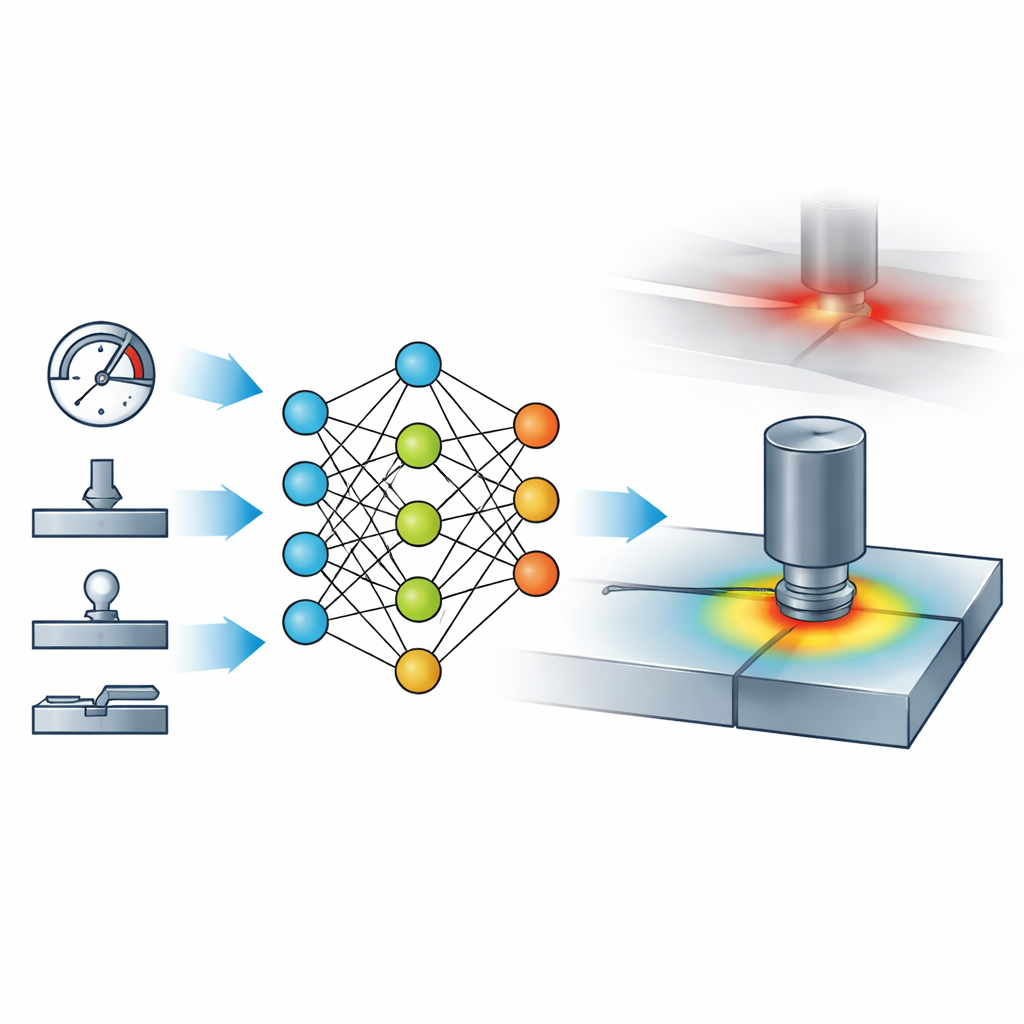
Letting a neural network predict the heat
To go beyond static rules of thumb, the authors trained a simple artificial neural network to learn the relationship between welding settings and peak temperature. They used the simulation results as examples, feeding in the six most relevant inputs (all knobs except tool material) and training the network to output the predicted maximum temperature. By splitting the data into training, validation and test sets and using a standard backpropagation method, the network learned to reproduce the simulation results with very high accuracy: its predictions differed from simulation by about 1% on average, better than the 3–4% errors from the Taguchi regression and ANOVA-based formula. This shows that even with a relatively small dataset, a well-designed neural network can capture subtle interactions among parameters that simpler models miss.
What this means for real-world welding
The study concludes that combining finite element simulations, statistical design and neural networks offers a powerful toolkit for making friction stir welding both safer and more efficient. By identifying axial force and rotational speed as the dominant drivers of heat, and by providing a fast predictor for peak temperature, the approach can guide engineers to pick settings that avoid overheating while still producing sound joints. In practical terms, this means fewer defects, longer-lasting components and less trial-and-error on factory floors in aerospace, automotive and other industries that depend on lightweight aluminum structures.
Citation: Anis, A., Shakaib, M. & Hanif, M.S. Optimization and prediction of peak temperature in friction stir welding of Al 6061 T6 using statistical and machine learning techniques. Sci Rep 16, 7901 (2026). https://doi.org/10.1038/s41598-025-03217-y
Keywords: friction stir welding, aluminum alloys, thermal control, process optimization, neural network modeling