Clear Sky Science · en
Reinforcing role of graphene in high entropy alloy matrix composites
Why Stronger Metals Matter
From airplanes and rockets to power plants and next‑generation batteries, we rely on metals that can stay strong under extreme stress, heat, and wear. This study looks at a new class of materials that blend an ultra‑tough family of metal alloys with the remarkable stiffness of graphene, the single‑atom‑thick form of carbon. By zooming in to the atomic scale with computer simulations, the authors show how carefully adding and orienting graphene can make these already strong alloys even tougher and more reliable.
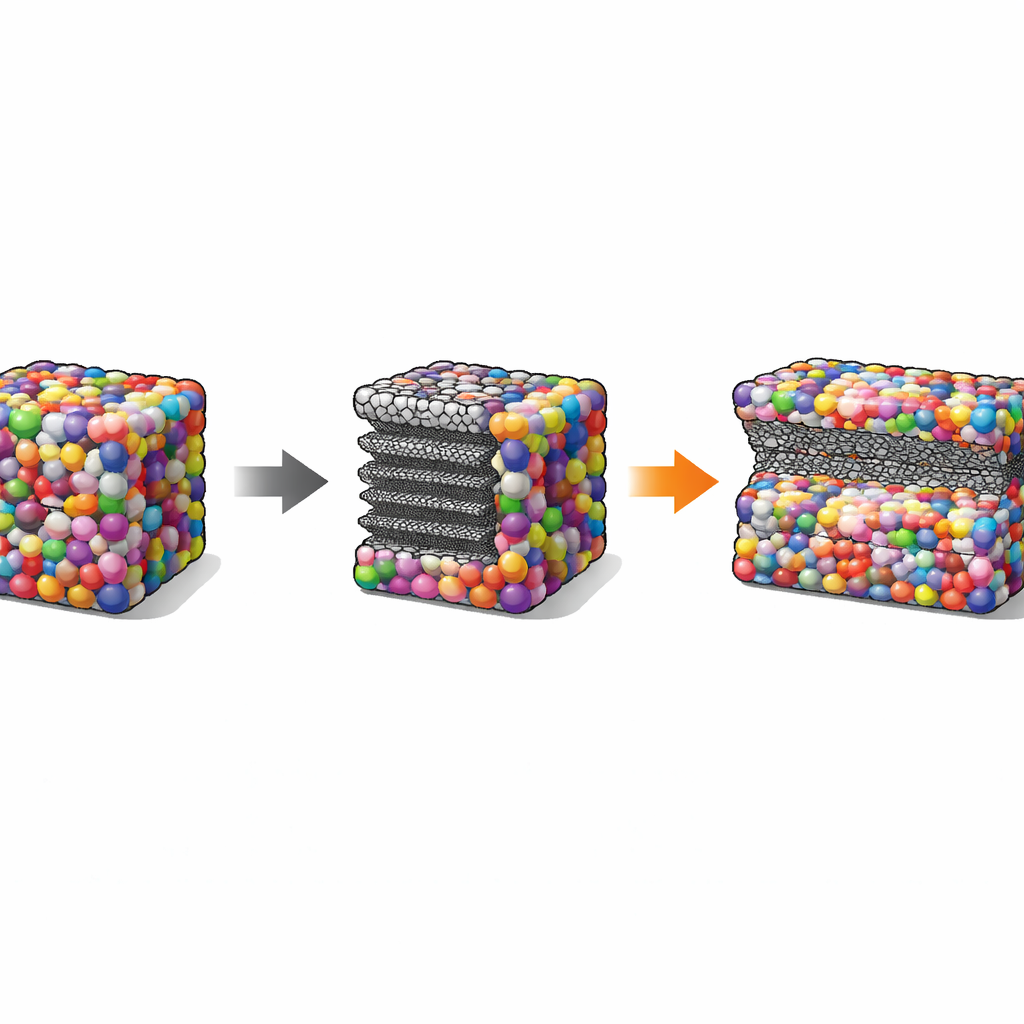
Blending a New Kind of Metal with a Wonder Sheet
The metal base in this work is a “high‑entropy alloy,” made by mixing roughly equal amounts of five elements: iron, nickel, chromium, cobalt, and copper. Unlike traditional alloys that are built around one main ingredient, these mixtures form a simple, stable crystal structure that is surprisingly strong and resistant to damage. The researchers embedded ultra‑thin graphene sheets inside this alloy and then stretched the resulting composite in computer models to see how it would behave. They varied how much graphene was present, which way the graphene sheets were oriented relative to the pulling direction, and whether the graphene was perfect or contained tiny missing atoms, known as vacancies.
How Graphene Makes the Metal Tougher
The simulations show that adding more graphene steadily increases how stiff and strong the composite becomes—up to a point. When the graphene sheets are aligned so that their strongest internal bonds line up with the pulling direction, the material can carry stresses around 30 gigapascals, far above the plain alloy. This happens because the graphene shares the load with the surrounding metal and acts as a barrier to tiny internal shifts in the metal’s atomic layers, known as dislocations. As the metal is stretched, these dislocations pile up against the graphene, making it harder for the material to deform further and causing a kind of atomic‑scale traffic jam that strengthens the whole structure.
Direction Matters for Strength
The study also reveals that this graphene‑metal partnership is highly directional. When the composite is pulled along the so‑called zigzag direction of graphene, where its strongest carbon‑carbon bonds lie, the material is noticeably stronger than when pulled along the armchair direction. In contrast, pulling the material “through” the graphene layers, out of their plane, gives much lower strength. In that case, only weak attractions hold neighboring layers together, allowing the sheets to bend and even peel away from the metal, which encourages early cracking and failure. This directional behavior, or anisotropy, means designers can tune how the material is built and oriented to best match the loads it will face in real applications.
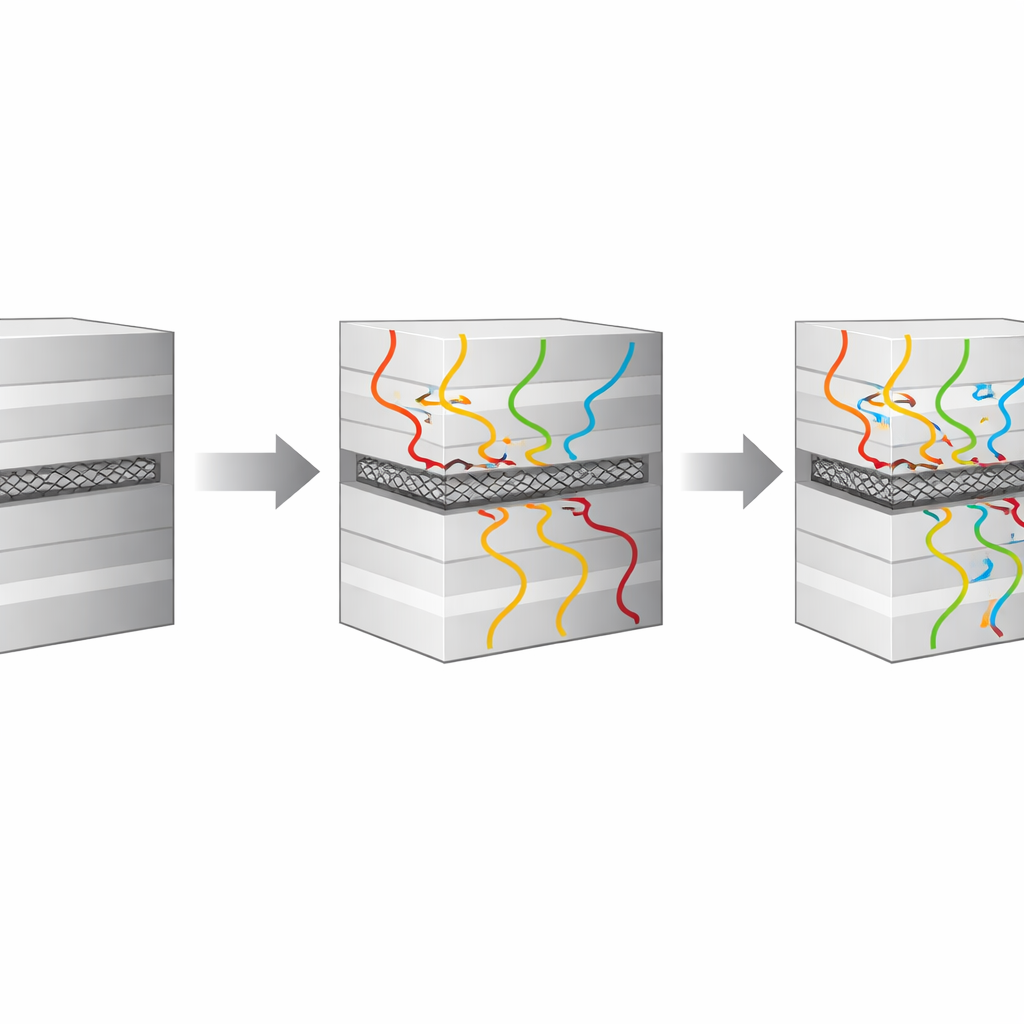
Interfaces, Layers, and Tiny Flaws
The connection between graphene and the surrounding alloy turns out to be both uniform and robust. A special type of simulation, where a graphene sheet is slowly pulled out of the metal, shows that the interface resists sliding with a high shear strength, helping the two components share load effectively. Stacking more graphene layers further boosts stiffness and strength and delays the onset of damage, because multiple sheets can arrest and tangle dislocations more effectively than one. However, the material is sensitive to atomic‑scale flaws in the graphene: introducing just one percent missing atoms cuts the tensile strength by nearly a quarter and the stiffness by about a quarter as well, underscoring how important clean, high‑quality graphene is for performance.
What This Means for Future Materials
Taken together, the results suggest that combining high‑entropy alloys with carefully arranged graphene sheets could yield a new generation of structural materials that are light, strong, and durable, even at high temperatures. By choosing the right amount of graphene, stacking it in multiple layers, and aligning it along the directions where it carries load best, engineers can tailor these composites for demanding uses in aerospace, energy, and advanced machinery. At the same time, the work highlights practical limits: out‑of‑plane loading and atomic‑scale defects can significantly weaken the material. Understanding these atomic‑level details offers a roadmap for turning graphene‑reinforced high‑entropy alloys from a promising idea into reliable components in real‑world technologies.
Citation: Islam, Z., Mayyas, M. Reinforcing role of graphene in high entropy alloy matrix composites. Sci Rep 16, 9172 (2026). https://doi.org/10.1038/s41598-025-02219-0
Keywords: graphene composites, high-entropy alloys, atomic-scale strengthening, metal matrix nanocomposites, advanced structural materials