Clear Sky Science · en
Microbial membrane transport genes in maize rhizosphere under fertilization – a preliminary study
Why Tiny Soil Helpers Matter for Our Food
Beneath every maize field lies a bustling underground world of microbes that quietly help crops find food. This study peeks into that hidden universe to ask a practical question: how does the way we fertilize soil change what these microbes can do? By reading the DNA of microbes living on maize roots, the researchers show that compost and chemical fertilizers do not just feed plants directly—they also reshape the genetic toolkit microbes use to move nutrients and other molecules in and out of their cells.
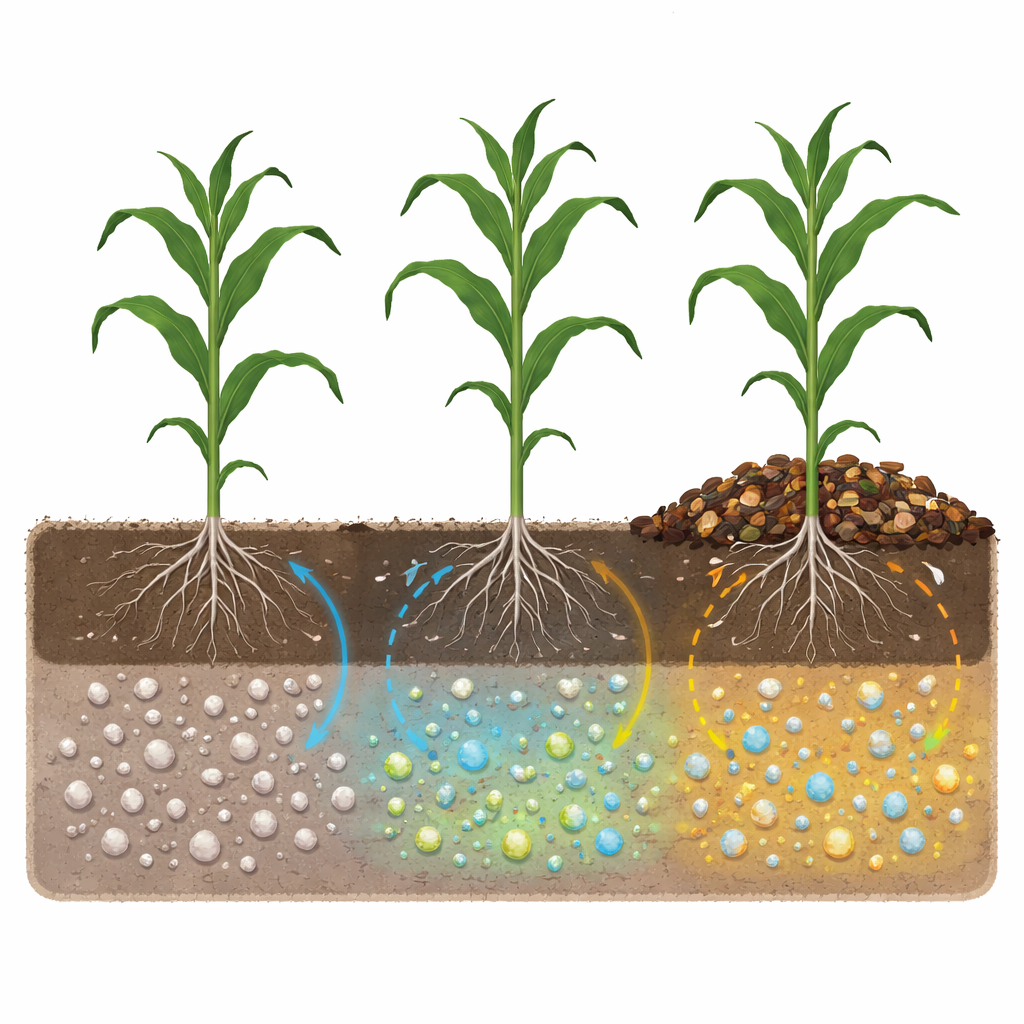
The Busy World Around Maize Roots
Plant roots are surrounded by a thin zone of soil called the rhizosphere, where roots, nutrients, and microbes constantly interact. In this study, maize was grown in plots receiving either compost, chemical fertilizer, lower doses of each, or no fertilizer at all. The scientists collected soil tightly clinging to the roots and extracted microbial DNA from it. Instead of growing microbes in the lab one by one, they used a metagenomic approach, sequencing all the DNA directly from the soil. This allowed them to see which kinds of genes were present in the entire microbial community, with a special focus on genes that build transport proteins—tiny molecular gates in microbial membranes.
Gatekeepers of Microbial Life
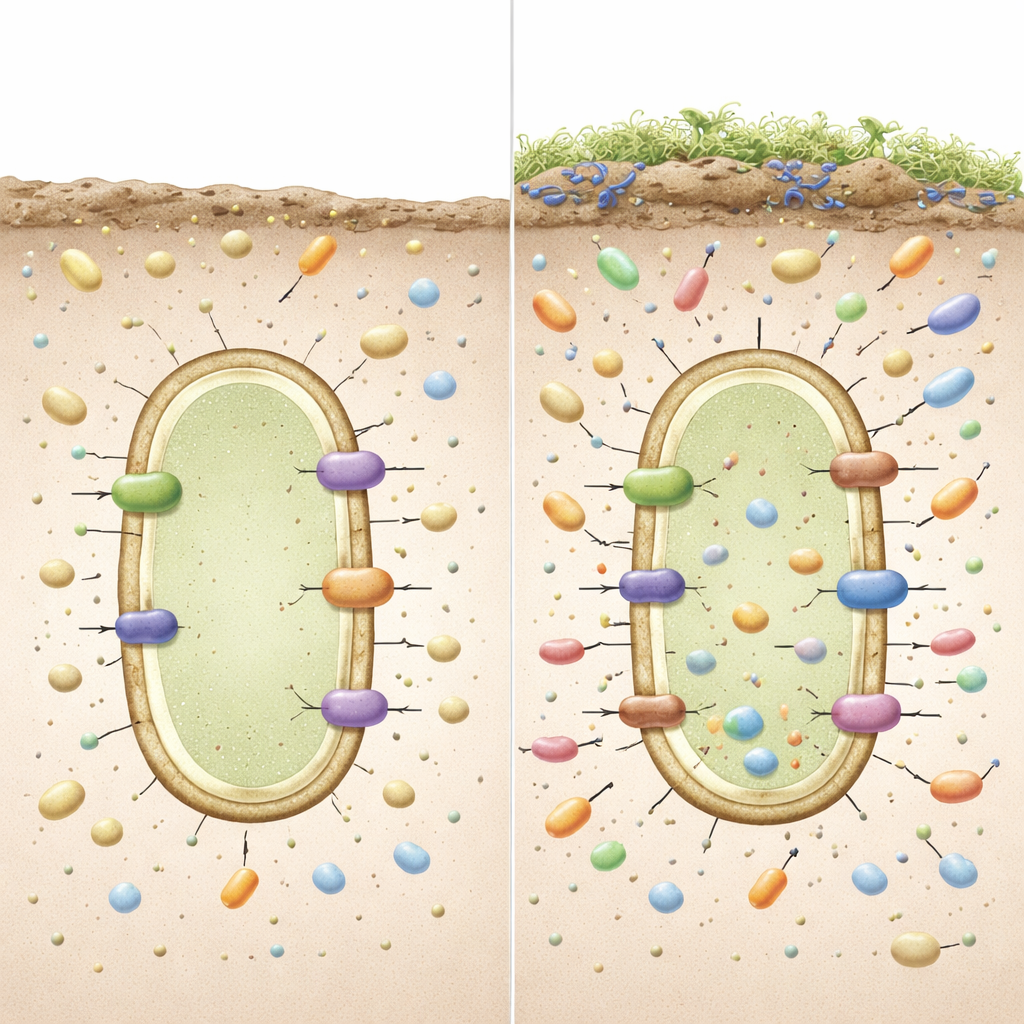
Transport proteins sit in the outer layer of microbial cells and control what gets in and out. Some act as importers, pulling in sugars, vitamins, amino acids, metals, phosphorus, sulfur compounds, and small peptides that microbes use as food or building blocks. Others are exporters, pushing out enzymes, toxins, and pieces of cell wall, or helping rid the cell of harmful substances. The genes for these transport systems often sit in clusters called operons, which encode parts of the same molecular machine: a binding component that recognizes a nutrient, a gate in the membrane, and an energy‑using unit that powers transport. Because they are so central to nutrition and survival, the number and type of transport genes in soil microbes give a strong clue about how actively they are foraging and interacting with their environment.
Compost Supercharges Microbial Gateways
Across all treatments, the researchers found 87 families of membrane transport genes grouped into 32 operon types—a rich toolbox for moving molecules across microbial membranes. But these genes were not evenly distributed. Plots fertilized with the higher compost dose (8 tons per hectare) had the highest relative abundance of key transport genes, while heavily mineral‑fertilized or lightly composted plots had much lower levels. Among the most enriched were genes that move short protein fragments called dipeptides and tripeptides, genes that transport hydrophobic branched‑chain amino acids, and genes that bring in sulfur‑containing compounds. A major exporter gene, secA, which helps push newly made proteins out of the cell, was also especially common under high compost.
Patterns Hidden in Microbial Diversity
Using statistical tools that measure diversity, the team showed that the variety and balance of transport genes differed significantly among fertilization treatments. However, the overall composition of gene types between treatments was not completely reshuffled; instead, certain genes became much more prominent under specific nutrient regimes. Graphical analyses that place samples in a two‑dimensional space based on their genetic makeup revealed that high‑compost plots separated clearly from high‑chemical‑fertilizer plots and from unfertilized soil. This separation was largely driven by the overrepresentation of peptide, amino acid, phosphorus, and sulfur transport genes in the compost‑treated rhizosphere, suggesting that rich organic inputs stimulate microbes to invest heavily in molecular machinery for capturing complex nutrients.
What This Means for Farming and Soil Health
To a non‑specialist, the take‑home message is straightforward: not all fertilizers are equal in how they shape the underground life that supports crops. Compost, especially at higher doses, encourages microbial communities whose DNA is packed with genes for importing and exporting a wide range of nutrients. This means microbes are better equipped to break down organic matter, recycle key elements like nitrogen, phosphorus, and sulfur, and feed both themselves and the plant. Heavy reliance on mineral fertilizer alone appears less effective at building this kind of active, diverse microbial network. The study suggests that applying ample organic fertilizer is a more sustainable way to boost soil fertility, support beneficial root‑microbe partnerships, and ultimately maintain healthy, productive maize fields.
Citation: Enebe, M.C., Babalola, O.O. Microbial membrane transport genes in maize rhizosphere under fertilization – a preliminary study. Sci Rep 16, 7871 (2026). https://doi.org/10.1038/s41598-024-80606-9
Keywords: soil microbiome, maize rhizosphere, organic fertilizer, membrane transport genes, compost manure