Clear Sky Science · en
An ontology-based description of nano computed tomography measurements in electronic laboratory notebooks
Why keeping track of experiments matters
Modern experiments at large X-ray facilities can image the inner structure of materials in stunning detail, down to billionths of a meter. But these measurements only remain useful if scientists can precisely remember how they were done: which settings were used, which sample was tested, and under what conditions. This article describes a new way to capture that surrounding information – the metadata – so that complex nano-scale X-ray experiments are not just recorded, but can be reliably found, understood, and reused years later by both humans and machines.
Big X-ray machines and even bigger data
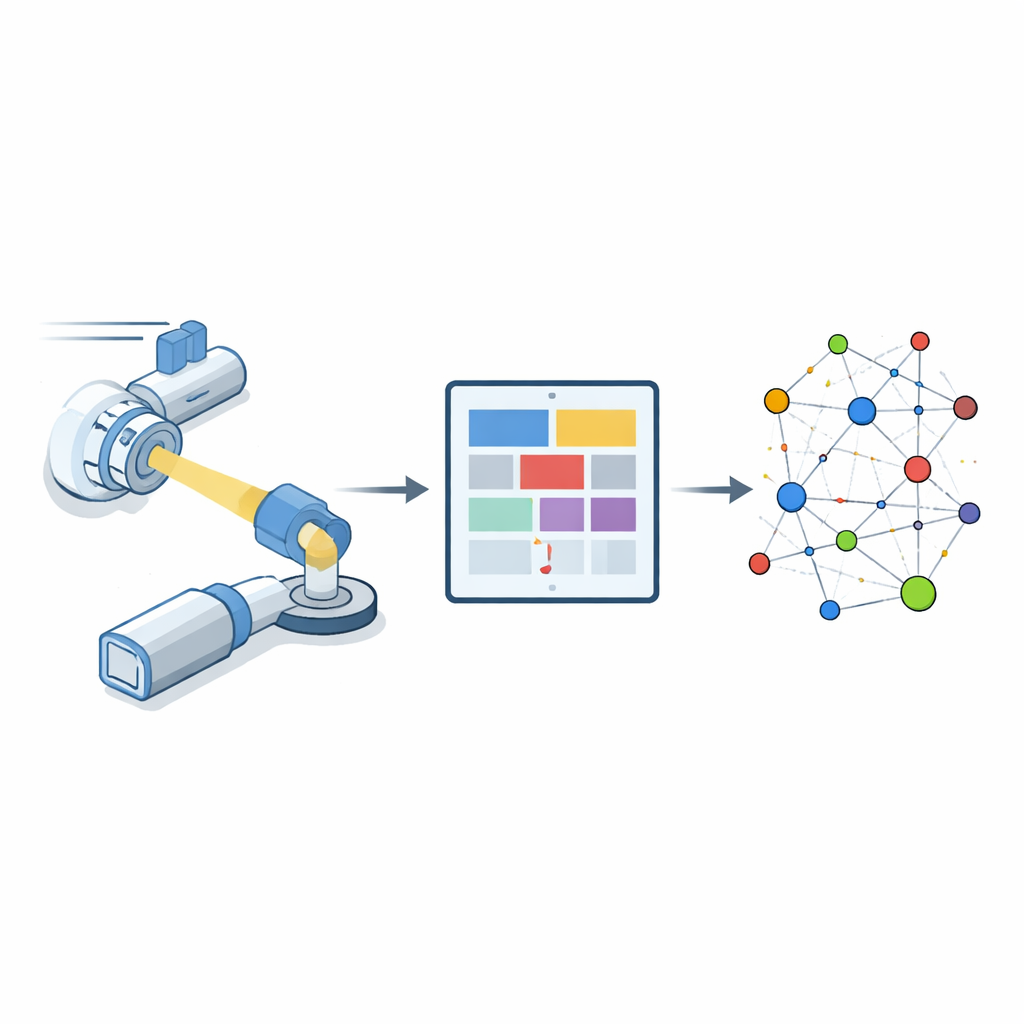
Synchrotron radiation-based nano computed tomography (SRnCT) is a type of three-dimensional X-ray imaging that reveals the fine inner structure of materials and biological samples. These measurements produce huge volumes of raw images, but just as important is the story around them: how the beamline was configured, which detector was used, the temperature and flow of liquids around the sample, and who carried out the work. At synchrotron beamlines, this setup changes every few days as new visiting teams arrive with different needs. Without careful, consistent documentation, it becomes almost impossible to compare experiments, repeat them, or use the data in computer models and machine learning.
From simple forms to smart, structured records
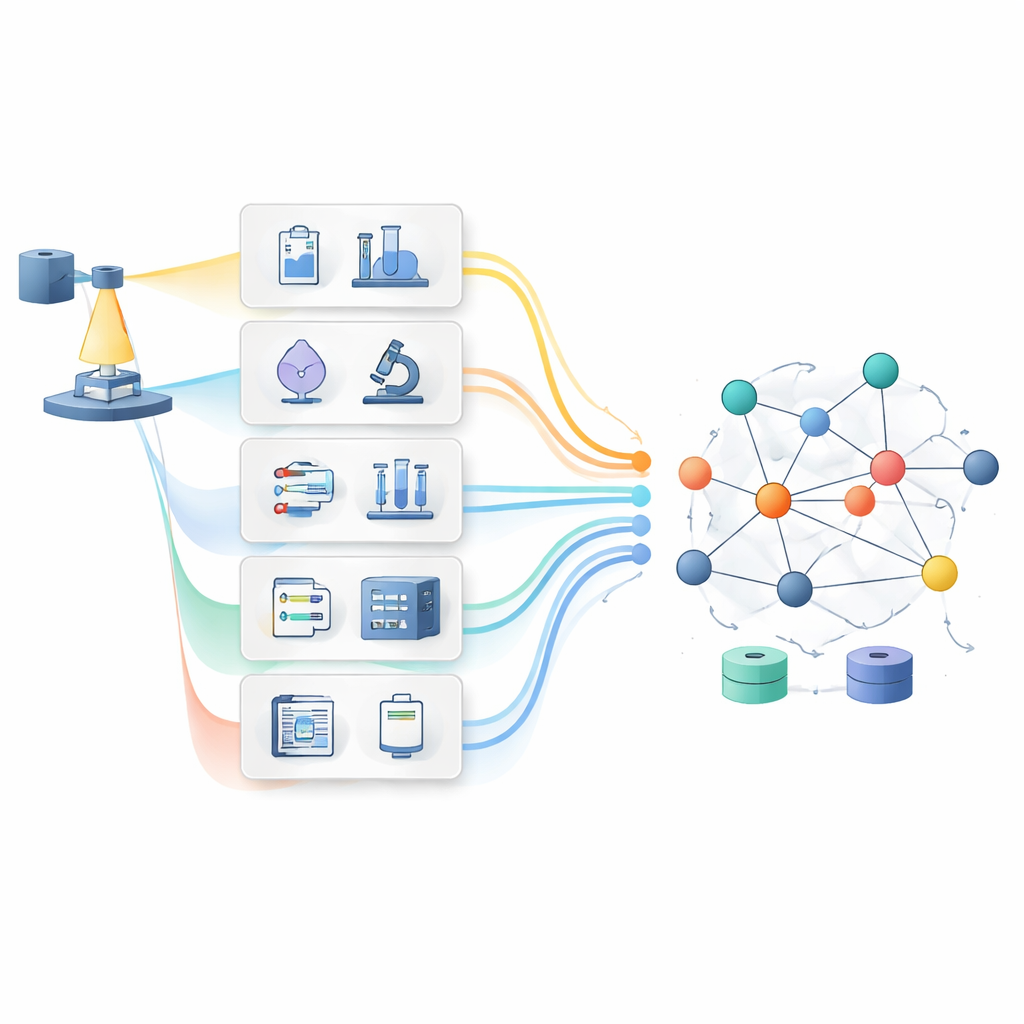
The authors tackle this challenge by starting with something scientists already understand: a structured checklist for what should be written down. They worked with beamline staff to design a detailed metadata "tree" for nano tomography scans. It divides each measurement into intuitive blocks, such as information about the experiment as a whole, the people involved, the sample, the measurement conditions, the instrument layout, and the resulting data. This structure is similar to what might be kept in a carefully organized spreadsheet or paper notebook, but it is precise enough that a computer can interpret every field in a consistent way.
Teaching the notebook what the words mean
To move beyond simple forms, the team linked this checklist to a formal "ontology" – a shared dictionary that tells a computer what each term means and how different pieces of information relate to one another. They built on existing community vocabularies from materials science so that their work would connect smoothly with other databases. Using the semantic electronic lab notebook Herbie, they turned the ontology into web forms that scientists see in their browser. Herbie automatically enforces which fields are required, how numbers and units must be entered, and how entries such as beamline settings or sample environments are reused across multiple scans. Behind the scenes, every click and value is stored as a node in a knowledge graph, a network-like data structure that is ideal for rich, interconnected information.
Putting the system to the test
The researchers evaluated this approach during a demanding in situ experiment in which magnesium wires, intended for use as biodegradable implants, were imaged while they slowly corroded in a fluid similar to body serum. As the experiment progressed, scientists used Herbie to record beamtime identifiers, sample details, precise information on temperature, flow rate and X-ray optics, and where the raw and processed data were stored. Because common elements such as the beamline layout changed little between scans, they only had to be entered once and then reused, cutting the per-scan documentation time down to just a few minutes. The resulting knowledge graph allowed the team to ask targeted questions – for example, "what were the energy, flow rate and system temperature for each scan?" – and obtain immediate answers using standard query tools, without manually searching through notes.
Making future experiments easier to share and reuse
By combining a carefully designed metadata structure, a shared scientific dictionary, and an intelligent electronic lab notebook, this work shows how information about complex nano-scale X-ray experiments can be made truly FAIR: findable, accessible, interoperable and reusable. The approach ensures that each dataset is unambiguously linked to its experimental conditions, people and instruments, and that this information can be exchanged with other lab notebooks or data catalogues, or converted into standard XML files if needed. In practical terms, this means that future researchers will be better able to repeat experiments, compare results across beamlines, and feed high-quality, well-described data into simulations and machine-learning models – turning today’s carefully logged beamtime into tomorrow’s new discoveries.
Citation: Kirchner, F., Wieland, D., Irvine, S. et al. An ontology-based description of nano computed tomography measurements in electronic laboratory notebooks. Sci Data 13, 432 (2026). https://doi.org/10.1038/s41597-026-07052-2
Keywords: electronic lab notebooks, nano X-ray tomography, scientific metadata, knowledge graphs, FAIR data