Clear Sky Science · en
ErythroCite: a database on red blood cell size of fishes
Why tiny cells in fish matter to us
Hidden inside every drop of fish blood are red blood cells of astonishingly different sizes. These microscopic differences help determine how fish breathe, cope with warming oceans, and evolve over millions of years. The ErythroCite project brings together, for the first time, a global, open database of red blood cell sizes across hundreds of fish species—offering a new window into how life deals with the basic challenge of getting oxygen where it is needed.
Building a global catalog of fish blood cells
The authors set out to answer a deceptively simple question: how big are red blood cells in different kinds of fish, and how much do they vary? To do this, they combed through nearly 9,000 scientific records from multiple databases, in seven languages, searching for studies that reported measurements of fish red blood cells. After removing duplicates and applying strict rules—such as including only original data from clearly identified species and mature cells—they distilled these records down to 186 usable studies. From these, they extracted 1,764 individual records covering 660 fish species, making ErythroCite the most comprehensive collection of fish red blood cell size data assembled so far.
From scattered numbers to a unified resource
Turning scattered measurements into a coherent resource required more than just copying values into a spreadsheet. In many papers, researchers had only reported the length and width of cells and their nuclei, not their area or volume. The team therefore used standard mathematical formulas, treating each cell as an oval or slightly flattened sphere, to calculate the missing traits. They also gathered extra details wherever possible—such as where the fish came from, their body size, sex, and life stage—and converted vague location descriptions into map coordinates. When studies provided body length instead of mass, the team relied on the FishBase database to estimate body weight, allowing comparisons across species.
Checking names, relationships, and data quality
To make the database truly useful, the authors ensured that every species name was current and correctly placed on the fish family tree. They cross-checked scientific names against several global taxonomic databases and reconciled inconsistencies, ultimately keeping only well-defined species-level entries. Using the Open Tree of Life, they linked 629 of the 660 species into a single evolutionary tree and noted which habitats each species occupies—freshwater, marine, brackish, or combinations of these. They then carefully examined the numerical data itself, plotting the distributions of all cell and nucleus measurements to spot possible errors or outliers. Suspect values were checked against the original papers and corrected when needed, and units were standardized so that cell and nucleus areas and volumes could be compared fairly across studies.
What the numbers reveal about fish diversity
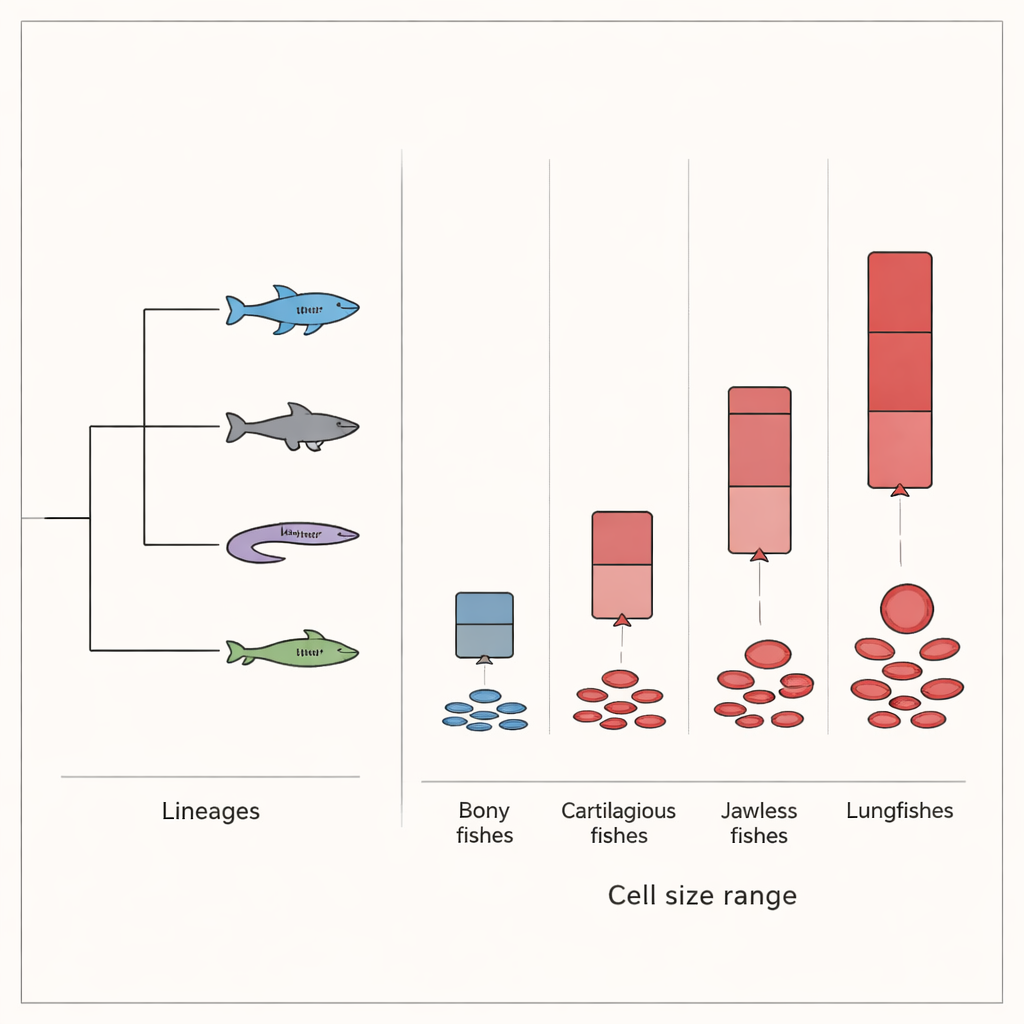
The compiled data show that fish red blood cells span an enormous 414-fold range in volume, with most information coming from bony fishes but also including sharks and rays, jawless fishes, and lungfishes. Yet the database also exposes important blind spots: juveniles and early life stages are rarely measured, and many studies omit basic information such as sex or precise origin of the fish. Despite these gaps, ErythroCite already allows scientists to explore big-picture questions, such as how cell size is linked to metabolism, how it varies among lineages, and how it might shift with environmental temperature or oxygen levels. The authors anticipate that statistical methods can be used to fill in some of the missing values based on evolutionary relationships, further strengthening the resource.
Why this matters beyond the lab
To a non-specialist, the size of a blood cell might sound like a minor detail, but it ties directly into how efficiently an animal moves oxygen, grows, and survives in changing environments. By offering an open, well-checked database of fish red blood cell sizes, ErythroCite gives researchers a powerful tool to study how fish are adapted to their habitats—from warm rivers to icy polar seas—and how they may respond as waters warm and oxygen conditions shift. In simple terms, this work turns countless separate measurements into a global map of cell diversity, helping us understand how the smallest building blocks of life shape the fate of entire species.
Citation: Leiva, F.P., Molina-Venegas, R., Alter, K. et al. ErythroCite: a database on red blood cell size of fishes. Sci Data 13, 307 (2026). https://doi.org/10.1038/s41597-026-06904-1
Keywords: fish red blood cells, cell size, oxygen and temperature, evolutionary adaptation, trait databases