Clear Sky Science · en
WearGait-PD: An Open-Access Wearables Dataset for Gait in Parkinson’s Disease and Age-Matched Controls
Why How We Walk Matters
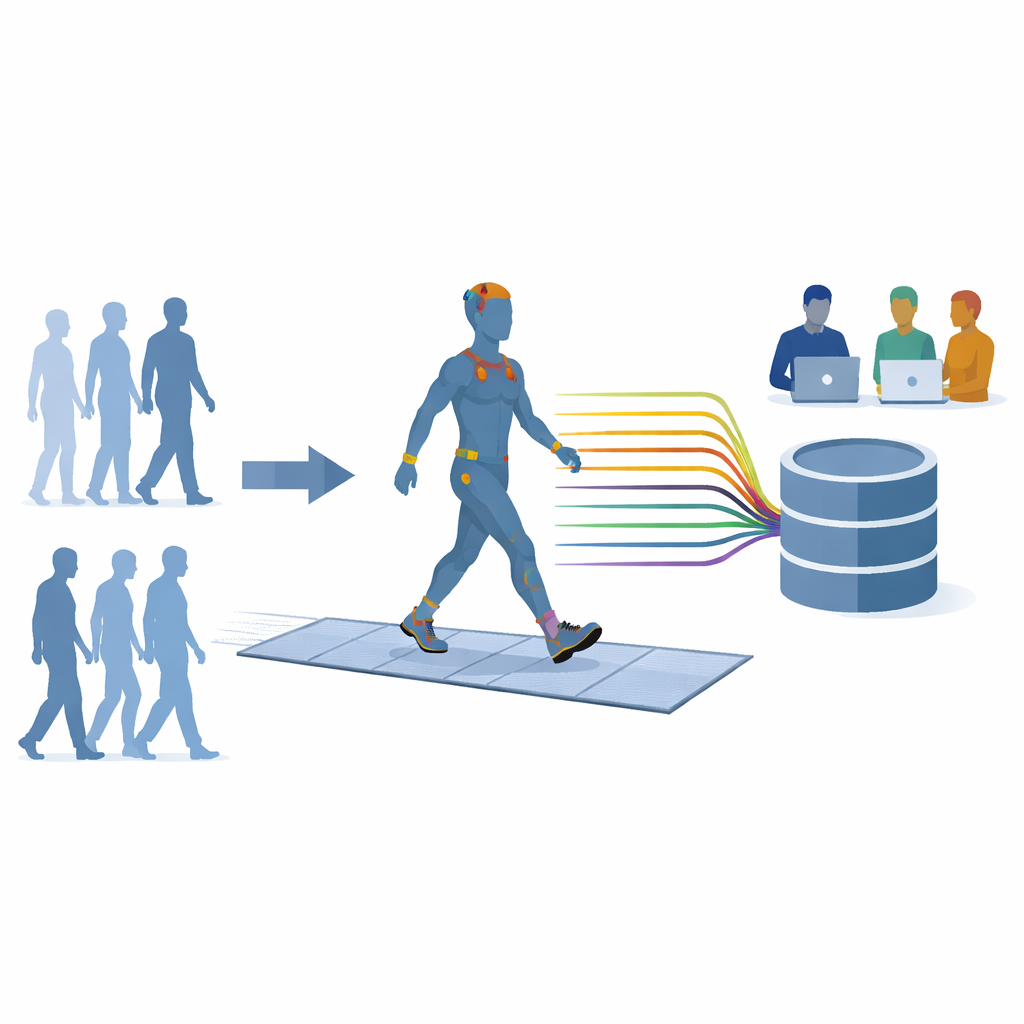
Walking is something most of us take for granted, but for people living with Parkinson’s disease, each step can be a challenge. Doctors know that changes in walking and balance are central to this condition, yet they still rely heavily on what they see during brief clinic visits and what patients remember to report. This article introduces WearGait-PD, a large, openly shared collection of detailed movement data gathered from people with Parkinson’s and older adults without the disease. By making these measurements available to anyone, the project aims to speed up the creation of better tests, treatments, and digital tools that can track walking and balance in everyday life.
From Clinic Checklists to Digital Footprints
Traditionally, doctors assess Parkinson’s disease with rating scales and observation: they watch a patient walk down a hallway, turn, stand still, and then assign scores. These methods are valuable but inherently limited—they capture just a few minutes in a clinic and depend on human judgment. At the same time, wearable technologies such as motion sensors and smart shoe inserts have grown powerful and affordable. They can record how a person moves, second by second, over many steps and tasks. Yet progress has been slowed by a basic problem: collecting high-quality data from many people with Parkinson’s is expensive and time‑consuming, so only a few well‑funded groups can do it, and they often keep the data private.
Building a Shared Resource of Real Steps
The WearGait-PD project set out to remove that barrier by assembling a rich, public dataset. The team recorded 185 volunteers: 100 people with Parkinson’s disease and 85 older adults of similar age without it. Participants completed a series of walking and balance tasks, such as strolling at a comfortable speed, hurrying, walking heel‑to‑toe, standing in challenging positions, navigating a doorway, and following a short indoor path that included hallways and a chair. For each person, these tasks produced multiple trials, together yielding more than 1,500 recordings of movement. Alongside the sensor data, the researchers collected medical information such as age, disease severity scores, medication use, and whether a person had a brain implant to manage symptoms.
Wiring Up the Body and the Floor
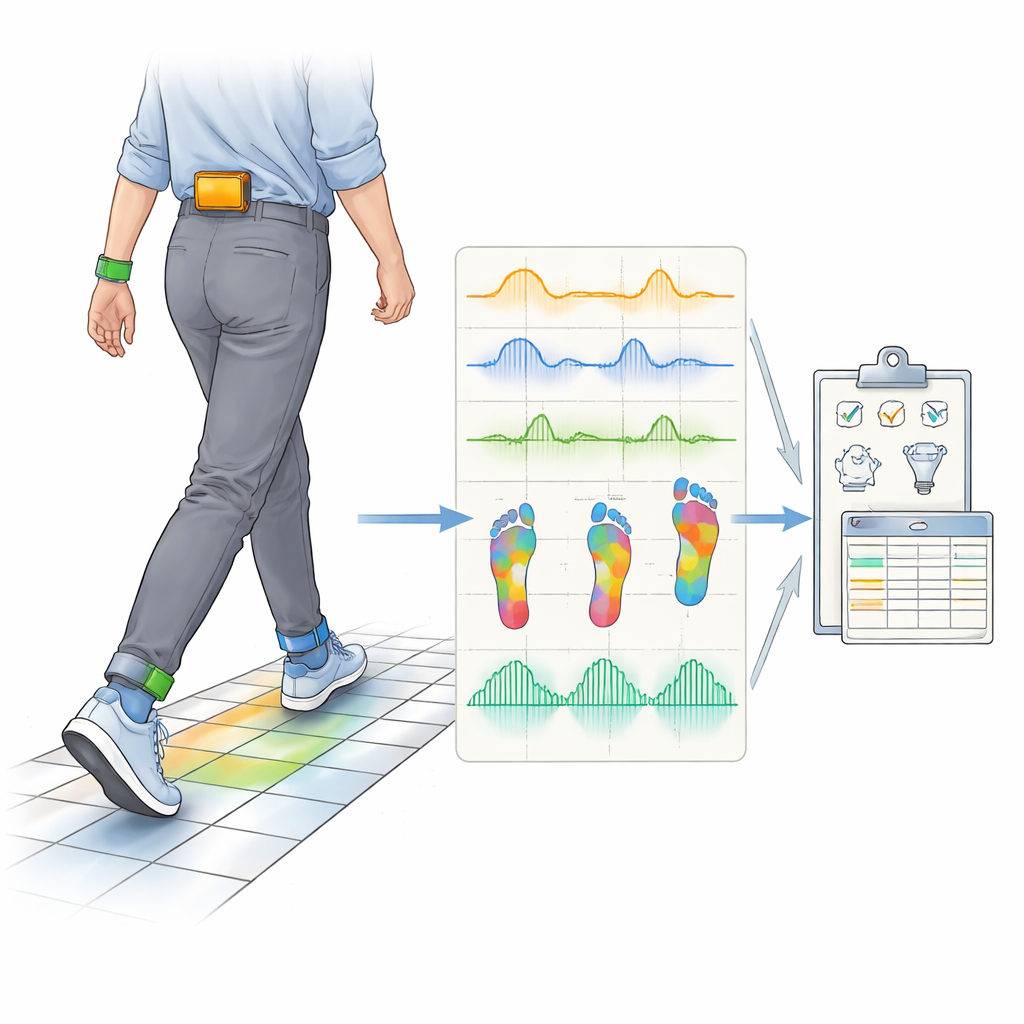
To capture movement in detail, participants wore 13 tiny wireless motion sensors on the head, trunk, arms, legs, ankles, and tops of the feet, plus a smart insole inside each shoe. These devices measured acceleration, rotation, and pressure under the feet at high speed. Participants walked across a special pressure‑sensing walkway—a thin mat filled with thousands of small sensors that detect exactly where and how hard each step lands. Two video cameras, set up from the front and side, filmed every task. Later, trained reviewers used the videos to mark what each person was doing frame by frame, including episodes of freezing of gait and stumbles. All these streams—body sensors, insoles, walkway, and video annotations—were carefully synchronized down to hundredths of a second, so that a researcher can line up a step seen on camera with the exact signals from every sensor.
Turning Raw Signals into Trustworthy Data
Collecting so much information is only half the job; ensuring that it is clean and reliable is just as important. The WearGait-PD team used a shared protocol across three medical centers so that sensors were placed the same way on every participant. After each session, they reviewed and corrected the raw recordings. They fixed issues such as slight timing delays between systems, checked that each footfall was labeled correctly on the walkway, and confirmed that the wearable signals stayed within expected ranges. Every trial went through both automatic checks and human review, and any problems were either repaired or clearly flagged. The final dataset includes both perfectly complete trials and some with minor, well‑documented gaps, giving users a realistic view of what to expect in real‑world studies.
Opening the Door to New Tools
All WearGait-PD data are freely available through an online platform, under a license that encourages reuse while protecting participants’ privacy. Because the dataset links detailed movement signals with clinical scores and expert video markings, it provides an ideal testbed for inventing new algorithms, training machine‑learning models, and checking whether digital measures of walking truly reflect a person’s condition. In practical terms, this means that future apps, smart insoles, or home‑based monitors for Parkinson’s disease can be built and validated more quickly and fairly, using shared evidence rather than isolated private studies. For people living with Parkinson’s, that could translate into more accurate tracking of symptoms, better‑timed treatments, and a clearer picture of how their walking—and their daily life—is changing over time.
Citation: Anderson, A.J., Eguren, D., Gonzalez, M.A. et al. WearGait-PD: An Open-Access Wearables Dataset for Gait in Parkinson’s Disease and Age-Matched Controls. Sci Data 13, 440 (2026). https://doi.org/10.1038/s41597-026-06806-2
Keywords: Parkinson’s disease, gait, wearable sensors, open dataset, digital health