Clear Sky Science · en
TURB-Smoke. A database of Lagrangian pollutants emitted from point sources in turbulent flows with a mean wind
Why tracking invisible clouds matters
When harmful chemicals or foul odors are released into the air or water, they do not simply drift away in a smooth, predictable cloud. Instead, turbulence – the chaotic swirling motion of fluids – chops and stretches these plumes into a patchy, ever-changing landscape. This makes it hard to locate the original leak or source, whether you are an emergency responder dealing with a gas release, an engineer monitoring water quality, or a robotic sensor searching for a hazardous spill. The TURB-Smoke project introduces a new, openly available digital “wind tunnel” that captures this hidden complexity in fine detail, offering a realistic playground for scientists, ecologists, and roboticists who need to understand and track such invisible clouds.
A digital laboratory for messy flows
The authors built TURB-Smoke as a high-precision numerical experiment rather than a physical one. Using powerful computers, they solved the fundamental equations that govern fluid motion inside a virtual cube where the flow is fully turbulent, meaning it is filled with swirling eddies of many sizes. Within this synthetic but realistic environment, they placed five small sources that continually emit “smoke” made of many tiny, massless tracer particles. These particles represent pollutants or odors carried by the flow. In some runs, the flow is purely chaotic without an overall drift; in others, a steady wind is added, mimicking conditions ranging from calm air to strong gusts. The result is a controlled yet richly varied set of scenarios that mirror how real contaminants spread in the atmosphere or the ocean.
From individual particles to visible plumes
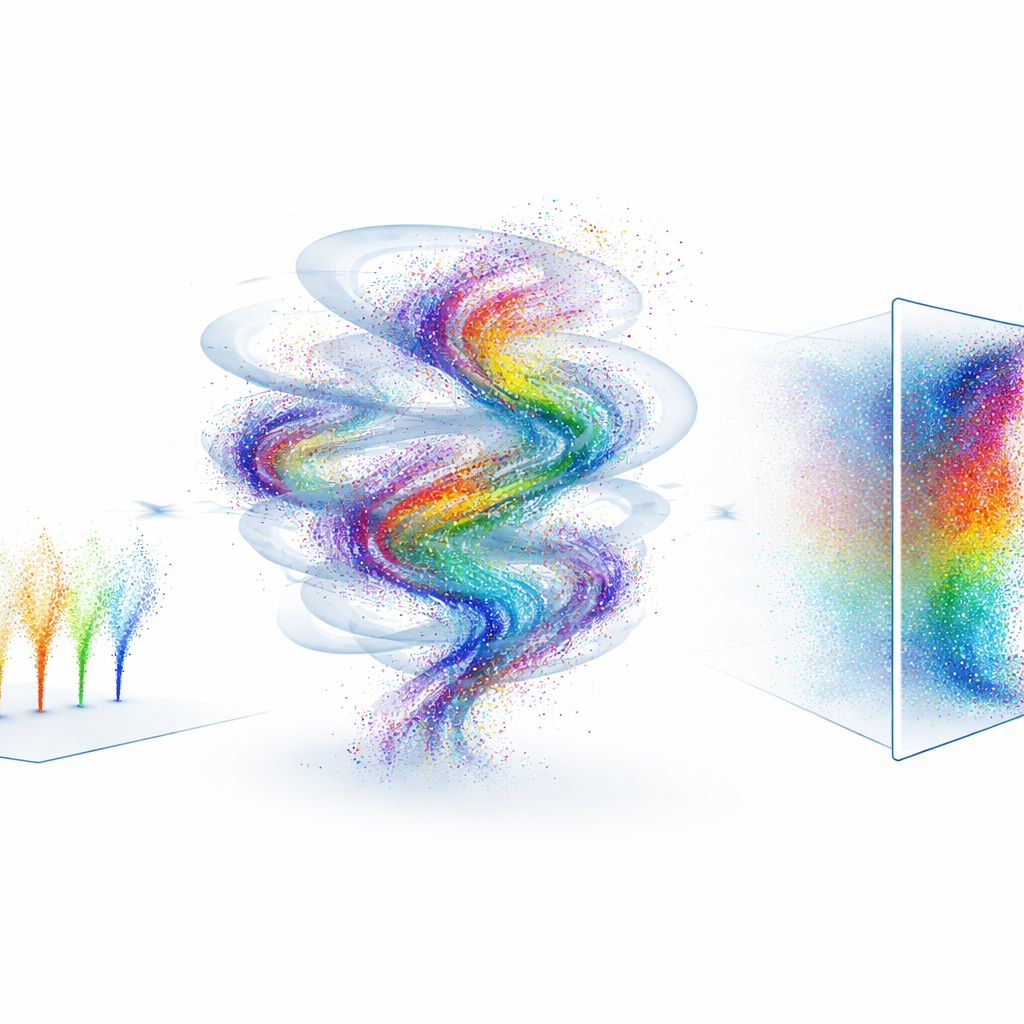
At the heart of the dataset is a detailed record of how each individual tracer moves. The simulation tracks hundreds of millions of particles, recording their positions and the local fluid velocity many times over the characteristic timescales of turbulence. This view, attached to the particles themselves, is called a Lagrangian description. It allows researchers to follow the “life story” of each bit of smoke as it leaves a source, gets trapped in whirling structures, and finally wanders far away. At the same time, the authors convert these raw trajectories into more familiar, camera-like views by counting how many particles pass through each cell of a coarse grid in three dimensions and in thin two-dimensional slices. These derived maps show where the concentration of pollutant is high or low at any instant, just like a weather radar image of rainfall intensity.
Capturing the role of wind and complexity
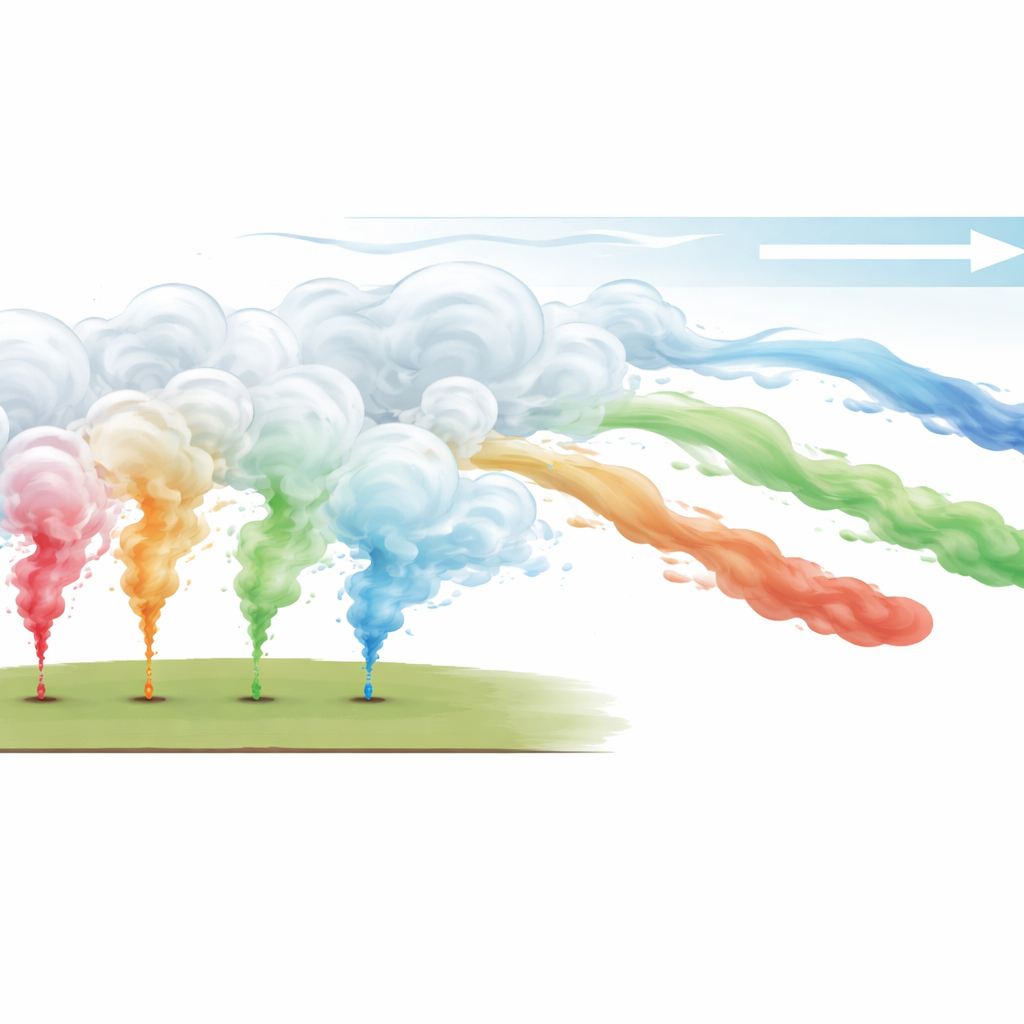
A key strength of TURB-Smoke is that it spans a range of background winds. With no mean wind, the plumes remain relatively compact and symmetric around the sources, but they still display sudden bursts and lulls as the turbulence rearranges them. As the wind picks up, the plumes are stretched downstream into long, filamentary structures. The authors tune the numerical grid so that these streaks are fully resolved while keeping the data size manageable. The resulting concentration fields show how the same source can create very different sensory experiences depending on the wind: a sensor might see frequent strong whiffs at short range under calm conditions, but only occasional, thin filaments of high concentration far downwind under strong flow. TURB-Smoke therefore exposes users to realistic spatiotemporal “patchiness” that simple textbook models miss.
A benchmark for search strategies and models
Because the underlying flow has been carefully validated against other state-of-the-art turbulence experiments and simulations, TURB-Smoke can act as a trustworthy benchmark. The authors show that the statistics of particle motion in their virtual cube match known signatures of real turbulent flows, including subtle departures from simple, bell-shaped distributions at short times. This matters because many search strategies for locating odor or pollutant sources – whether inspired by animal behavior or designed with artificial intelligence – rely on assumptions about how often strong cues appear and how independent successive detections are. With TURB-Smoke, developers of Bayesian search rules, reinforcement learning agents, or networks of static sensors can test their algorithms in a unified, realistic setting where the “ground truth” is fully known and controllable.
What this means for real-world problems
In practical terms, TURB-Smoke is a shared reference playground rather than a new theory. It does not solve pollution or leak detection by itself, but it gives scientists, engineers, and even ecologists a common, high-quality dataset to build upon. By making the particle trajectories, three-dimensional concentration fields, and two-dimensional slices freely accessible, along with example Python notebooks and an executable version of the simulation code, the authors lower the barrier for others to explore questions such as: How quickly can a robot find a hidden source? How should a network of sensors be arranged to detect a leak early? How do different search strategies fare when the wind changes? For a lay reader, the central message is that the spread of odors and pollutants in turbulent flows is far from random noise, and TURB-Smoke offers a detailed, open window into that hidden structure, enabling better tools to locate and contain harmful releases in the real world.
Citation: Biferale, L., Bonaccorso, F., Cocciaglia, N. et al. TURB-Smoke. A database of Lagrangian pollutants emitted from point sources in turbulent flows with a mean wind. Sci Data 13, 428 (2026). https://doi.org/10.1038/s41597-026-06774-7
Keywords: turbulent plumes, pollutant dispersion, odor search, Lagrangian particles, environmental monitoring