Clear Sky Science · en
Two-decade in-situ oceanographic and meteorological observations from Ieodo Ocean Research Station in the northern East China Sea
Why a Lonely Ocean Tower Matters
Far from shore in the East China Sea, a single steel tower has been quietly watching the sky and sea for more than twenty years. This station, perched above a submerged reef called Ieodo, has recorded every gust of wind, raindrop, and change in water temperature hour by hour. In a time when coastal communities, fisheries, and shipping routes are increasingly vulnerable to extreme weather and warming oceans, this long, unbroken record offers a rare window into how one of Asia’s busiest and fastest‑warming seas is changing. 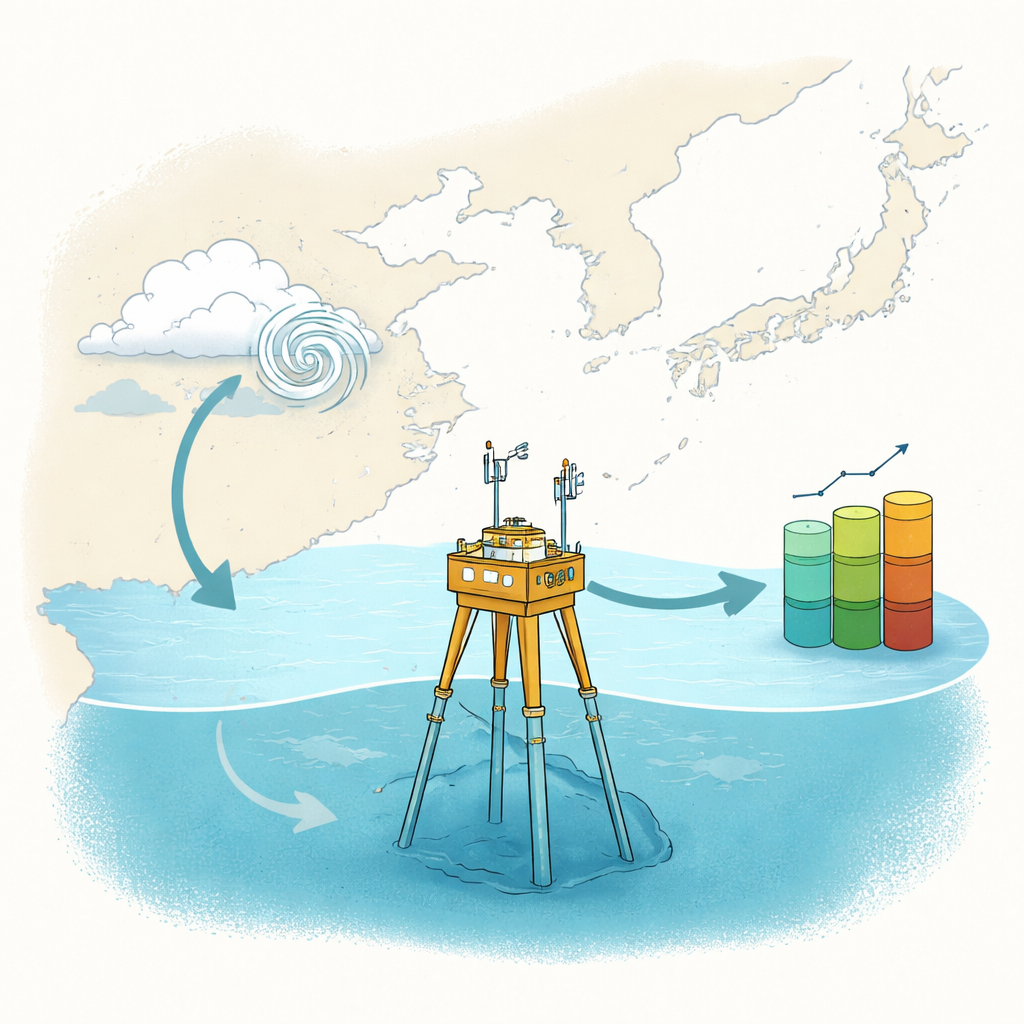
A Hotspot Sea Under Pressure
The East China Sea has become a climate hotspot, warming about twice as fast as the global average. That extra heat can ripple through the entire marine system: it can stress fish and shellfish, reduce microscopic plant life that forms the base of the food web, and intensify storms. Yet, despite this importance, direct measurements from the open sea are scarce. Satellites can only see the ocean surface, and computer models can miss short, sharp events or subtle changes with depth. The Ieodo Ocean Research Station was built in 2003 to fill this gap, standing roughly 150 kilometers southwest of Korea’s Jeju Island at the crossroads of powerful currents and along a major typhoon pathway.
A Tower Packed with Instruments
The station itself is a tall, open steel structure anchored to the seafloor about 40 meters down. On its upper decks, instruments measure air temperature, pressure, wind, humidity, and rain. Below the surface, a line of sensors tracks water temperature at three depths: near the surface, mid‑depth, and close to the bottom. Most measurements are taken every ten minutes and then combined into hourly values. Over two decades, engineers and scientists have kept the system running through harsh storms, salt spray, and biological growth on the equipment, ensuring that the record remains as continuous as possible. 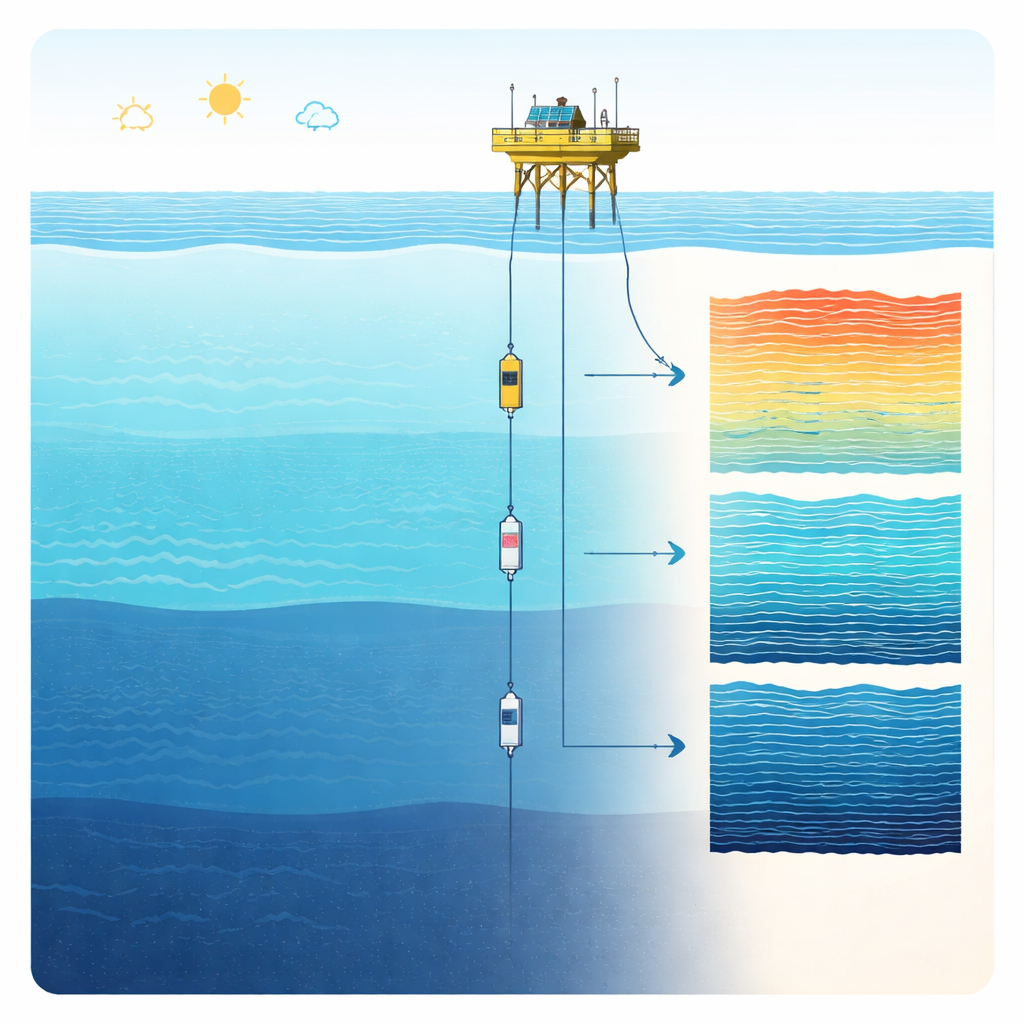
Cleaning and Checking the Record
Collecting data is only half the job; making sure it is trustworthy is just as critical. The research team runs all measurements through a multi‑step quality check. Computer routines first weed out impossible values, unusual jumps, or long stretches where sensors appear stuck. Human experts then review maintenance logs and compare overlapping sensors to catch any hidden problems, merging the best parts into single, clean time series. They also convert all readings to standard reference heights and depths so that other scientists can easily compare them with measurements from different places.
How Well Do Models Match Reality?
To test how reliable the Ieodo record is—and how well modern climate and weather products perform over this busy sea—the team compared the station’s hourly and daily data with several widely used global datasets. For most variables, such as air temperature, sea level pressure, wind, and near‑surface water temperature, the agreement was very strong: the patterns seen at the tower are closely mirrored in the model‑based products. Rain and deeper water temperatures matched less well, revealing where global systems still struggle, especially with complex vertical layering and short‑lived events like internal waves.
Seeing Warming and Its Reach
Using the 20‑year record, the researchers showed that both surface water and near‑surface air at Ieodo have warmed by about 0.55–0.58 °C per decade—roughly double the average warming seen across much of the world’s oceans and atmosphere. By examining how well day‑to‑day swings at Ieodo line up with patterns across the broader region, they found that the station’s measurements reflect conditions over hundreds of kilometers, capturing signals from major currents such as the Kuroshio and its branches. This means a single point in the sea can speak for a wide swath of the northern East China Sea.
What This Means for People and Coasts
For non‑specialists, the key message is simple: the northern East China Sea is warming fast, and we now have a carefully checked, openly available record that shows how and when those changes occur from hour to hour, season to season, and year to year. The Ieodo station’s datasets will help improve storm and wave forecasts, support early warnings for marine heatwaves and heavy rain, and guide long‑term planning for fisheries and coastal infrastructure. As the station continues to operate for decades to come, it will remain a vital sentinel, tracking how one of Asia’s most important seas responds to a changing climate.
Citation: Kim, GU., Min, Y., Lee, SW. et al. Two-decade in-situ oceanographic and meteorological observations from Ieodo Ocean Research Station in the northern East China Sea. Sci Data 13, 400 (2026). https://doi.org/10.1038/s41597-026-06769-4
Keywords: East China Sea, ocean observatory, climate warming, marine heatwaves, air–sea interaction