Clear Sky Science · en
High-resolution Dataset of Electric Vehicle Charging Responses Under Varied Power Quality Disturbances
Why your car’s plug-in matters
As electric cars become everyday vehicles, we tend to focus on batteries, driving range, and how many chargers are available. But another, less visible factor quietly shapes how fast and safely these cars fill up: the steadiness of the electricity coming from the grid. This study introduces a detailed, open dataset that captures how a real electric vehicle reacts when the power from the wall is momentarily “imperfect” in different ways, laying the groundwork for smarter chargers, sturdier grids, and better protection for expensive batteries.
Invisible hiccups in the power supply
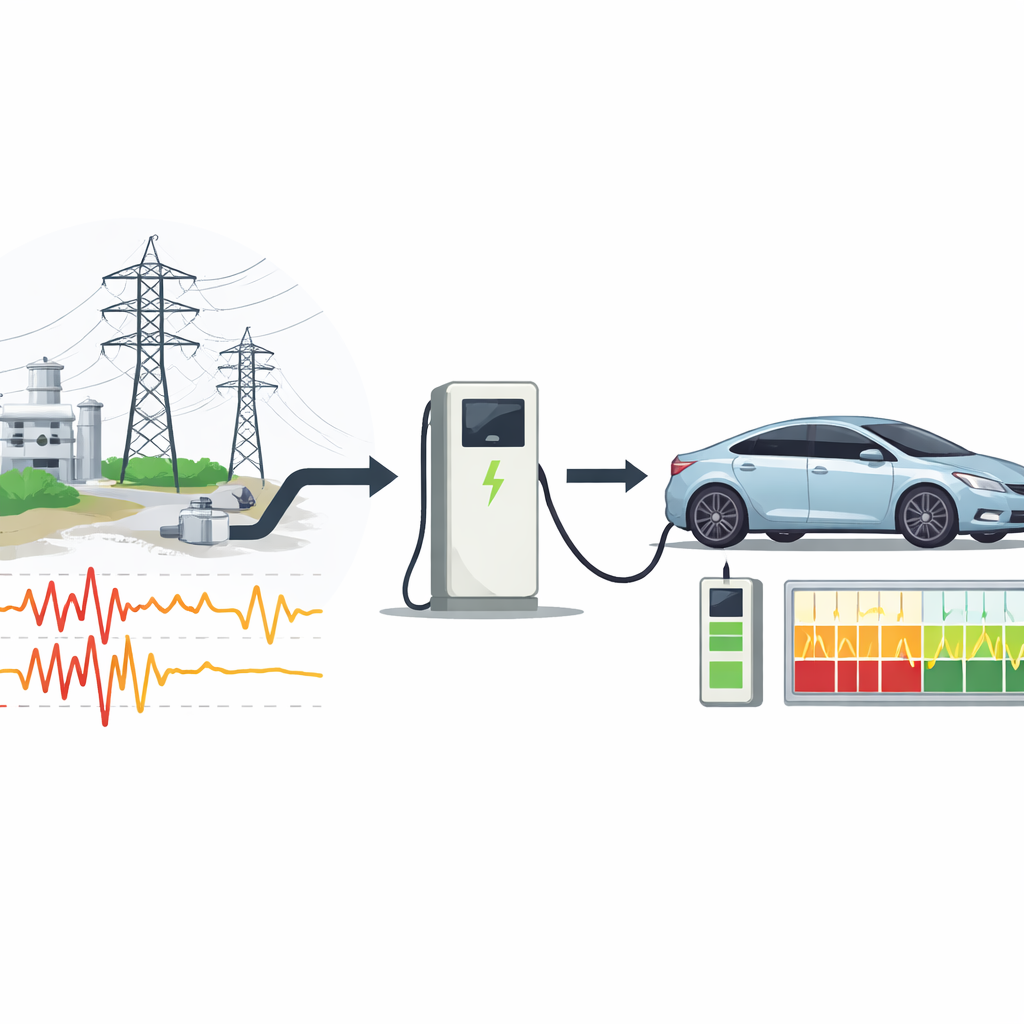
In real power networks, the electricity flowing to your home or parking garage is not always perfectly smooth. The grid can experience brief dips in voltage, sudden spikes, small interruptions, or distorted wave shapes caused by heavy machinery, renewable energy fluctuations, or storms. These power quality disturbances can slow charging, trip safety protections, or, if they happen often enough, shorten battery life. Until now, researchers and engineers have had little shared, real-world data showing exactly how a full electric vehicle behaves under each type of disturbance, making it hard to compare studies or design robust charging hardware.
Building a controlled test bench
To close this gap, the authors built a specialized laboratory platform that lets them “play back” many kinds of imperfect grid conditions in a controlled way. They first create disturbed voltage waveforms either with dedicated hardware or by generating them in software and then replaying them as real electrical signals. These signals feed a programmable AC power source, which in turn powers a standard AC charging post connected to a production electric car. While the car charges, instruments record the grid-side voltage and current at high speed, and a data interface inside the car logs battery voltage, charging current, state of charge, temperature, and other key signals. All of this information is stored in simple, machine-readable files so that other groups can reuse the data.
Ten kinds of rough power and how the car reacts
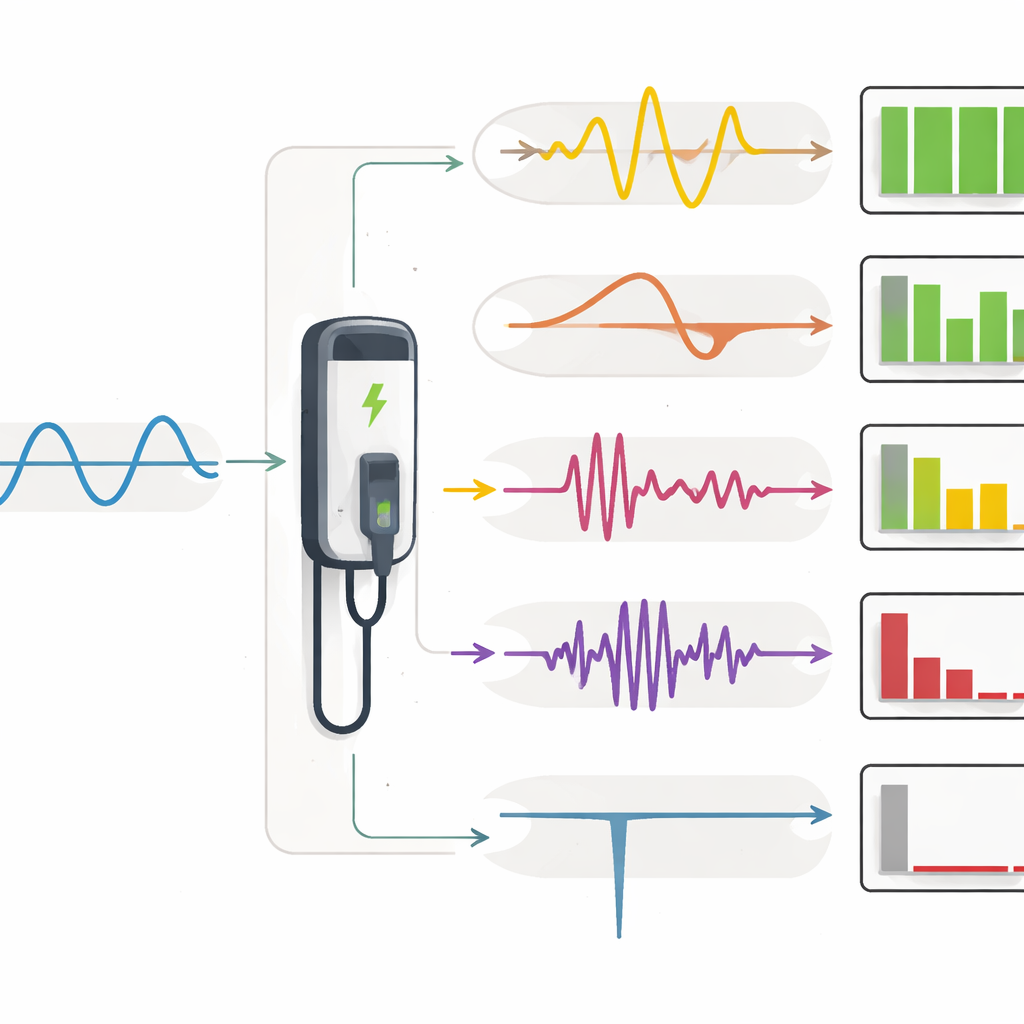
The dataset systematically explores ten representative disturbance types, such as frequency shifts, added harmonics (extra ripples on the power wave), short or long-lasting undervoltages and overvoltages, complete or partial interruptions, and classic “sags” and “swells” where the voltage suddenly drops or rises. Each experiment tweaks how strong and how long the disturbance is, while keeping the car’s battery at a known starting charge level. By overlaying the disturbed voltage with the car’s charging current, the authors show how different events leave different “fingerprints”: interruptions drive the current nearly to zero, sags often trigger the charger’s protection and abruptly stop charging, while very brief transients hardly disturb the current at all. Longer, milder deviations gently push the current up or down, revealing how sensitive the charger is to everyday grid variations.
From raw signals to a research workhorse
Beyond collecting the data, the team took care to make sure it is accurate and broadly useful. They calibrated instruments against reference meters, checked timing alignment down to a few thousandths of a second, repaired small gaps in the in-car data stream, and confirmed that the disturbances matched their target strengths and durations. They then summarized what was recorded in each file through simple statistics and frequency measures, and used clustering methods to verify that clearly different events, like a full voltage loss, stand out cleanly in this feature space. An extended subset of tests focused on voltage sags across different cars, chargers, and starting charge levels, showing that while absolute current levels change, the basic pattern—deeper sags leading to weaker charging—is strikingly consistent.
Why this matters for future charging
In the end, this work does not propose a new algorithm or charger design by itself. Instead, it delivers a carefully validated “common language” of real measurements that others can build on. With this dataset, researchers can more fairly compare methods for spotting and classifying power disturbances, manufacturers can stress-test new chargers in virtual form before deploying them, and grid planners can better understand when EV charging is likely to falter. For drivers, the long-term payoff is quieter: chargers and grids that handle everyday electrical hiccups gracefully, keeping charge times predictable and batteries healthier over years of use.
Citation: Li, H., Zhang, Y., Yang, S. et al. High-resolution Dataset of Electric Vehicle Charging Responses Under Varied Power Quality Disturbances. Sci Data 13, 403 (2026). https://doi.org/10.1038/s41597-026-06768-5
Keywords: electric vehicle charging, power quality disturbances, voltage sag, smart grid data, battery charging reliability