Clear Sky Science · en
Demographic, behavioral, and ecological data from a long-term field study of wild baboons in Amboseli, Kenya
Why Decades of Watching Baboons Matters
Imagine being able to follow the lives of the same animal families for more than half a century, watching how they grow up, find food, raise young, and cope with droughts and heatwaves. This article describes exactly that: a 50-year record of wild baboons living in the Amboseli region of southern Kenya. The researchers have now made their hard-won data openly available, offering a treasure trove for anyone interested in how animals adapt to a changing world.
A Living Laboratory in the Savannah
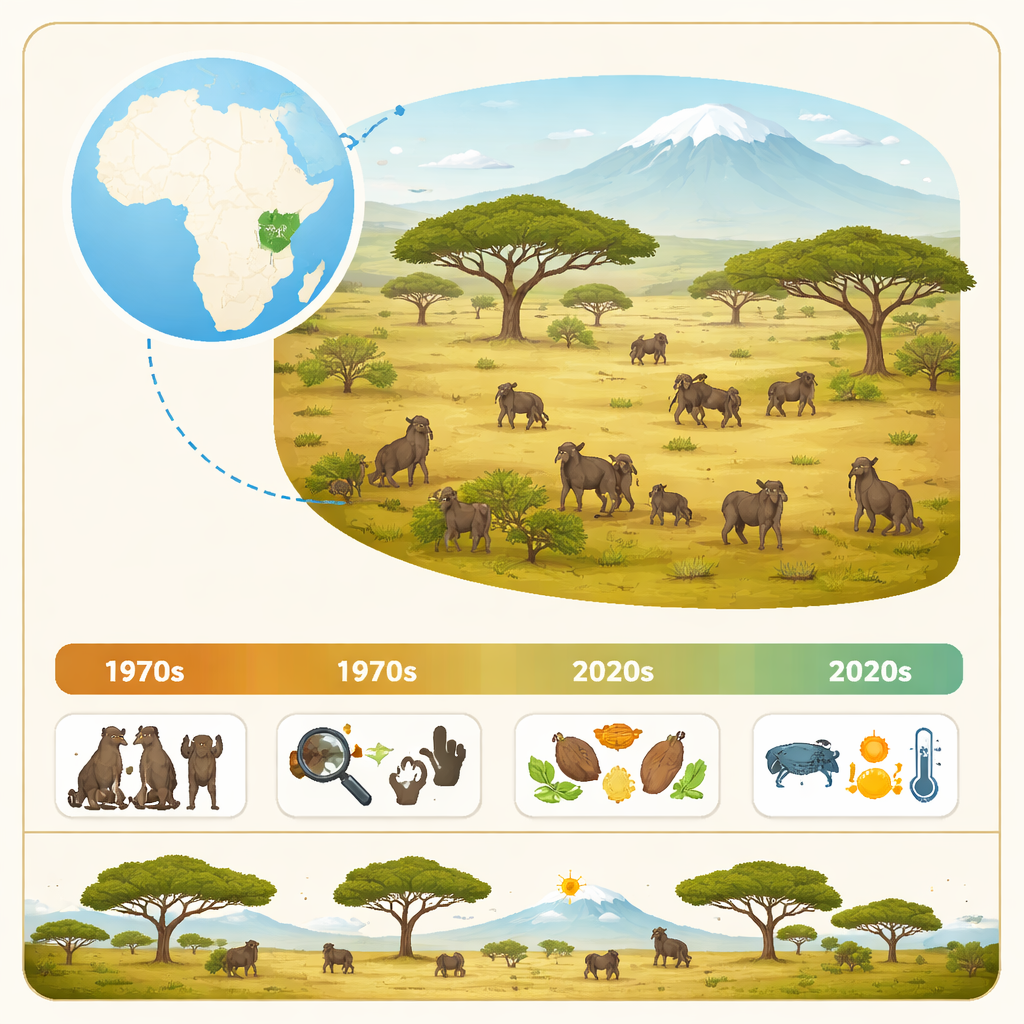
Since 1971, the Amboseli Baboon Research Project has tracked more than 2,000 individual baboons that roam a semi-arid grassland dotted with acacia trees in Kenya. Baboons are highly social monkeys that live in groups ranging from about 20 to over 120 animals, with adult males and females, teenagers, and youngsters all sharing the same space. The environment they inhabit is anything but stable: rainfall is strongly seasonal, temperatures swing across the year, and longer-term shifts bring runs of unusually wet or dry years. This combination of rich social life and environmental uncertainty makes the Amboseli baboons a natural laboratory for studying how animals adjust their behavior and family structure over time.
Four Windows into Baboon Life
The authors describe four long-term data sets that are now publicly accessible. First are detailed records of group size and makeup for 21 baboon groups followed over 52 years. These records note how many adult males, adult females, and youngsters lived in each group, and track events like births, deaths, and individuals switching groups. Second are "activity budgets" for adult females and young animals, measured from 1984 onward. Trained observers watched specific baboons for 10-minute stretches and recorded, minute by minute, whether they were feeding, walking, resting, or socializing. Third are diet records that note what types of food the baboons ate during those feeding minutes—grass blades, underground corms, fruits, flowers, seeds, tree gum, and insects, among others. Finally, the team collected daily weather data—rainfall and minimum and maximum temperatures—from 1976 to 2023, giving a local climate backdrop for everything the baboons experienced.
Following Seasons, Storms, and Social Shifts
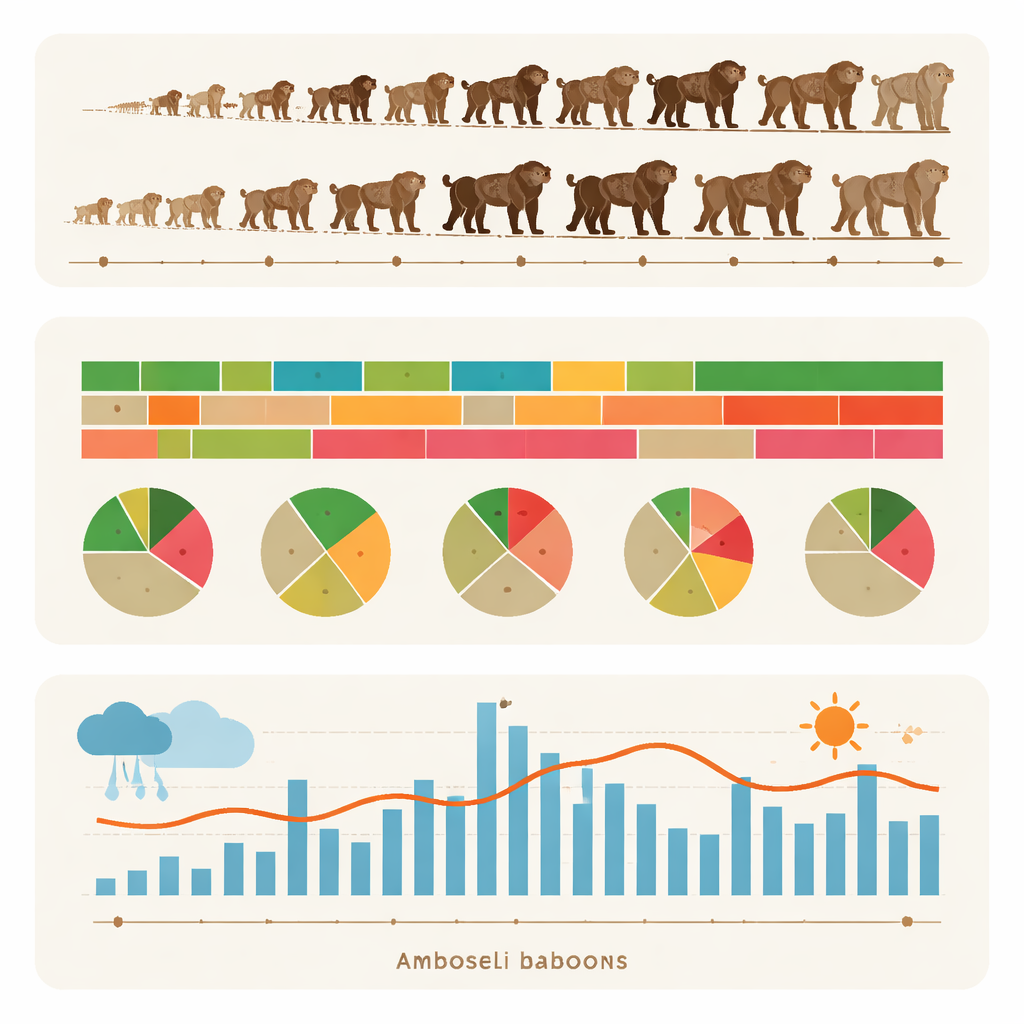
To make these data easier to analyze, the researchers summarized them by month and by "hydrological year," which in this region runs from November to October to match the rainy seasons. The paper shows how rainfall tends to cluster in two wet seasons separated by dry spells, and how temperatures peak early in the year and dip in the cool dry months. Across decades, rainfall varies dramatically from year to year, while temperatures change more smoothly. At the same time, the baboon groups themselves are constantly reshaping: large groups split, smaller ones sometimes merge, and the number of animals of each age and sex waxes and wanes. By aligning group, behavior, diet, and weather information on the same time scales, the data allow researchers to ask questions such as how droughts influence birth rates, how heat and rain alter daily activity, or how food availability affects growth and reproduction.
How the Data Were Collected and Checked
Gathering such detailed information required a small army of fieldworkers visiting baboon groups for half-days, six days a week, for decades. They carried notebooks, and later handheld computers and tablets, to keep track of individuals and record what they saw. All data—censuses, behavior, diet, and weather—were checked repeatedly, both in the field and by database managers who maintain a dedicated system for this project. The team also notes the limits of the data: observations were mostly made in the morning and late afternoon, and certain conditions, such as when animals were moving quickly across the landscape, made it harder to record behavior accurately. Weather instruments were moved several times as field camps shifted, and subtle differences between stations may influence the readings. These caveats are clearly described so that future users can interpret the numbers wisely.
Why This Open Data Set Matters
To a non-specialist, these data may look like endless tables of numbers, but they capture the unfolding story of real animals navigating a harsh, changing environment. By sharing decades of carefully curated records on baboon families, their daily routines, their food, and their weather, the authors give scientists and students around the world a chance to explore questions about survival, social life, and adaptation in the wild. In practical terms, this resource can help us understand how long-lived animals respond to climate swings and habitat change—insights that matter not only for baboons, but for wildlife conservation more broadly, and even for thinking about our own species’ place in a shifting planet.
Citation: Southworth, C.A., Winans, J.C., Gordon, J.B. et al. Demographic, behavioral, and ecological data from a long-term field study of wild baboons in Amboseli, Kenya. Sci Data 13, 311 (2026). https://doi.org/10.1038/s41597-026-06741-2
Keywords: baboons, long-term field study, animal behavior, savannah ecology, climate and wildlife