Clear Sky Science · en
Seismocardiography Pig Hypovolemia Dataset for Signal Quality Indexing and Validated Cardiac Timings
Listening to the Heart Without Breaking the Skin
Imagine checking how well your heart is pumping using something as simple as a small sticker-like motion sensor on your chest, instead of tubes and catheters inside your arteries. That is the promise of seismocardiography, a technique that records tiny chest vibrations caused by each heartbeat. This paper presents a rigorously labeled dataset collected from pigs undergoing controlled blood loss, giving scientists the trusted reference they need to turn those chest vibrations into reliable tools for early detection of dangerous drops in blood volume and heart problems.
Why Heart Vibrations Matter
Heart disease remains a leading cause of death, and many people first show critical symptoms outside the hospital. Continuous, low-cost monitoring could help spot trouble earlier, especially in ambulances, rural clinics, or at home. Seismocardiography (SCG) records the subtle trembling of the chest with tiny accelerometers and can reveal when heart valves open and close, how forcefully the heart is pumping, and how blood volume changes. Previous studies suggest these vibration-based measurements can estimate blood pressure, stroke volume, and blood volume status more sensitively than simple vital signs like heart rate or average blood pressure. But one major obstacle has slowed progress: researchers have not had a large, openly available set of SCG signals that are carefully checked and labeled by experts.
The Missing Piece: Trusted Reference Data
Existing public databases contain SCG together with other signals like the electrocardiogram (ECG), which measures the heart’s electrical activity, and blood pressure waveforms. However, most of these collections lack clear markings of key heartbeat events, such as the exact moment when the aortic valve opens (AO) or closes (AC), or any consistent rating of how clean or noisy each heartbeat is. Without such labels, it is hard to train or test computer algorithms that must work reliably on real-world signals full of movement, speech, and other interference. The authors of this study set out to close this gap by building a carefully annotated dataset and the tools needed to create it, focusing on a demanding scenario: hypovolemia, the dangerous loss or redistribution of blood volume that can lead to shock.
A Controlled Look at Blood Loss in Pigs
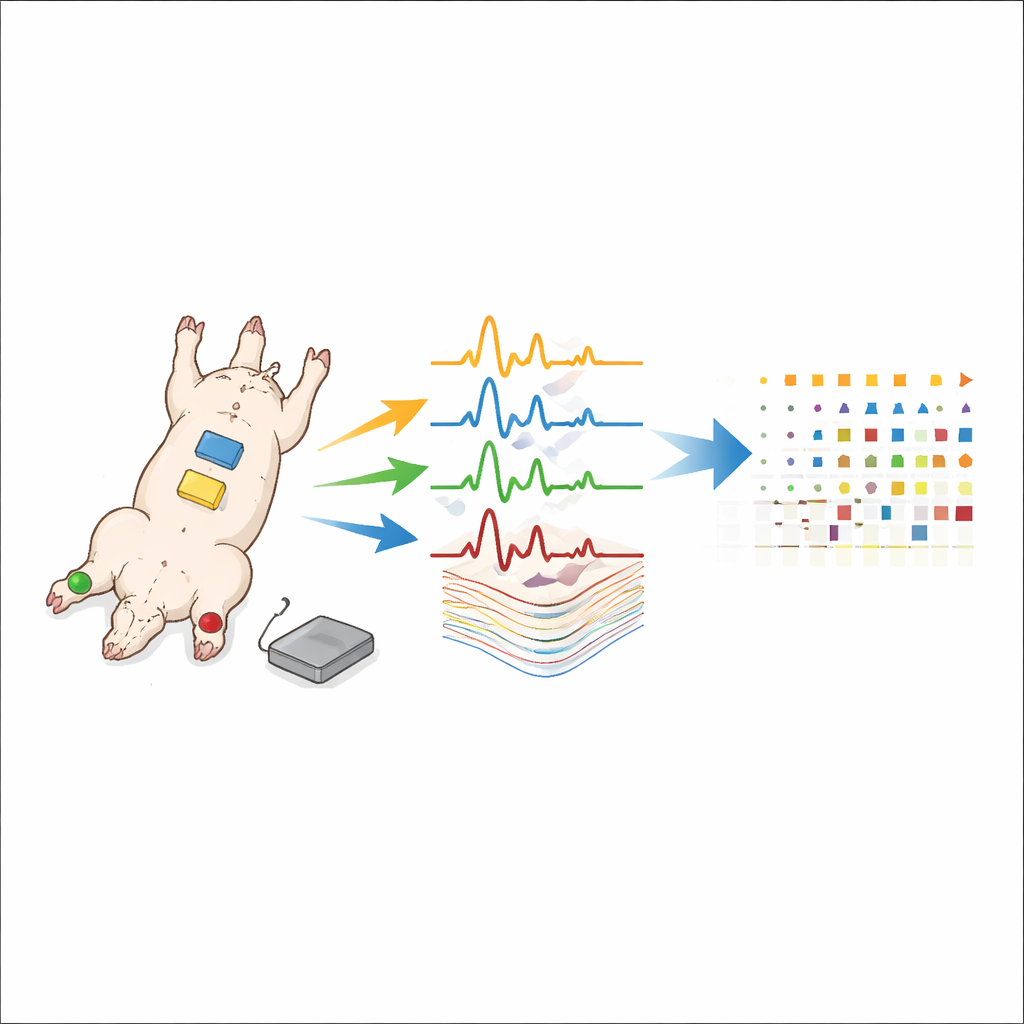
To construct this dataset, the team used six Yorkshire pigs whose heart and chest anatomy behaves much like that of humans. While the animals lay on their backs under anesthesia, the researchers gradually altered blood volume in two ways: by withdrawing blood (absolute hypovolemia) and by using drugs that widen blood vessels (relative hypovolemia), followed by resuscitation with the animals’ own blood. Throughout these stages, they continuously recorded SCG from sensors on the sternum and back, ECG from standard electrodes, and highly accurate blood pressure from a catheter placed in the aortic root. They then split the recordings into individual heartbeats using the ECG as a timing guide, and selected every fifth beat for manual inspection, yielding 17,059 SCG beats that span normal conditions, severe blood loss, and recovery.
How Experts Marked Each Heartbeat
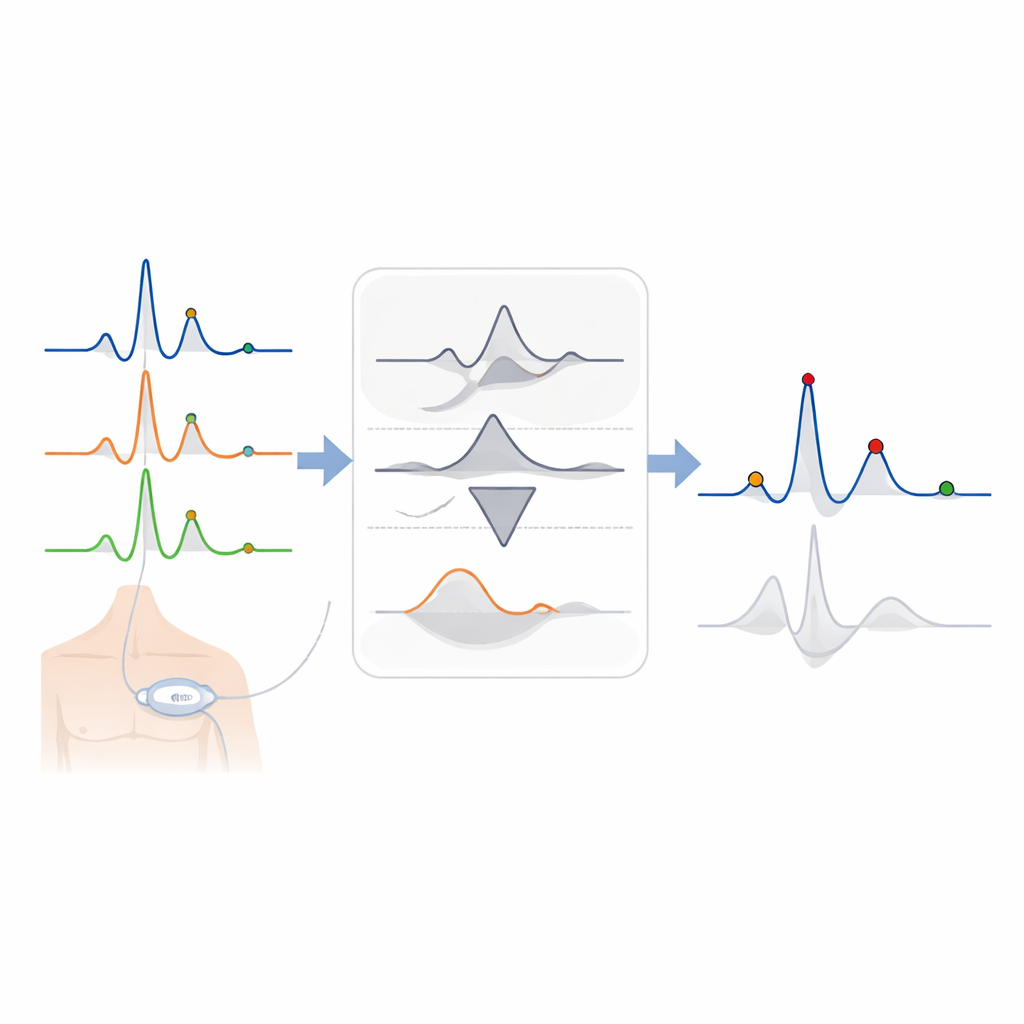
The researchers created a custom graphical interface to make expert labeling fast and consistent. Each SCG beat appears alongside its matching ECG beat and a heatmap showing how nearby beats evolve over time. Trained annotators—graduate students and postdoctoral researchers specializing in cardiovascular signals—clicked on four key landmarks on each SCG beat: aortic valve opening (AO), aortic valve closing (AC), a valley just after AC (ACv), and the opening of the mitral valve (MO), which marks when the ventricle begins to refill. They also rated signal quality as “good,” “average,” or “bad” based on how clearly the important features could be seen. Every beat was independently labeled by two annotators, with a third acting as a tiebreaker when needed. Final values for each timing and quality score were set by taking the median of the three decisions, which reduces the influence of outliers and disagreements.
Checking Against the Gold Standard
To ensure that the labels truly reflect what the heart was doing, the authors compared the expert markings to timings extracted from the invasive aortic pressure catheter, which directly senses the pressure rise and fall caused by the heart’s pumping. Using signal-processing steps such as filtering, averaging, and examining the curvature of the pressure waveform, they estimated the true AO and AC moments for each selected beat. They then measured how closely the human annotations matched these catheter-derived timings. Across all pigs, the annotated AO events showed very strong correlation (r = 0.926) with the catheter measurements, and the AC events were similarly accurate (r = 0.911). Statistical agreement measures, including several forms of inter-rater reliability metrics, showed that annotators were generally consistent with one another, especially for more visually distinct landmarks like AO and the main valleys in the filling phase.
What This Means for Future Heart Monitoring
From a lay perspective, this work delivers a trustworthy “dictionary” that translates chest vibrations into precise heart events, validated against the most accurate internal measurements available. By openly sharing both the raw waveforms and the expert labels, along with the annotation software, the authors provide a foundation on which others can build smarter algorithms for detecting blood loss, monitoring heart failure, or tracking recovery after surgery using wearable sensors. In simple terms, this dataset helps bridge the gap between promising lab prototypes and robust tools that could one day warn doctors, medics, or even patients themselves when the heart is struggling, well before it is too late.
Citation: Cho, M.J., Yaldiz, C.O., Nawar, A. et al. Seismocardiography Pig Hypovolemia Dataset for Signal Quality Indexing and Validated Cardiac Timings. Sci Data 13, 423 (2026). https://doi.org/10.1038/s41597-026-06733-2
Keywords: seismocardiography, cardiac monitoring, blood loss detection, wearable sensors, annotated biomedical datasets