Clear Sky Science · en
Critical classification parameters linking species to Plant Functional Type in African ecosystems
Why African plants matter for our future
Africa’s landscapes—from rainforests and savannas to deserts—play a crucial role in regulating the planet’s climate, storing carbon, and supporting millions of people. Yet, compared with Europe or North America, African plants are still poorly represented in the computer models scientists use to predict future climate and ecosystem change. This study tackles that blind spot by building a detailed link between real African plant species and the broad plant groups that climate and land-surface models actually use.
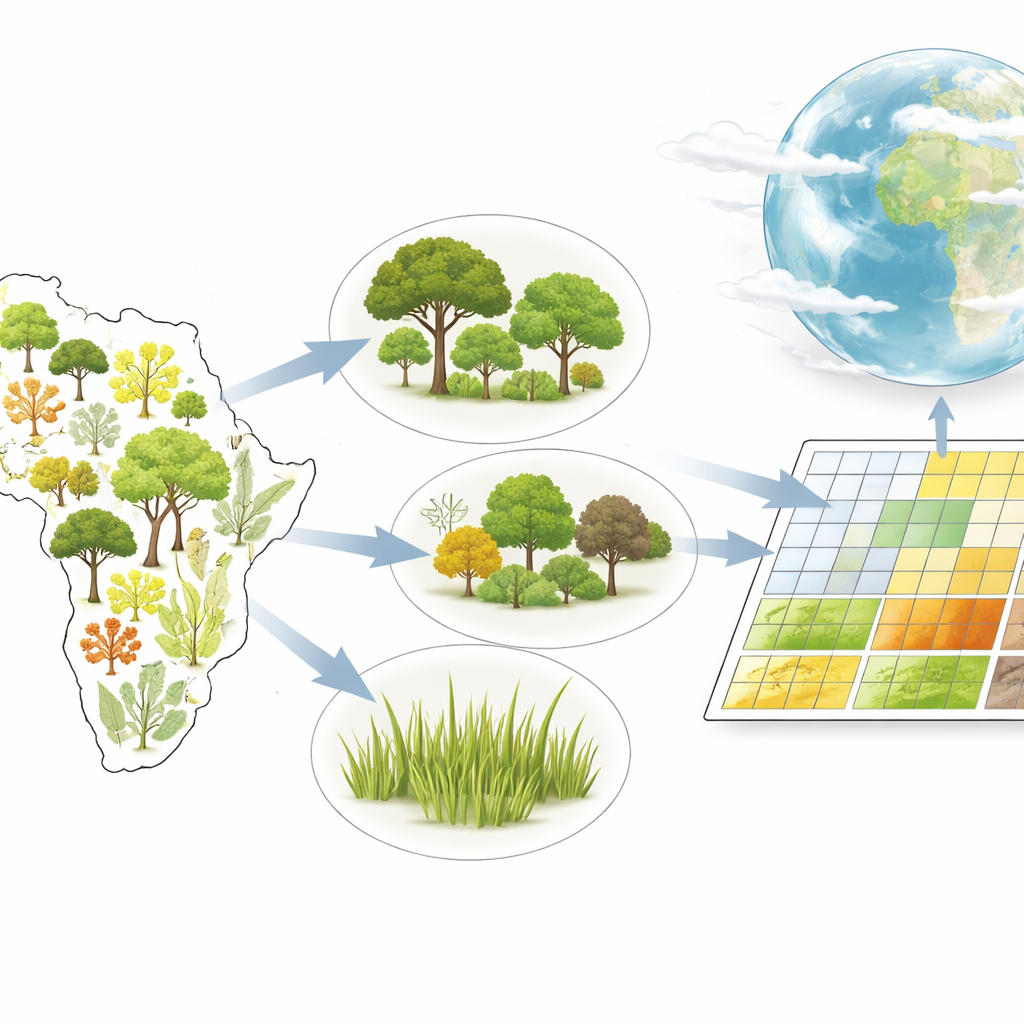
Turning a wild jungle of species into usable groups
Modern climate and land-surface models cannot track every individual plant species. Instead, they use a handful of “plant functional types” that stand in for many species sharing similar roles and traits—such as evergreen trees, deciduous shrubs, or different kinds of grasses. These groups help models estimate how vegetation exchanges water, energy, and carbon with the atmosphere. However, because African plants are under-studied, many species on the continent could not be clearly assigned to these functional types, weakening model reliability for African ecosystems and, by extension, for global climate projections.
Building a richer picture from scattered data
The authors started with the TRY plant trait database, a global collection containing millions of measurements that describe how plants look and function. From this vast resource, they pulled all available records for African species and cleaned the data, discarding entries with missing names or zero values and keeping only those inside Africa’s boundaries. They then standardized species names using the World Flora Online taxonomic backbone so that different spellings, synonyms, and outdated names would not fragment the data. This careful harmonization ensured that each species was recognized consistently across trait records and external botanical sources.
Key plant features that drive the classification
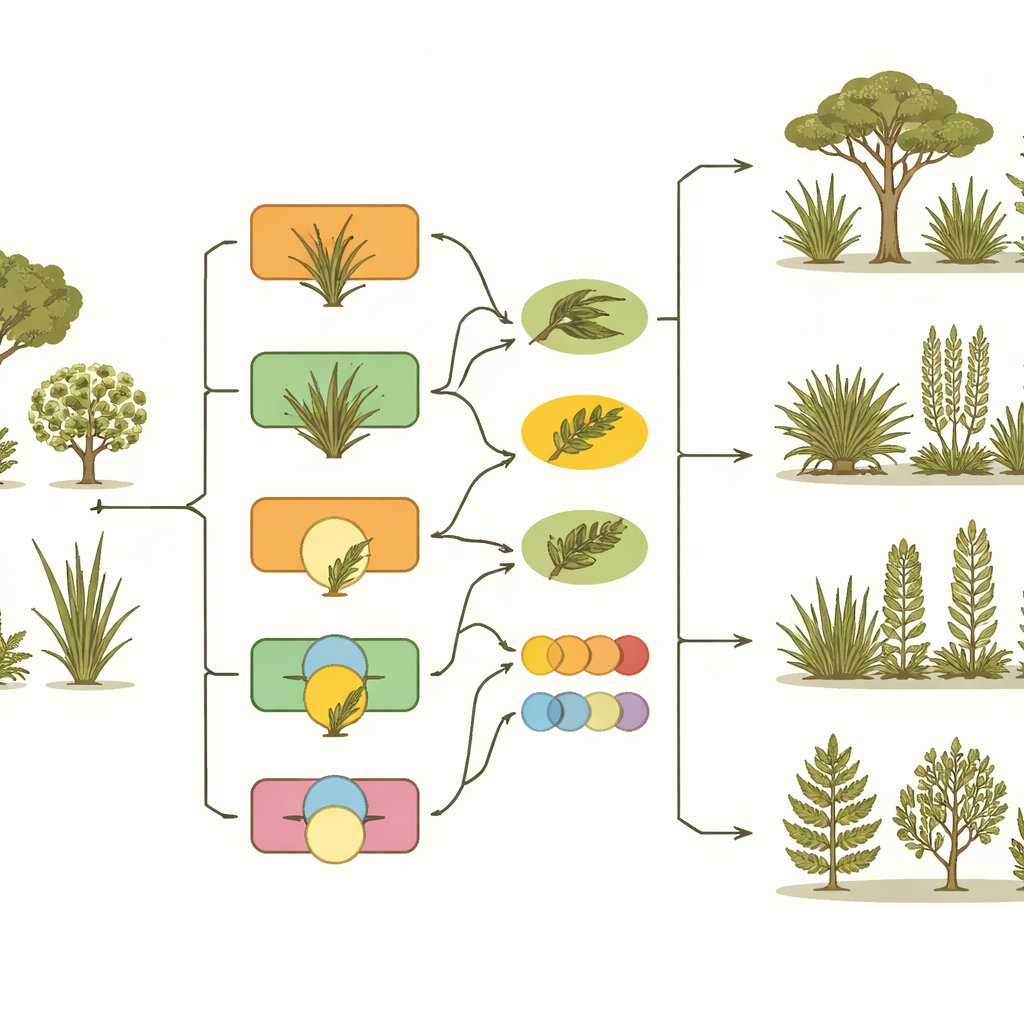
Next, the team identified a set of simple but powerful characteristics that determine how a species fits into model-friendly plant types. These traits included whether a plant grows as a tree, shrub, grass, herb, or fern; whether its leaves are broad or needle-like; whether it keeps its leaves year-round or sheds them seasonally; the basic pathway it uses to perform photosynthesis; and whether it naturally occurs in tropical or temperate climates. When information was missing from the TRY database, the authors systematically searched authoritative plant databases and scientific literature to fill the gaps, only using general web sources as a secondary cross-check. They then applied a structured decision flowchart to assign each species to one of nine plant functional types used by the JULES land-surface model.
From a data desert to a usable map of African plants
This method transformed a sparse and patchy dataset into a much more complete resource. Previously, only 265 African species in TRY could be linked to JULES plant types. After the new classification effort, 1,603 species—spanning 137 plant families—were successfully mapped, a sixfold increase. The number of usable trait observations for model-level analyses grew fivefold as well, from about seven thousand to over thirty-five thousand records. Most classified species turned out to be tropical broadleaf evergreen trees or evergreen shrubs, reflecting both the true dominance of these forms in many African landscapes and ongoing data gaps for other lineages such as certain conifers, ferns, and some flowering plant families.
What this means for people and the planet
The resulting lookup table and code are openly available for anyone to download and reuse. Modelers can now plug many more African species into established plant functional types, improving how climate and land-surface models represent African vegetation and its responses to warming, drought, and land-use change. Ecologists can also use these classifications to study functional diversity and plant–environment relationships across the continent. While some species still lack enough information for confident grouping, this work dramatically narrows the data gap and provides a clear framework for future updates. For non-specialists, the message is simple: by better connecting real African plants to the simplified categories inside our models, scientists can produce more trustworthy forecasts of how African ecosystems—and the global climate they influence—may change in the decades ahead.
Citation: Akhabue, E.F., Cunliffe, A.M., Bett-Williams, K. et al. Critical classification parameters linking species to Plant Functional Type in African ecosystems. Sci Data 13, 336 (2026). https://doi.org/10.1038/s41597-026-06728-z
Keywords: African ecosystems, plant functional types, climate models, plant traits, biodiversity data