Clear Sky Science · en
The ERIES-BOLT project: Behaviour of Telecommunication Lattice Towers under Thunderstorm Winds
Why storm winds matter for everyday connections
Every time you make a call or stream a video, your signal often travels through tall steel towers that dot the landscape. These telecommunication towers must stand firm not only in steady breezes, but also in violent thunderstorm winds that can topple structures in minutes. This article presents a rich new dataset from a large wind research facility that recreates these fierce storm winds in the laboratory and measures how realistic models of phone towers behave, with the goal of making our communication network more reliable and safer.
Storm blasts that hit like invisible hammers
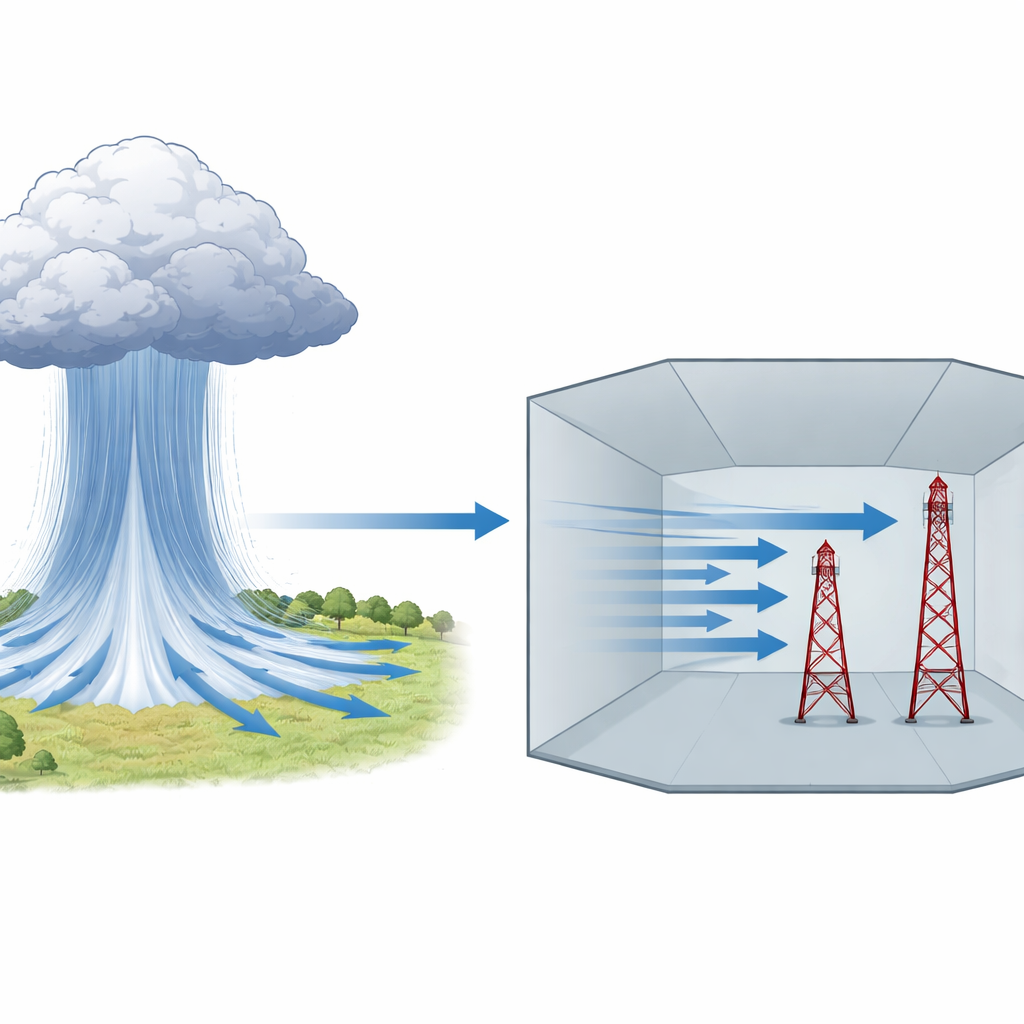
Thunderstorms can produce powerful, short-lived wind events called downbursts. Instead of a gentle sideways flow, a mass of cold air plunges downward from a storm cloud, hits the ground, and spreads out in all directions like water from a burst pipe. These outflows can last only 10 to 30 minutes and span just a few kilometers, making them hard to measure in the real world. Yet they are responsible for serious damage to low and mid-rise structures, including transmission lines and telecommunication towers. Engineers have learned a great deal from field campaigns and full-scale monitoring, but there is still a gap between what is measured outside and what can be replicated reliably in wind tunnels.
Recreating real storms inside a giant wind dome
The ERIES-BOLT project tackles this challenge using the WindEEE Dome in Canada, a unique hexagonal chamber ringed with more than 100 fans and a large opening in the ceiling. This facility can produce both large-scale weather flows, like ordinary boundary-layer winds over open terrain, and intense localized outflows that mimic downbursts. In the project, researchers first created and measured four families of wind conditions: traditional atmospheric boundary layer flows; pure downburst-like jets; downbursts superimposed on background winds; and a new “tripped” downburst configuration where small obstacles on the floor push the strongest winds higher above the ground, closer to what is seen in real storms. Using fast-response probes, they recorded three-dimensional wind speeds and turbulence at many heights and radial distances, building a detailed picture of how these artificial storms evolve in time and space.
Miniature phone towers put to the test
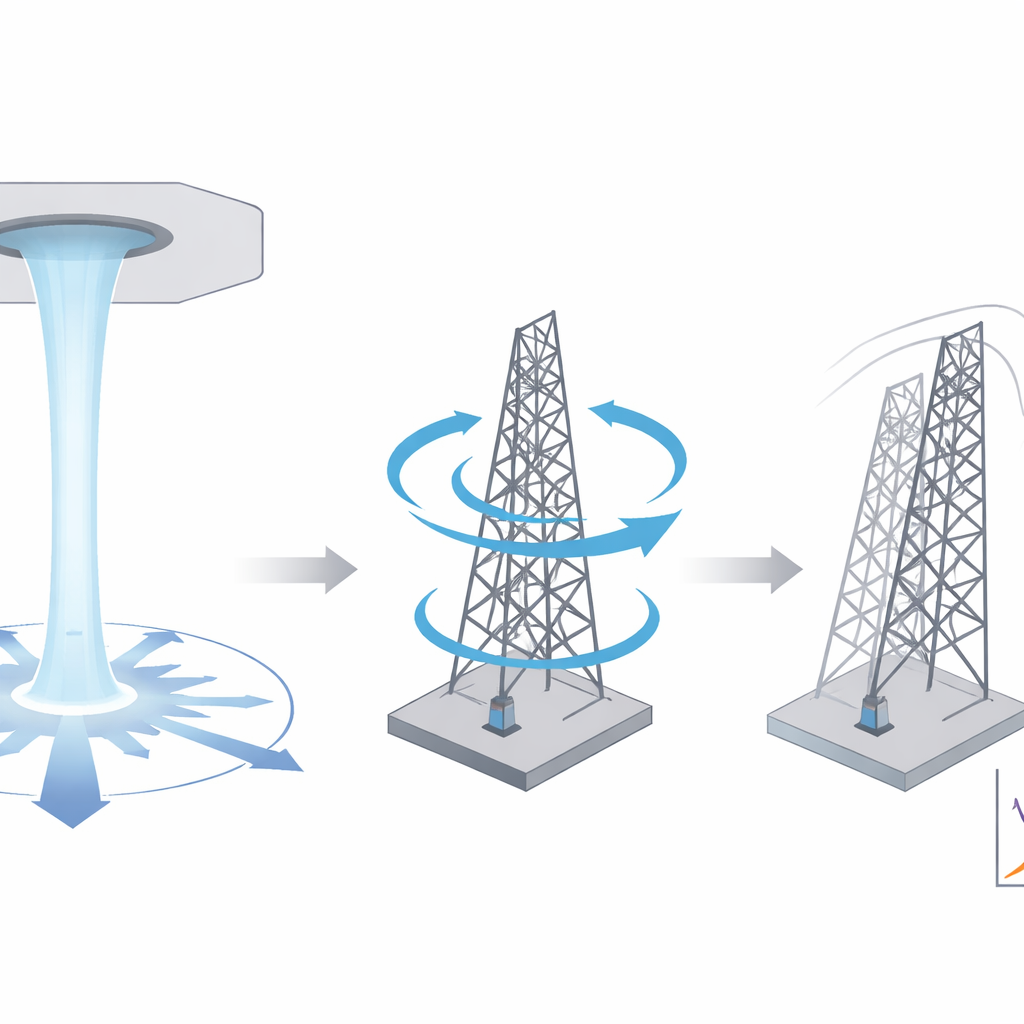
Next, the team installed finely crafted models of real triangular lattice towers—scaled to one-hundredth of the heights of 50-meter and 90-meter full-scale structures—inside the dome. The models were built from stainless-steel tubing and 3D-printed joints and mounted on sensitive six-component force balances, with tiny accelerometers attached at mid-height and at the top. By carefully choosing how lengths, times, masses, and stiffnesses were scaled, the researchers ensured that the miniature towers would sway and vibrate in a way that faithfully represents their full-scale counterparts under both steady winds and fast-rising downbursts. They then exposed the towers to dozens of combinations of wind speed, tower orientation, and distance from the downburst center, recording base forces, bending moments, and accelerations at high sampling rates.
Zooming in on the tower’s upper works
Because many failures start at the upper part of a tower—where platforms, ladders, railings, and antennas add weight and catch the wind—the project also included focused tests on a larger, one-tenth scale section of the top of the 50-meter tower. This sectional model could be configured as a bare frame, a frame with a solid top plate, or a fully equipped version with platforms, railings, and panel antennas. Mounted on another precision force balance and placed in a controlled boundary-layer flow, the model was rotated through many angles of attack and tested at several wind speeds. These measurements revealed how each added component increases drag and changes lift and twisting moments, and confirmed that the results are robust across the relevant range of flow conditions.
From data structure to real-world confidence
All measurements from the wind fields, aeroelastic tests, and sectional model experiments are organized in a shared online repository using a consistent, machine-readable format. Each file stores time histories of wind speeds, tower motions, and loads together with detailed metadata about test setups, making it straightforward for other researchers and designers to reuse the data. The team validated their laboratory storms by comparing the measured wind profiles with accepted engineering guidelines and analytical formulas, and, crucially, by matching a real downburst recorded on a monitored tower in Romania with a scaled event reproduced inside the WindEEE Dome. After adjusting for scale, both the wind histories and the tower accelerations agreed closely, with peak responses differing by less than about ten percent.
What this means for safer towers and networks
To a non-specialist, the core message is that engineers can now study, in great detail, how realistic phone towers respond to realistic thunderstorm winds without waiting for rare storms to happen. The ERIES-BOLT dataset bridges the gap between full-scale monitoring and laboratory testing, confirming that carefully scaled models in a sophisticated wind dome can mimic the violent buffeting experienced by real towers. This foundation will help refine design rules, improve numerical simulations, and ultimately lead to towers that are better prepared for the sudden, hammer-like blasts of downburst winds that threaten our everyday communications.
Citation: Calotescu, I., Coșoiu, CI., Hangan, H. et al. The ERIES-BOLT project: Behaviour of Telecommunication Lattice Towers under Thunderstorm Winds. Sci Data 13, 365 (2026). https://doi.org/10.1038/s41597-026-06727-0
Keywords: downburst winds, telecommunication towers, wind tunnel experiments, structural response, thunderstorm hazards