Clear Sky Science · en
Chromosome-level genome assembly of the striped venus clam Chamelea gallina
Why this small clam matters
The striped venus clam may be only a few centimeters long, but it plays an outsized role in European coastal life. It filters seawater, feeds fish and crabs, supports a multi‑million‑euro fishery, and ends up on many dinner plates. Yet, until now, scientists lacked a complete “instruction manual” for this species—the full DNA blueprint that underpins its survival, its sensitivity to pollution and heat, and its value to the blue economy. This study delivers that missing manual by assembling the clam’s genome at the level of individual chromosomes, opening new paths for conservation, sustainable harvesting, and food safety.
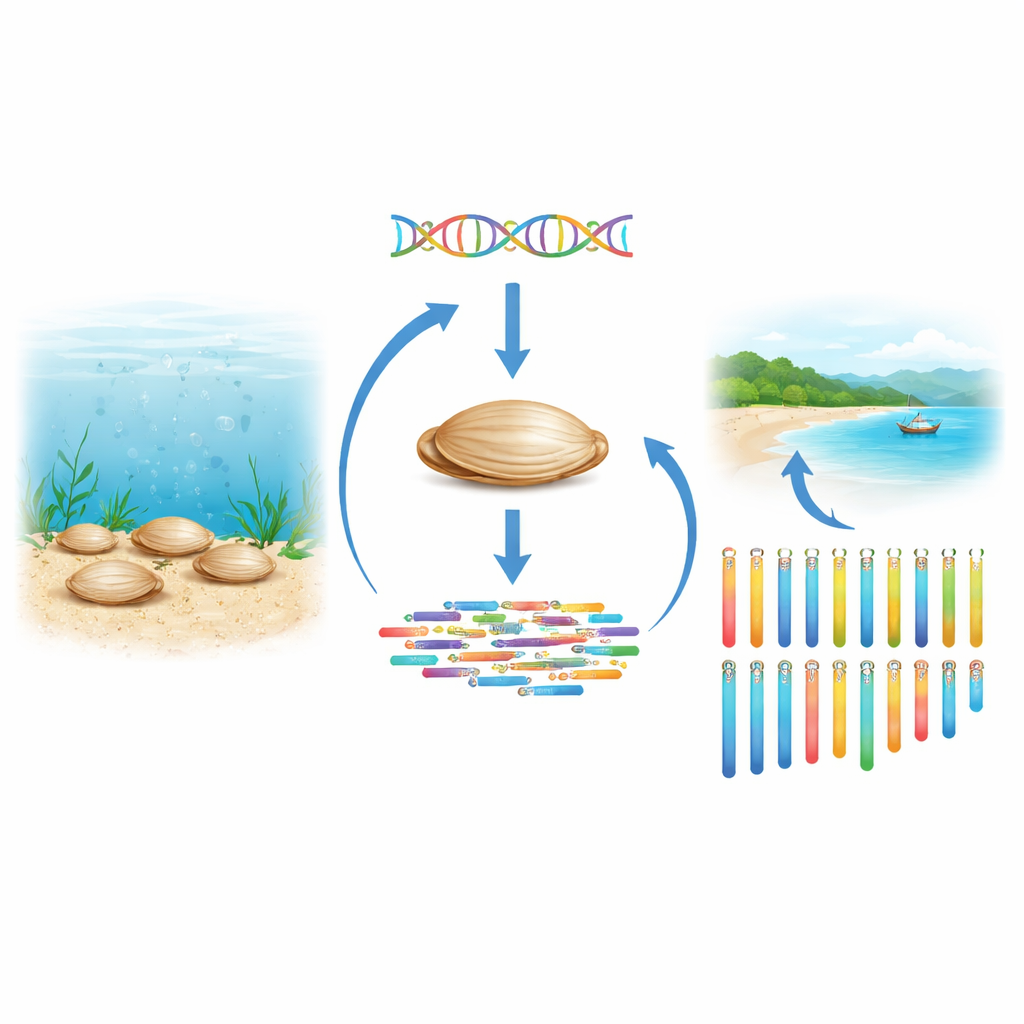
The life and work of a sandy seafloor resident
The striped venus clam lives buried in sandy bottoms from the North Atlantic coasts of Europe down to the Mediterranean and Black Seas, especially in the Adriatic. As a filter feeder, it constantly pumps water through its body, trapping microscopic algae and particles. In doing so, it helps clean coastal waters and recycles nutrients, while its burrowing behavior stirs the seafloor and creates habitat for other species. These clams are also an important food source for marine animals and humans alike; recent catches in Europe exceeded 18,000 tonnes per year, worth around 100 million euros, with Italy as the leading harvester.
Threats from a changing and polluted sea
Despite their importance, striped venus clam populations have been hit by sudden die‑offs linked to low oxygen events, river flood pulses, storms, pollution, and disease. Because the clams readily accumulate tiny plastic particles, they are being used to gauge microplastic contamination in coastal zones—and those same particles can then reach people who eat them. Populations also respond differently to marine heatwaves: clams from richer, more productive areas show stronger antioxidant and immune defenses, while those from poorer areas show signs of stress. To understand why such differences exist and how resilient these shellfish can be to climate change, scientists need detailed genetic information, which had been largely missing.
Building the clam’s genetic blueprint
To close this gap, the researchers collected striped venus clams from the Adriatic Sea and extracted DNA and RNA from several tissues. They combined three advanced sequencing approaches: very accurate long DNA reads, abundant short DNA reads, and Hi‑C technology, which captures how pieces of DNA sit next to each other inside the cell nucleus. Using specialized software, they stitched these data together into a highly continuous genome of about 1.8 billion DNA letters. The final assembly consists of 19 large scaffolds that match the known number of clam chromosomes, indicating that the genome has been reconstructed almost chromosome by chromosome with few breaks or misplacements.
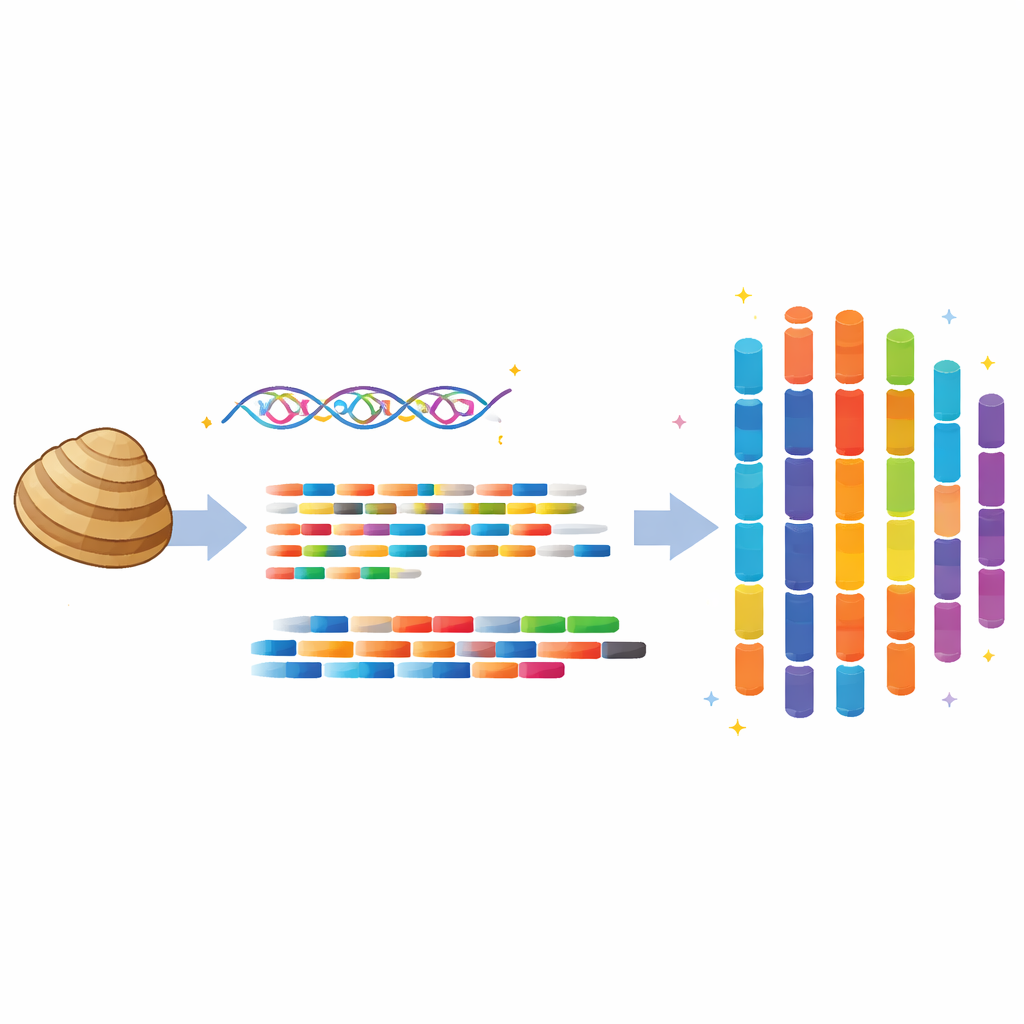
What the genes reveal
Once the genome was in place, the team mapped RNA from mantle, gill, digestive gland, blood‑like fluid, and gonad to identify which stretches of DNA code for working molecules in the cell. They catalogued over 58,000 protein‑coding genes and tens of thousands of non‑coding RNA pieces that help regulate cell functions. More than half of the genome consists of repeated sequences, such as jumping DNA elements, which are common in animals but had never been quantified in this clam. The scientists also assembled the small circular mitochondrial genome, which powers the cell’s energy factories, and used it to confirm the species’ identity and evolutionary relationships with other clams.
Tools for cleaner seas and safer seafood
For non‑specialists, the power of this work lies not in any single gene, but in the toolbox it creates. A complete, high‑quality genome makes it possible to compare striped venus clams from different regions, pinpoint DNA variants linked to heat tolerance or resistance to pollution, and track populations using genetic markers. Fisheries managers can use these markers to trace the origin of harvested clams, combat mislabeling, and plan sustainable quotas. Researchers studying microplastics, disease outbreaks, or climate stress now have a reference map to interpret changes in gene activity. In short, this chromosome‑level genome turns a once obscure shellfish into a well‑characterized model for understanding how coastal resources can be protected in a rapidly changing ocean.
Citation: Bortoletto, E., Rosani, U., Profico, C. et al. Chromosome-level genome assembly of the striped venus clam Chamelea gallina. Sci Data 13, 427 (2026). https://doi.org/10.1038/s41597-026-06726-1
Keywords: bivalve genomics, marine conservation, shellfish fisheries, climate change adaptation, microplastic pollution