Clear Sky Science · en
An open benchmark dataset for machine learning and intelligent trajectory optimization in fixed-wing unmanned aerial systems
Why Smarter Drone Flights Matter
From crop surveys to search-and-rescue, fixed-wing drones quietly do a growing amount of work high above our heads. Making these aircraft more reliable and more independent of human pilots could unlock safer deliveries, sharper environmental monitoring and more resilient operations in emergencies or conflict zones. But progress is increasingly limited not by clever ideas, but by a lack of real-world data. This article introduces a new open dataset of hundreds of autonomous drone flights, designed so that engineers and students anywhere can develop and test smarter flight algorithms on the same rich, shared foundation.
A Flying Lab for Real-World Missions
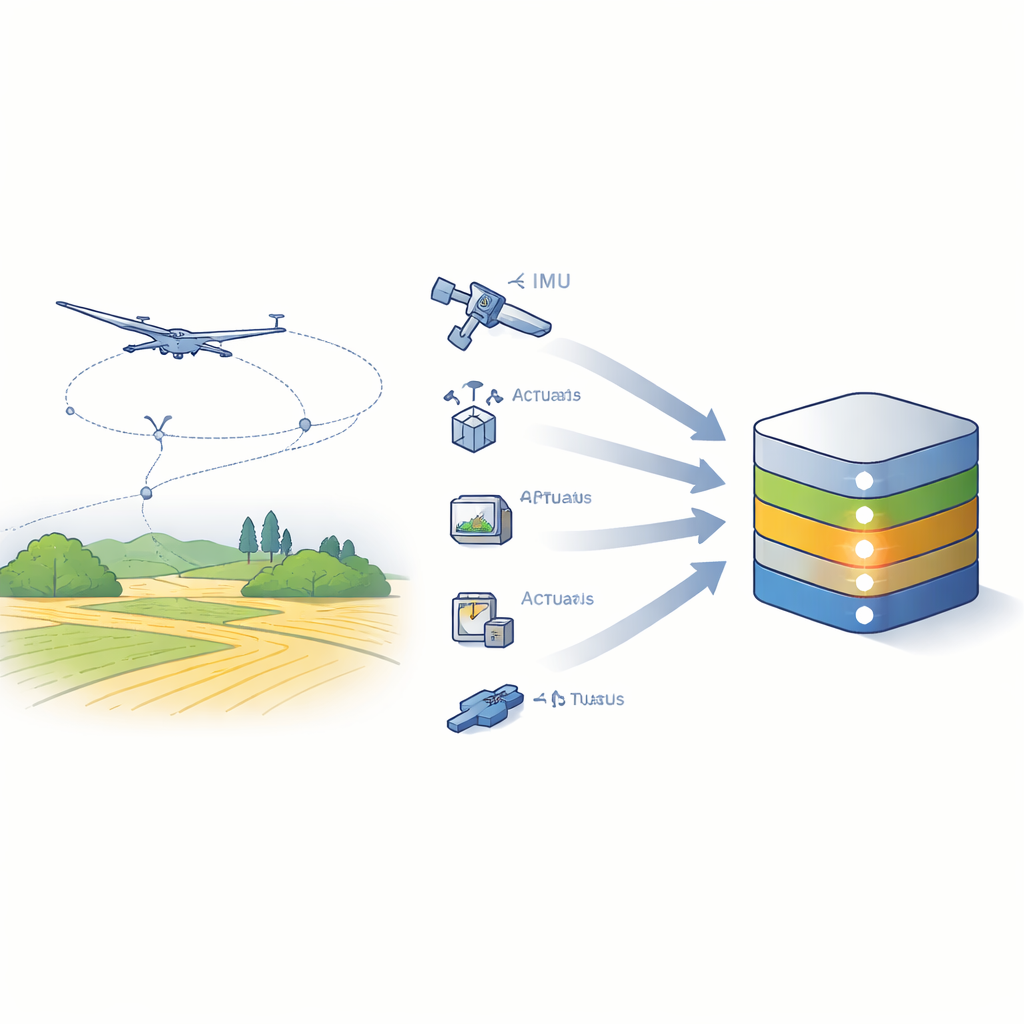
The authors built their dataset using a robust, motor-glider–style airplane called the Volantex Ranger 2400. With its two‑and‑a‑half‑meter wingspan, efficient wing shape and roomy fuselage, the aircraft can carry modern electronics while staying aloft for long, stable missions. It is powered by a rear-mounted electric motor and a custom lithium‑ion battery pack tuned for endurance rather than short bursts of power. The team flew this platform in fully autonomous mode, using pre-planned routes that covered key phases of flight: take‑off, cruising straight legs, tight turns, dynamic maneuvers and automatic landings. This controlled but realistic setup turns the Ranger into a flying laboratory that behaves like small operational drones used in civil and defence settings.
Two Brains, One Airplane
To capture a wide range of use cases, the researchers equipped the same airframe with two very different “brains.” One configuration uses a compact, inexpensive SpeedyBee F405 flight controller, similar in spirit to the electronics hobbyists might put on a home‑built drone. The other combines a professional Pixhawk 6X autopilot with a powerful Jetson Orin NX computer, capable of running demanding artificial‑intelligence software onboard. Both systems log detailed telemetry, including motion from inertial sensors, GPS position and speed, altitude, airspeed, control‑surface commands, battery status and flight mode, at rates high enough to reconstruct the aircraft’s motion in fine detail. By keeping the airframe constant while swapping the electronics, the dataset lets researchers study how different levels of onboard computing and sensing affect flight behaviour.
What Lives Inside the Dataset
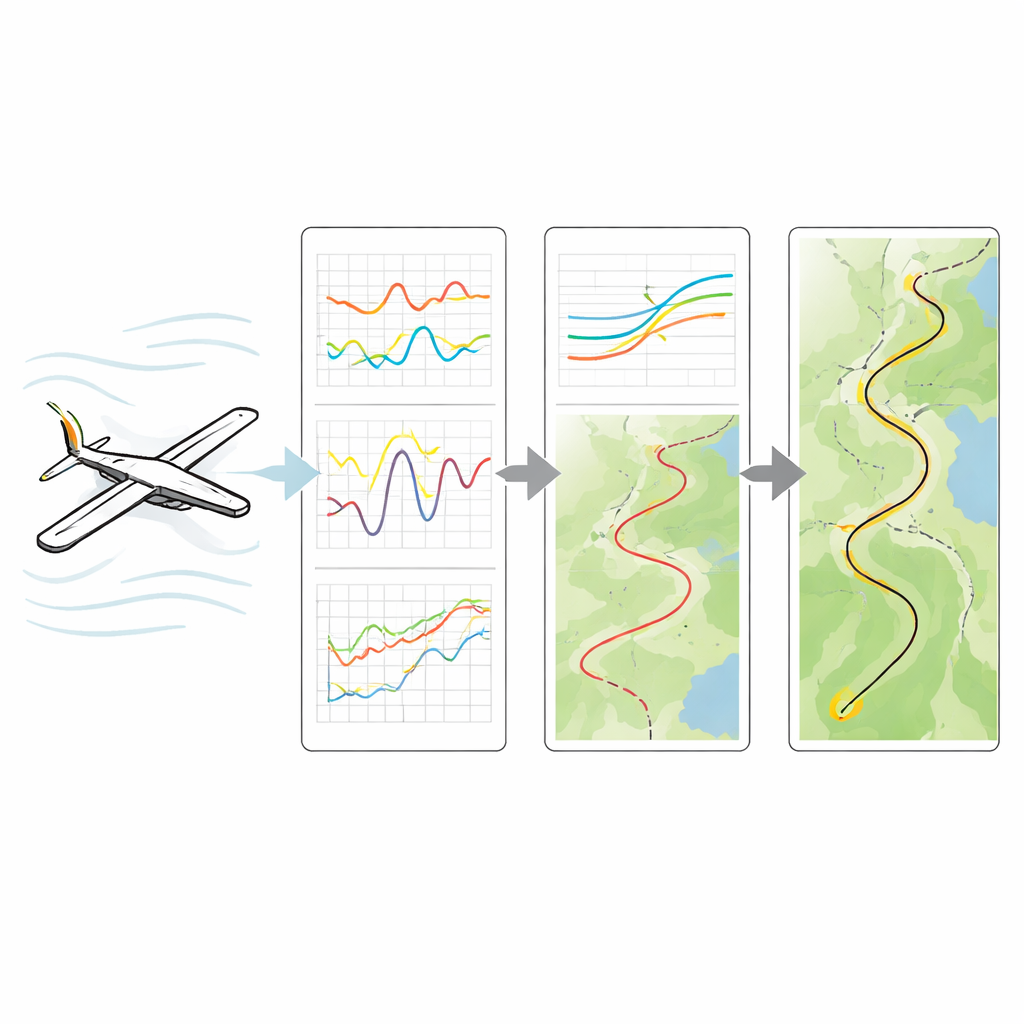
The resulting IDF‑DS collection consists of 240 autonomous flights, roughly 32 hours of airborne time and tens of millions of recorded samples. Each flight is stored with a consistent folder structure so users can quickly find the main log, mission plan, controller settings and a ready‑to‑view GPS track. One family of missions follows a zigzag pattern over a rectangular field, ideal for repeatable comparisons or training predictive models. Another traces a race‑track–like loop inspired by a famous MotoGP circuit, introducing sharp bends, sweeping curves and straight segments that challenge the autopilot. For every configuration and mission, the logs capture how the aircraft really flew, not just how it was supposed to fly.
Turning Raw Flights into Insights
To show what can be done with this trove, the authors walk through several example analyses. They check the quality of the onboard motion sensors by comparing them with accelerations and rotations inferred from the GPS‑based trajectory, confirming that the measurements are reliable enough to serve as “ground truth” for training models. They study how well the autopilot estimates speed in three directions, how closely the aircraft tracks its planned path, and how much electrical power it draws during climbs, turns and steady cruising. By combining airspeed, ground speed and attitude, they even reconstruct the wind that the plane experienced along its route, building a picture of gusts and crosswinds purely from onboard readings. Another use case outlines how the same data streams could train an artificial‑intelligence model to estimate position when satellite navigation is unavailable.
How This Resource Helps Future Flights
In everyday terms, this work is about giving the community a shared “black box” from hundreds of flights that anyone can open. Instead of each team having to gather its own expensive test data—and keeping it private—researchers and students can download this open dataset and immediately begin exploring new ways to keep drones on course when GPS fails, spot faults before they become dangerous, or stretch battery life by choosing more efficient paths. The paper itself does not build these smart systems; it builds the foundation they require. For readers, the takeaway is that progress in aerial autonomy now depends as much on open, carefully documented flight records as it does on clever algorithms—and this dataset is a substantial step toward that future.
Citation: García-Gascón, C., Bas-Bolufer, J., Castelló-Pedrero, P. et al. An open benchmark dataset for machine learning and intelligent trajectory optimization in fixed-wing unmanned aerial systems. Sci Data 13, 364 (2026). https://doi.org/10.1038/s41597-026-06716-3
Keywords: fixed-wing drones, flight telemetry, autonomous navigation, machine learning dataset, trajectory optimization