Clear Sky Science · en
A Real-World Dataset for detecting Handwashing in daily Life using Wrist Motion Data from Wearables
Washing Hands, Watching Health
Most of us scrub our hands without a second thought. For people working in hospitals or handling food, and for people living with obsessive-compulsive disorder (OCD), handwashing can shape health, safety, and daily life. This study introduces a new kind of data resource: weeks of real-world wrist-worn sensor recordings that capture both everyday and compulsive handwashing. The goal is to help future smartwatches recognize when we wash—and eventually tell the difference between healthy routines and distress-driven rituals.
Why Handwashing Matters So Much
Clean hands are one of the simplest defenses against infection, whether at home, in a clinic, or in a factory kitchen. Yet handwashing is surprisingly hard to monitor outside of controlled settings. Existing systems often rely on cameras at sinks or sensors installed in specific workplaces, which can be intrusive, raise privacy concerns, or simply not scale to daily life. At the same time, for many people with OCD, handwashing is not just about hygiene: it can become a time-consuming, painful response to overwhelming fears of contamination. Their washing may be much more frequent and longer than necessary, leading to damaged skin and a lower quality of life. A technology that reliably spots handwashing as it naturally happens could therefore serve two very different needs: checking that professionals wash enough, and helping patients notice when washing is being driven by anxiety rather than need.
A Month of Life on the Wrist
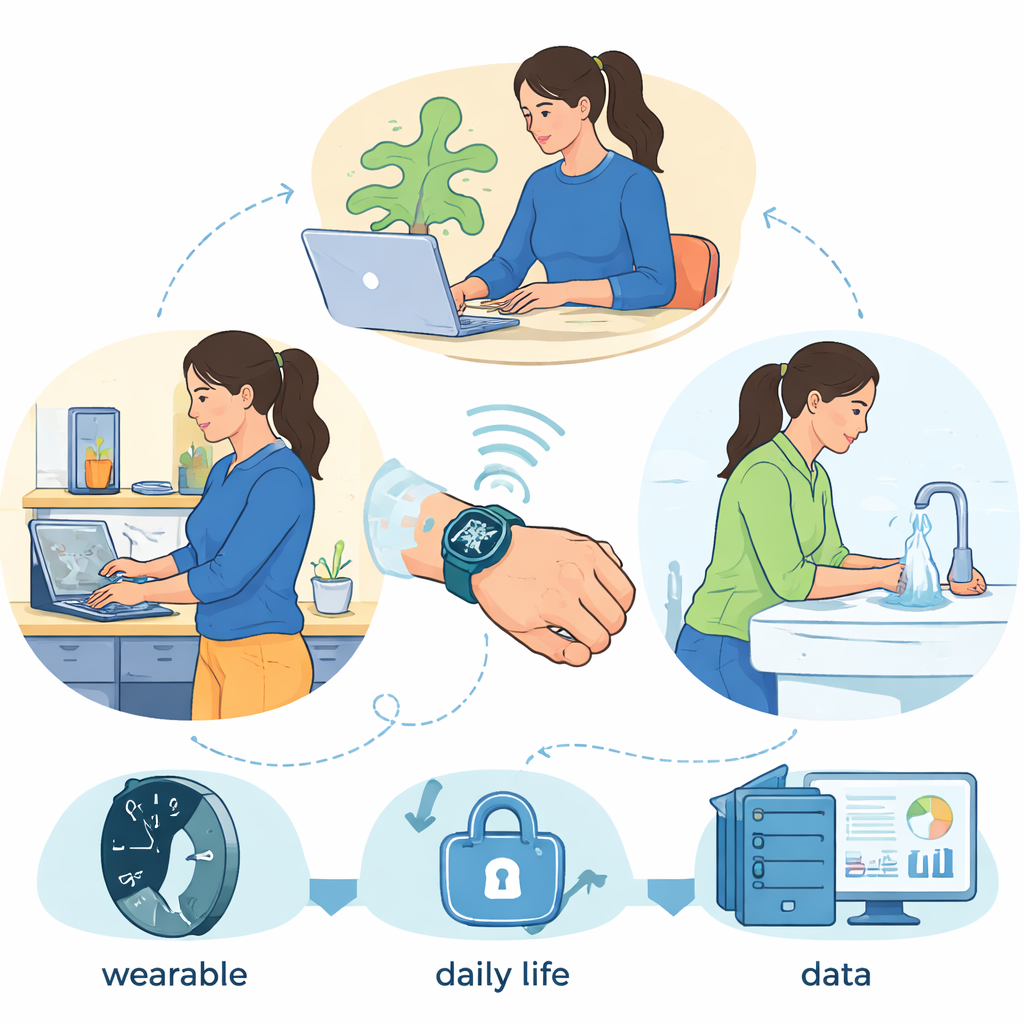
To build a realistic picture of handwashing in the wild, the researchers recruited 22 adults diagnosed with compulsive handwashing OCD in Switzerland. Each person wore an Android-based smartwatch on the wrist for four weeks, aiming for at least six hours per day. The watch recorded subtle wrist movements 50 times per second using built-in motion sensors, similar to those in fitness trackers. Whenever participants finished washing their hands, they tapped a button on the watch and then answered a few quick questions: was this wash compulsive or routine, how strong was their urge to wash, and how tense did they feel (all on a 1–5 scale). Every evening, the watch also asked them to rate how often and how intensely they had washed that day and how often they had remembered to confirm washes.
Turning Noisy Days into Usable Data
Real life is messy: people forget to wear devices, taps can be mislabeled, and watches sit on tables recording nothing but silence. The team therefore designed an extensive cleaning and labeling process. They removed entire recordings when there was clearly no movement or when files were too short or corrupted, and they marked long stretches of idleness so other researchers could easily skip them. Because each button press only gave a single time point, the scientists had to infer when each wash started and ended. First, they estimated typical wash durations from a supervised example in the lab, then they refined labels using a sliding time window and, for six carefully selected participants, painstaking manual relabeling by trained annotators who inspected the motion traces by eye. The end result is the OCDetect dataset: about 2,600 hours of everyday activity, including roughly 31 hours of handwashing spread across 2,930 washes, split almost evenly between self-declared routine and compulsive events.
Teaching Machines to Spot Washing
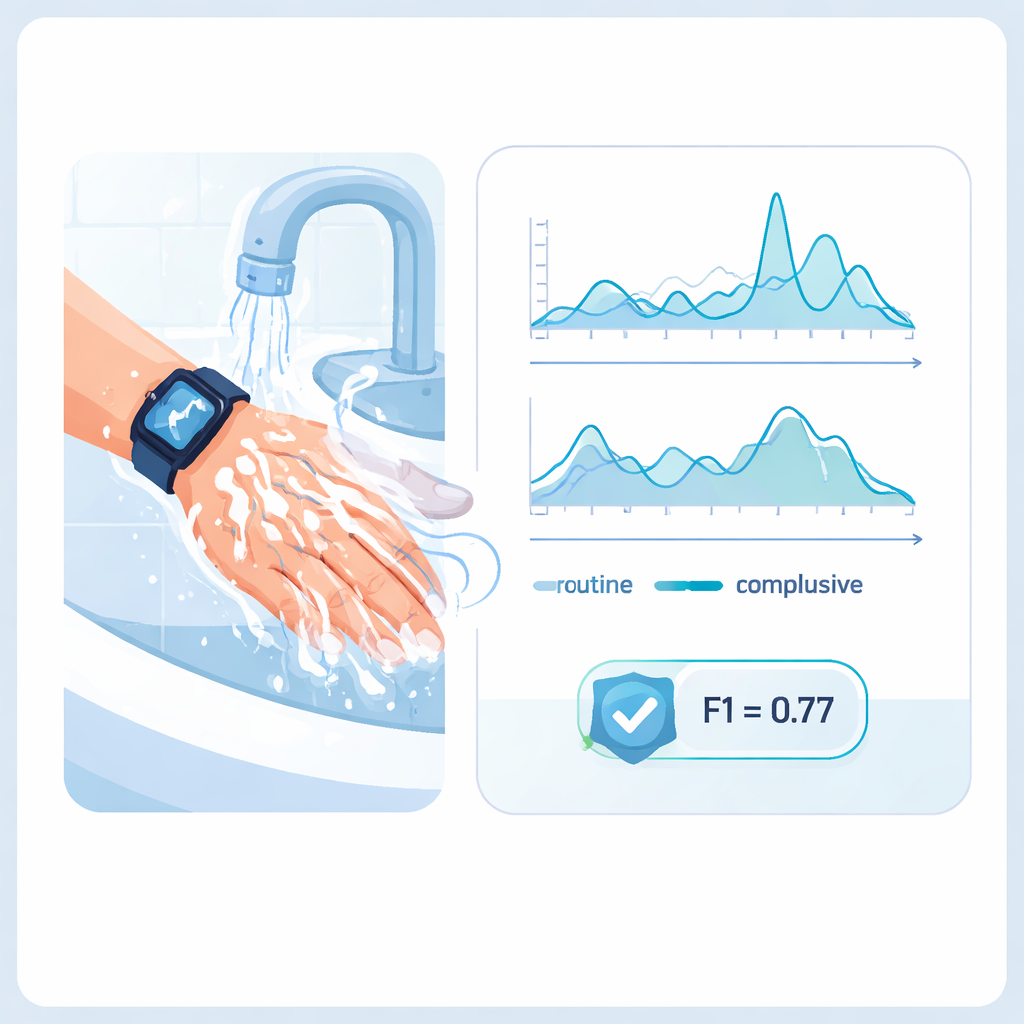
With this dataset, the team tested how well standard machine-learning methods could pick out handwashing from everything else people do in a day. This is a tough challenge: washing makes up only about 1% of the recorded time, and different people wash in very different ways. Using short five-second windows of motion data and a collection of simple features—such as how strong or how jerky the movements were—they trained classic models like random forests and gradient boosting. These models were evaluated in a strict way, always testing on participants the algorithms had never seen before. The best setup reached an F1 score of up to 0.77 (on average about 0.33 across people), far above chance, when simply deciding “handwash or not.” However, when the task was to separate routine from compulsive washes, performance fell back to chance. In other words, current motion patterns alone do not reliably reveal the emotional reasons behind a wash.
What This Means for Future Smartwatches
To a layperson, the message is twofold. First, smartwatches already have enough sensing power to notice most handwashing episodes in daily life, even against the noisy backdrop of walking, cooking, or working. Second, knowing why someone is washing—whether for hygiene or driven by OCD-related distress—is much harder than just knowing that they are washing. The OCDetect dataset, now publicly available, gives researchers a realistic, openly shared foundation to improve detection methods, explore more advanced models, and combine motion data with other clues or clinical insight. In time, this could pave the way for tools that gently support both infection control and therapy for OCD, while remaining privacy-friendly and unobtrusive on the wrist.
Citation: Burchard, R., Kirsten, K., Miché, M. et al. A Real-World Dataset for detecting Handwashing in daily Life using Wrist Motion Data from Wearables. Sci Data 13, 179 (2026). https://doi.org/10.1038/s41597-026-06698-2
Keywords: handwashing, wearable sensors, obsessive-compulsive disorder, smartwatch data, human activity recognition