Clear Sky Science · en
Behavioral and electroencephalographic dataset simultaneously acquired during the Iowa gambling task
Why our choices under pressure matter
Every day we make decisions that balance risk and reward, from financial bets to health choices. Scientists have long used a card game called the Iowa Gambling Task to study how people weigh short‑term wins against long‑term losses. In this study, researchers went a step further: they recorded both behavior and brain activity at the same time while volunteers played the game, then released the full dataset openly so other scientists can explore how the brain guides risky choices. 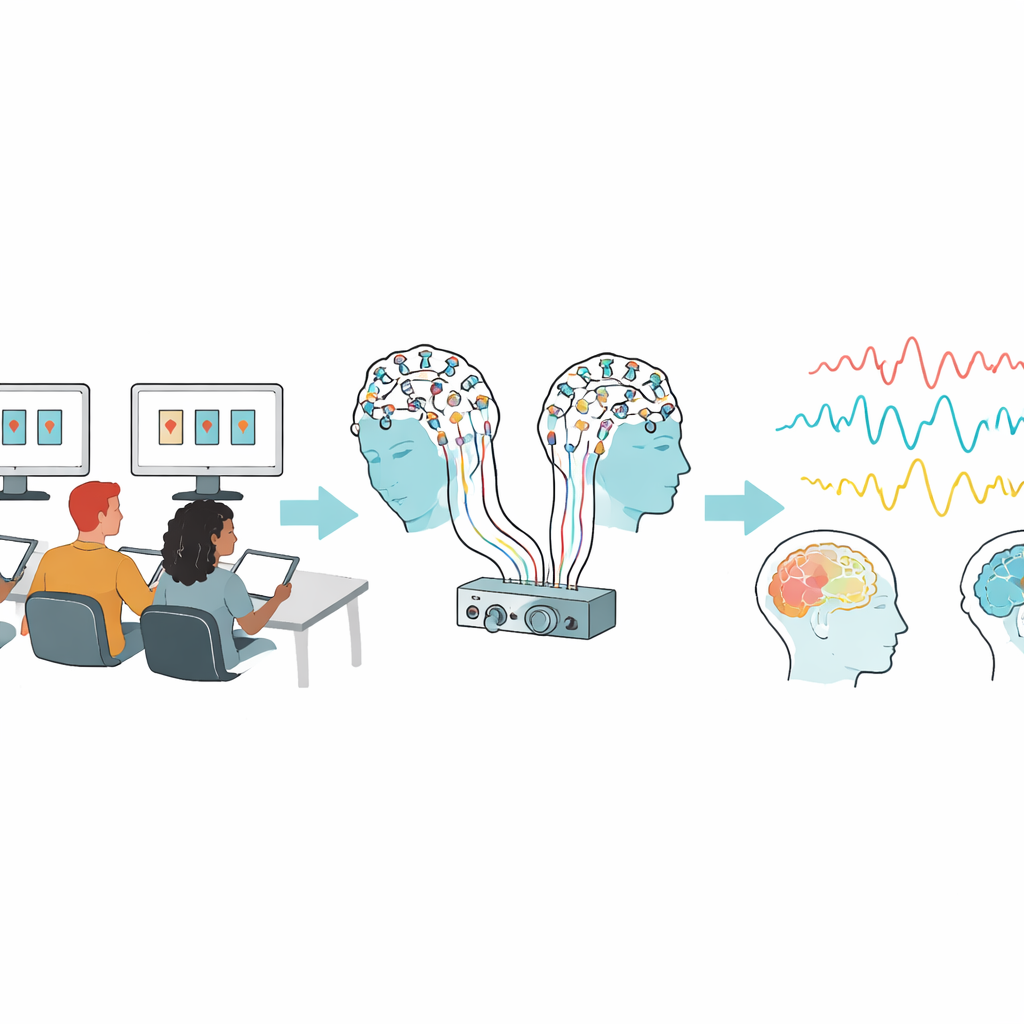
A card game that reveals hidden habits
The Iowa Gambling Task looks simple on the surface. Players repeatedly choose from four decks of cards that look the same, trying to earn as many points or “credits” as possible. Some decks offer big wins but even bigger losses, while others give smaller, steadier gains. Over time, most healthy people quietly learn to favor the safer decks, even if they cannot explain exactly why. The task has become a classic tool for probing decision‑making in many groups, including people with brain injuries, mood disorders, or addictions.
Watching both choices and brain signals
To build their dataset, the team recruited 59 university students without known neurological or psychiatric problems. All participants sat in a quiet, controlled room, wore a cap with 21 small electrodes on the scalp, and played a computerized version of the card game. The experiment followed a clear routine: three minutes of resting with eyes open, a first block of 100 card choices, a short rest, and then a second block of 100 choices. For each turn, the data capture when a person thought about which deck to pick, which card they chose, how many credits they won or lost, and how quickly they reacted, all aligned in time with the brain recording.
What the dataset contains and how it is built
Beyond game scores, the authors collected rich background information: age, sex, academic field, use of substances such as alcohol or tobacco, and for women, basic menstrual‑cycle details, because hormone shifts can subtly change brain rhythms. The brain signals were recorded in raw form, at 256 measurements per second, using a standard arrangement of electrodes spread over frontal, central, and back scalp areas. Data are organized using a widely adopted structure for brain studies so that other researchers can easily load the files in many software tools. Each volunteer has a folder with three main pieces: the full gambling‑task log, the original brain recording, and a preprocessed version ready for more advanced analysis. 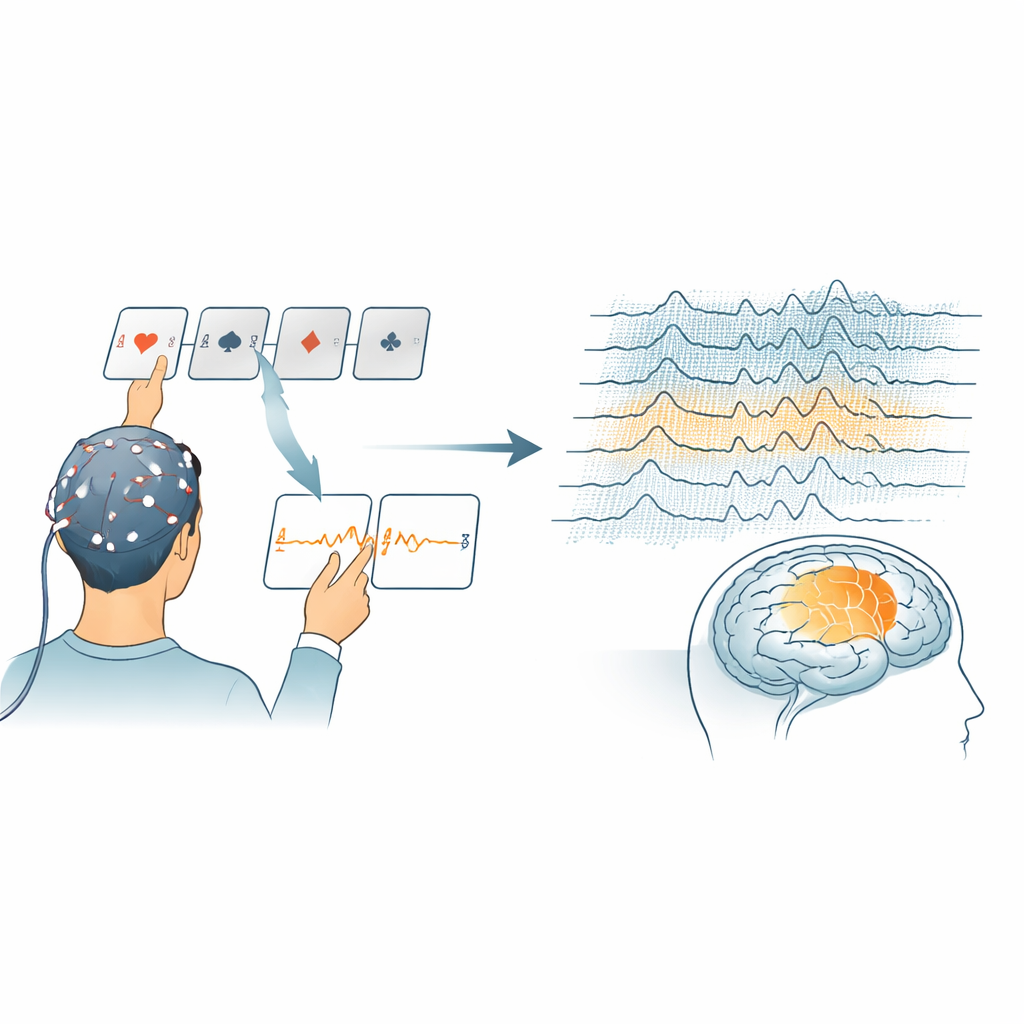
Checking that the signals and behavior make sense
To confirm the data’s quality, the team performed several sanity checks. First, the overall pattern of card choices matched what is usually seen in healthy groups: players tended to lose points at the beginning, then gradually shift toward strategies that accumulate more credits, especially in the first 100 trials. Second, they examined the strength of brain activity compared with background electrical noise and showed that the key frequency ranges where the cortex operates were clearly above the noise floor. Finally, they averaged brain responses around each decision to look for well‑known “bumps” and “dips” in the signal that appear when people process feedback, update expectations, and evaluate outcomes. These standard signatures were present at the expected scalp locations and times, supporting the reliability of the recordings.
Strengths, limits, and future uses
The volunteers came from two academic tracks—engineering and physical culture and sports—and the sample was nearly balanced between men and women. This design makes it possible to ask how sex or educational background might shape risk‑taking styles and brain responses, though it also means the findings may not represent older adults, teenagers, or people with different life paths. Importantly, the recordings were left intentionally uncleaned, so different research groups can test their preferred methods for removing blinks, muscle activity, and other artifacts, or for training machine‑learning models on untouched data.
What this means for understanding everyday decisions
In practical terms, this work does not offer a new treatment or a single headline result. Instead, it delivers a carefully documented, freely accessible map of how the brain behaves while people learn from rewards and punishments in a realistic game‑like setting. By pairing second‑by‑second choices with equally detailed brain signals, the dataset gives scientists a powerful sandbox for studying healthy decision‑making and for comparing it to clinical groups in future studies. Over time, such open resources may help clarify why some people are more prone to risky habits, and how changes in brain function relate to the way we all adjust our choices when the stakes are high.
Citation: Chávez-Sánchez, M., Torres-Ramos, S., Román-Godínez, I. et al. Behavioral and electroencephalographic dataset simultaneously acquired during the Iowa gambling task. Sci Data 13, 359 (2026). https://doi.org/10.1038/s41597-026-06662-0
Keywords: decision making, EEG, Iowa Gambling Task, risk and reward, open neuroscience data