Clear Sky Science · en
Tjotta accelerometer monitored lambing dataset
Why Birth-Time Matters on the Farm
For sheep farmers, the hours when lambs are born can mean the difference between healthy animals and heartbreaking losses. Yet watching every ewe around the clock is nearly impossible, especially on large farms with aging workforces. This study introduces a rich new dataset from Norwegian barns that captures the tiny movements of pregnant ewes using collar-mounted motion sensors, offering a path toward automated alerts when a ewe is about to give birth.
From Lambing Worries to Smart Monitoring
Sheep in Norway and Portugal usually give birth once a year, in tightly planned seasons that line up with pasture growth and holiday demand for meat. Despite this careful timing, many lambs still die before ever reaching pasture, often because trouble during birth is not spotted quickly enough. Farmers know that helping at the right moment can save both lambs and their mothers, but constant night-and-day supervision is exhausting and expensive. The authors argue that simple wearable devices, already used in larger livestock, could help close this gap for sheep by signaling when a ewe’s behavior shifts into the patterns that precede birth.
How Collars and Cameras Watched the Ewes
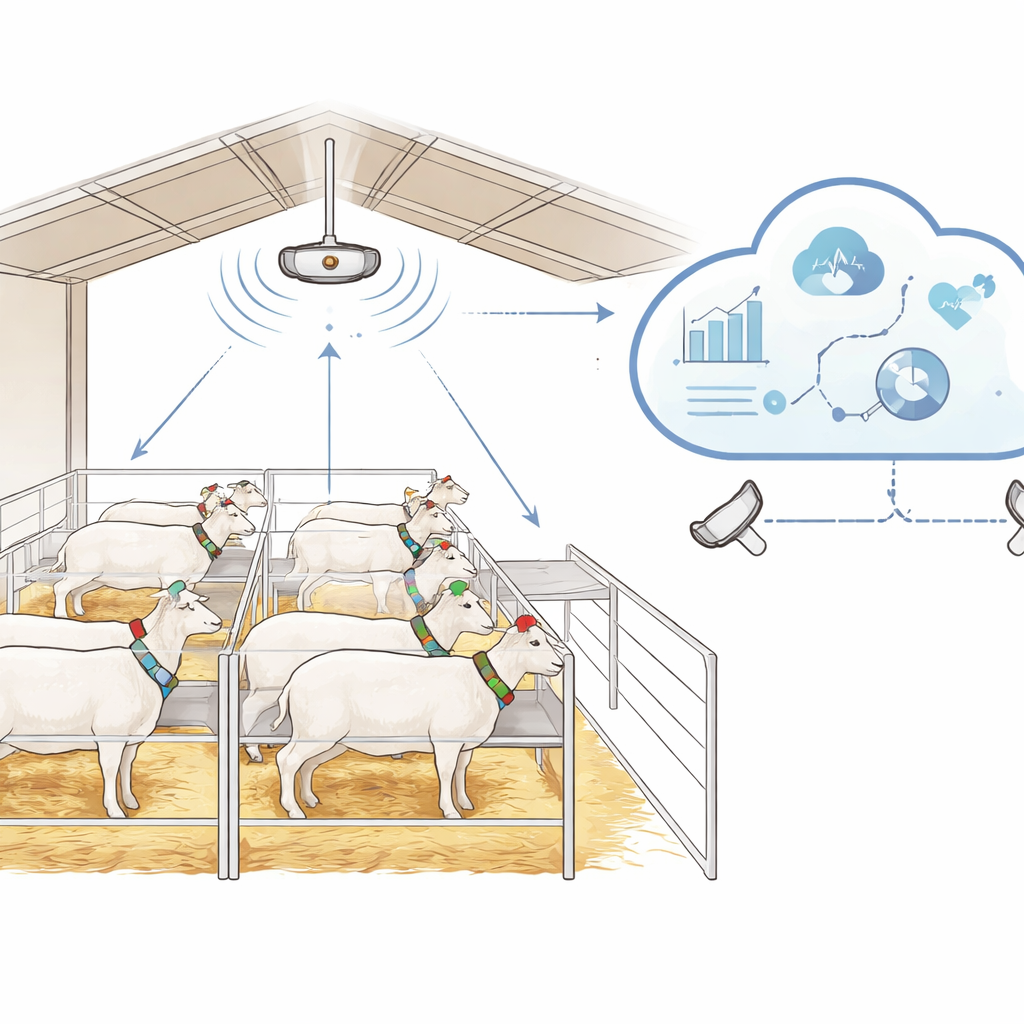
To build a reliable foundation for such tools, the team closely monitored 61 ewes of mainly Norwegian White breed in a research barn in northern Norway. Each ewe wore a sturdy collar containing a small motion sensor that measured movement along three directions and also recorded temperature 20 times per second. The animals lived in individual pens with standard feed, water, and flooring, and were moved into the experimental area about a week before they were due to lamb. At the same time, a ceiling-mounted gateway collected the collar data and sent it to the internet, while multiple video cameras continuously recorded each pen to provide an exact record of every birth.
Turning Barn Life into Usable Data
Over just one month, from late April to late May 2024, the system captured more than fifty million raw records from the collars as the ewes went about their daily routines and eventually gave birth to 113 lambs. After cleaning out incomplete entries and obvious sensor glitches, the final dataset contained nearly one billion high-frequency measurements linked to individual animals and to specific lambing events. The researchers organized the files by ear tag and collar, and added tables with background details such as each ewe’s age, previous lambing history, litter size, and whether help was needed during birth. Handwritten notes from experienced farm staff and carefully reviewed video footage were used together to determine the exact time of each birth and to double-check the quality of the records.
What the Motion Patterns Reveal
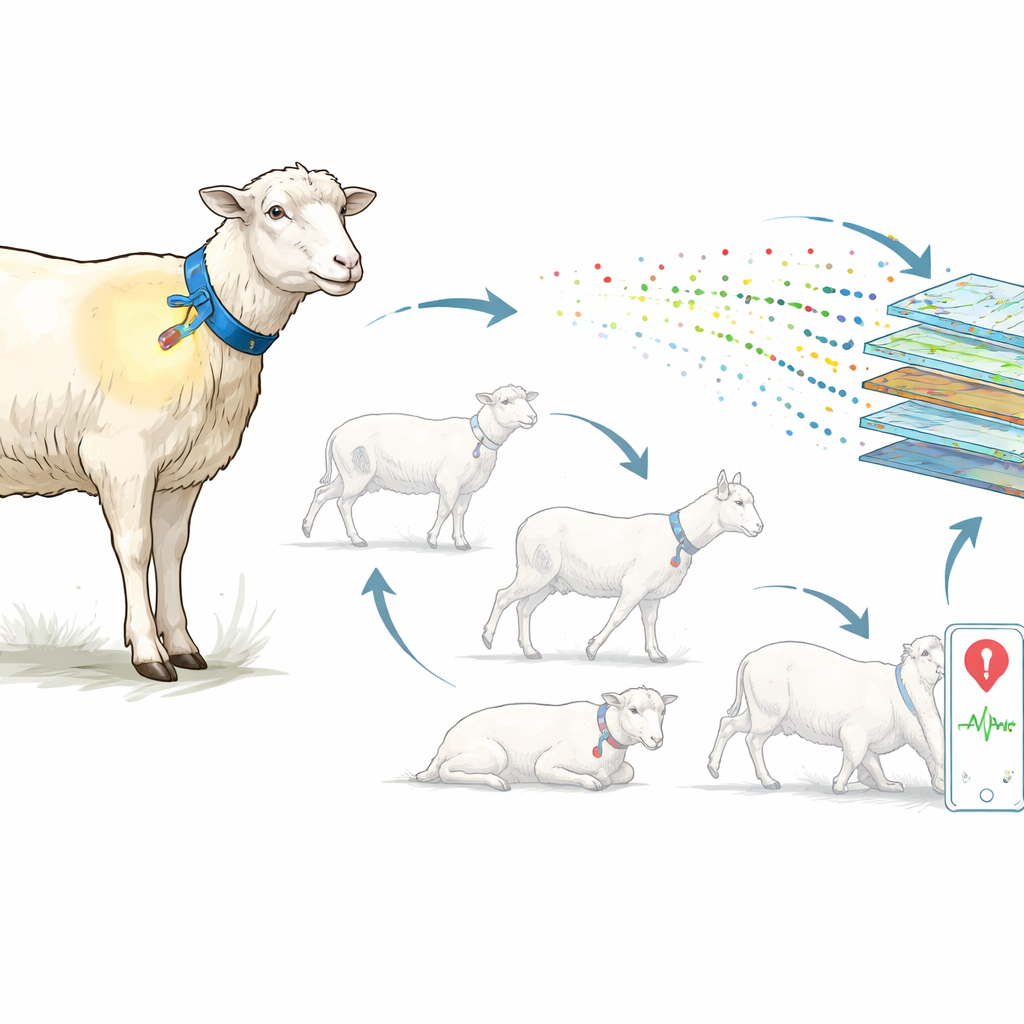
Example plots from one ewe show how the up-and-down, side-to-side, and forward–backward motions captured by the sensor change as birth approaches. Histograms of the data illustrate how often different movement strengths occur, while time-series charts display bursts of activity and calmer periods over hours and days. The authors explain that frequent shifts between standing and lying, long recognized by farmers as a sign that lambing is near, are clearly visible in these motion traces. They also discuss practical issues, such as collars that were sometimes put on in reverse and later fixed using simple mathematical corrections, and statistical challenges like imbalanced behavior types that future model builders will need to handle.
Strengths, Limits, and Future Uses
Because the recordings were made indoors under controlled barn conditions, the dataset does not fully represent how sheep behave on open pasture, where they roam farther, graze freely, and respond to predators and weather. Differences in breed, age, and body size also affect how strongly animals move, which means computer models will need to adjust for these factors to avoid confusing “slow movers” with animals in trouble. Still, the authors emphasize that the data remain deliberately unpolished: no outliers were removed beyond obviously broken records, and missing values were not filled in, preserving a realistic view of what real-world farm sensors produce.
What This Means for Everyday Farming
For non-specialists, the key message is that this work does not yet offer a finished “birth alarm” but rather the raw material needed to build one. By sharing a carefully documented, open dataset that ties detailed motion records to confirmed lambing times, the researchers give engineers, data scientists, and animal-welfare experts a common starting point for designing and testing algorithms. In time, such tools could quietly watch over pregnant ewes via simple collars, alerting farmers only when a birth is beginning to go wrong. That could save lambs and mothers, reduce stress and labor for farmers, and make seasonal lambing a little less of an all-night vigil.
Citation: Goncalves, P., Nyamuryekung’e, S., Corrente, G. et al. Tjotta accelerometer monitored lambing dataset. Sci Data 13, 426 (2026). https://doi.org/10.1038/s41597-026-06660-2
Keywords: sheep welfare, wearable sensors, lambing detection, precision livestock, accelerometer data