Clear Sky Science · en
Submesoscale daily data from a non-hydrostatic OGCM at 1/90° resolution over Northern South China Sea in 2019
Why tiny ocean motions matter
The northern South China Sea is crisscrossed by powerful underwater waves, swirling eddies, and narrow filaments that shuffle heat, salt, and nutrients between the surface and the deep. These fine-scale motions influence weather, marine ecosystems, and even climate models, but they are too small and fast for most global ocean datasets to capture clearly. This study introduces a new, very high‑resolution numerical simulation for 2019 that is designed to resolve these small structures more faithfully, and it makes the resulting data freely available to the research community.
A digital laboratory for a busy marginal sea
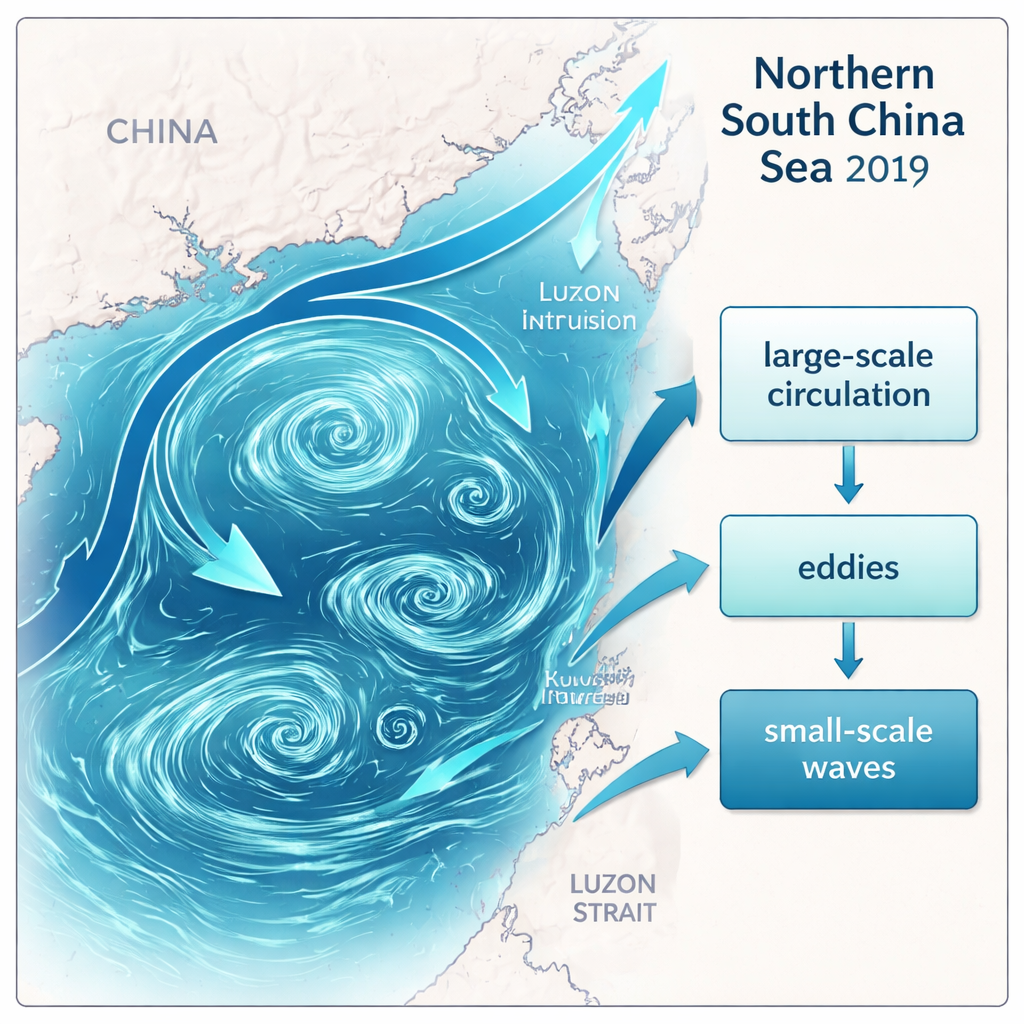
The researchers focused on the northern South China Sea, a semi‑enclosed basin strongly shaped by rugged seafloor, steep continental slopes, and the intrusion of the Kuroshio Current through the Luzon Strait. In this region, large‑scale currents, kilometer‑scale eddies, and smaller filaments and fronts all coexist and interact. To explore this complexity, the team used a regional ocean circulation model configured on an extremely fine grid of 1/90 of a degree—roughly 1 kilometer spacing—covering depths from the surface down to 4,000 meters, with daily output for the year 2019. Such a setup allows the model to represent not only broad circulation patterns but also the beginnings of submesoscale features that were previously blurred or missed.
Letting water move vertically, not just sideways
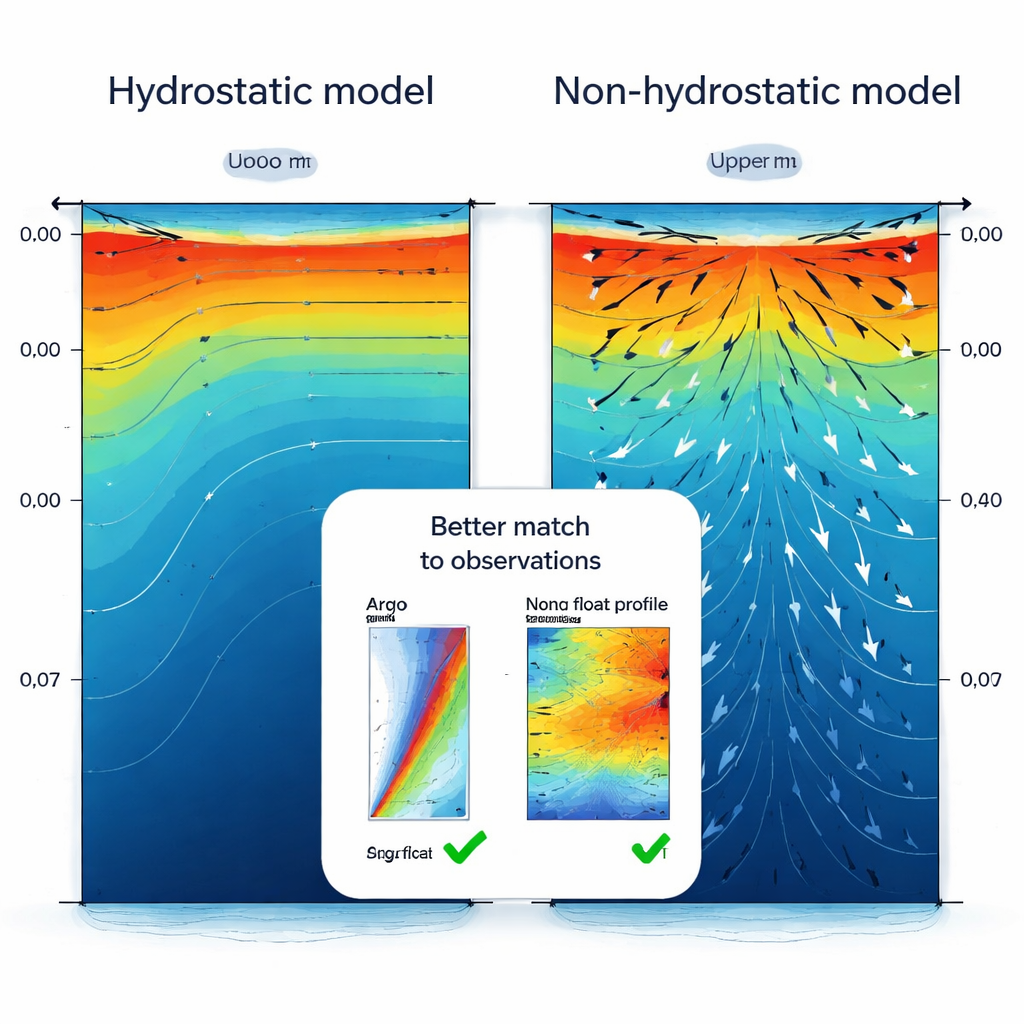
Most traditional ocean models assume that water pressure depends mainly on the weight of the water above—a simplification known as the hydrostatic approximation. This works well for large, slowly varying currents but breaks down when motions become as tall as they are wide, as happens in steep underwater waves and narrow straits. The new simulation uses a “non‑hydrostatic” version of the model, which relaxes this approximation and explicitly solves for rapid vertical accelerations. The authors adopt a pressure‑correction technique that balances accuracy with computational efficiency, allowing the model to step forward in time while keeping vertical motions and pressure fields consistent.
Testing the new approach against theory and observations
To check whether the added complexity pays off, the team first ran an idealized test of small standing waves in a closed basin, where an exact mathematical solution is known. In this controlled setting, the non‑hydrostatic model reproduced the expected current patterns and oscillation periods far more closely than a comparable hydrostatic version, with velocity errors reduced by more than 90 percent. They then turned to the real ocean: comparing simulated internal tides—large underwater waves triggered as tides cross submarine ridges—with satellite imagery, they found that both model versions captured the main wave patterns, but the non‑hydrostatic run produced stronger and finer vertical motions that better reflected the observed structures.
Sharper view of temperature and surface patterns
The authors also evaluated how well the simulations reproduced temperature structure and sea surface temperature. Using profiles from autonomous Argo floats, they showed that the non‑hydrostatic model generally matched the observed temperature with smaller errors, especially west of the Luzon Strait and near the Dongsha Atoll, where energetic internal waves and mixing are common. The stronger vertical motions in the improved model help bring colder, deeper water upward, making the simulated temperature profiles more realistic. At the surface, comparisons with a widely used satellite‑based temperature product revealed that both models captured the broad patterns, but the non‑hydrostatic run consistently reduced temperature errors by up to a few tenths of a degree Celsius during key winter periods.
An open resource for studying hidden ocean motions
In practical terms, this work delivers a public 290‑gigabyte dataset of daily, three‑dimensional ocean fields for 2019 over the northern South China Sea, computed with a model that treats vertical motions more faithfully than standard approaches. For non‑specialists, the key message is that many important ocean processes happen on small scales and involve strong up‑and‑down movement, which older models tended to smooth out. By resolving more of these features and matching observations more closely, the new dataset offers a sharper, more dynamic picture of how energy, heat, and material move through this busy marginal sea, providing a foundation for future studies of weather, climate, ecosystems, and marine operations in the region.
Citation: Zhuang, Z., Song, Z., Shu, Q. et al. Submesoscale daily data from a non-hydrostatic OGCM at 1/90° resolution over Northern South China Sea in 2019. Sci Data 13, 300 (2026). https://doi.org/10.1038/s41597-026-06653-1
Keywords: South China Sea, internal tides, ocean modeling, submesoscale, sea surface temperature