Clear Sky Science · en
Global compilation of bioavailable strontium isotope data
Why rocks can reveal where things come from
Imagine being able to tell where a person lived, where a bottle of wine was produced, or where a migrating bird has traveled, all by looking at a chemical “signature” locked into bones, teeth, plants, or water. This paper describes a huge international effort to bring together those signatures for one particular element—strontium—into a single, openly available global database that scientists and investigators of many kinds can now use as a shared reference map. 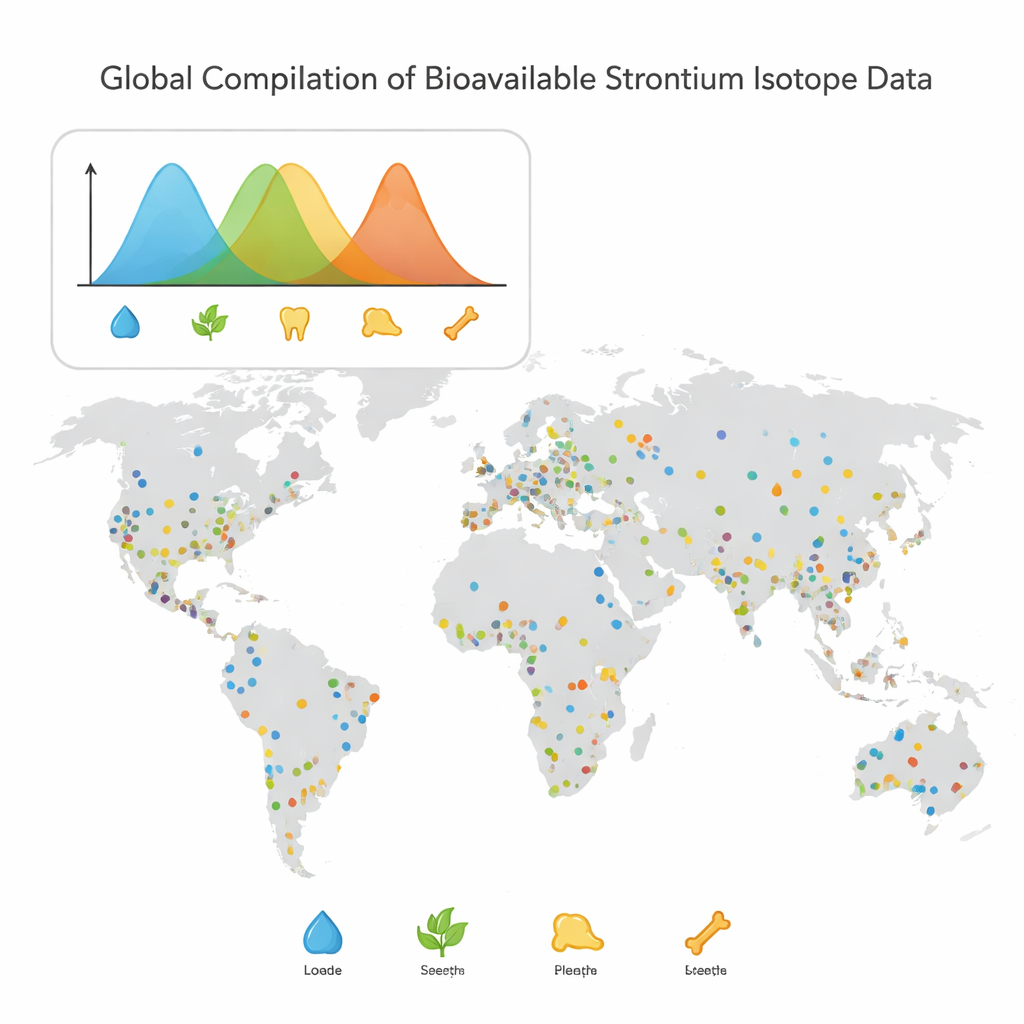
A chemical fingerprint written by the Earth
Strontium is a naturally occurring element found in rocks, soils, water, and living things. Different types of rocks, and the processes that shape them, give rise to slightly different ratios of two forms (isotopes) of strontium, known as 87Sr and 86Sr. When rocks break down into soil and dissolve into water, these isotope ratios are passed into plants and then into animals, including humans, through food and drink. Tissues that grow slowly or only during certain life stages—such as teeth, bones, hair, feathers, shells and plant tissues—can preserve the local strontium “fingerprint” from the time and place where they formed.
Following movements, from mammoths to modern people
Because these strontium fingerprints differ from place to place, they can be used to estimate where a sample came from or to track movement over time. Researchers have already used strontium isotopes to study how ancient humans and animals migrated, to identify where modern wildlife spends different parts of its life, to check the claimed origin of foods like wine and coffee, and even to assist forensic investigations of unidentified human remains or illegal drugs. All of these applications rely on comparing an unknown sample to good background data that describe what strontium looks like in different regions of the world.
Building a single worldwide reference collection
Until now, reference measurements of bioavailable strontium—values from soil, water, plants, and animal tissues that represent what living organisms actually absorb—were scattered across hundreds of papers and reports. In this study, the authors systematically searched the scientific literature, including peer-reviewed articles, theses, and other technical reports, to find published measurements of 87Sr/86Sr that reflect what is present in the environment. They gathered 28,347 such data points from 474 studies across more than 150 countries. Each record is linked back to its original source, and the team carefully standardized how information is recorded, including sample type, location, dates, and laboratory details, so that the dataset can be reused and combined in reliable ways.
Turning scattered dots into global maps
To make the data genuinely useful, the authors did more than list numbers. They checked for obvious mistakes, such as impossible coordinates or isotope values outside the natural range on Earth, and they documented how locations were obtained—whether from GPS readings, digitizing maps, or estimating coordinates from site names. They recorded how laboratories calibrated their instruments using a common reference material so that measurements can be compared fairly. The resulting dataset is stored in two community-run online repositories, IsoArcH and IsoBank, where users can download everything at once or filter for specific kinds of samples, such as only soils, only waters, or only a particular country. These data can then feed into computer models that predict how strontium ratios vary across landscapes, producing continuous “isoscapes” that act like geographic heat maps of chemical signatures. 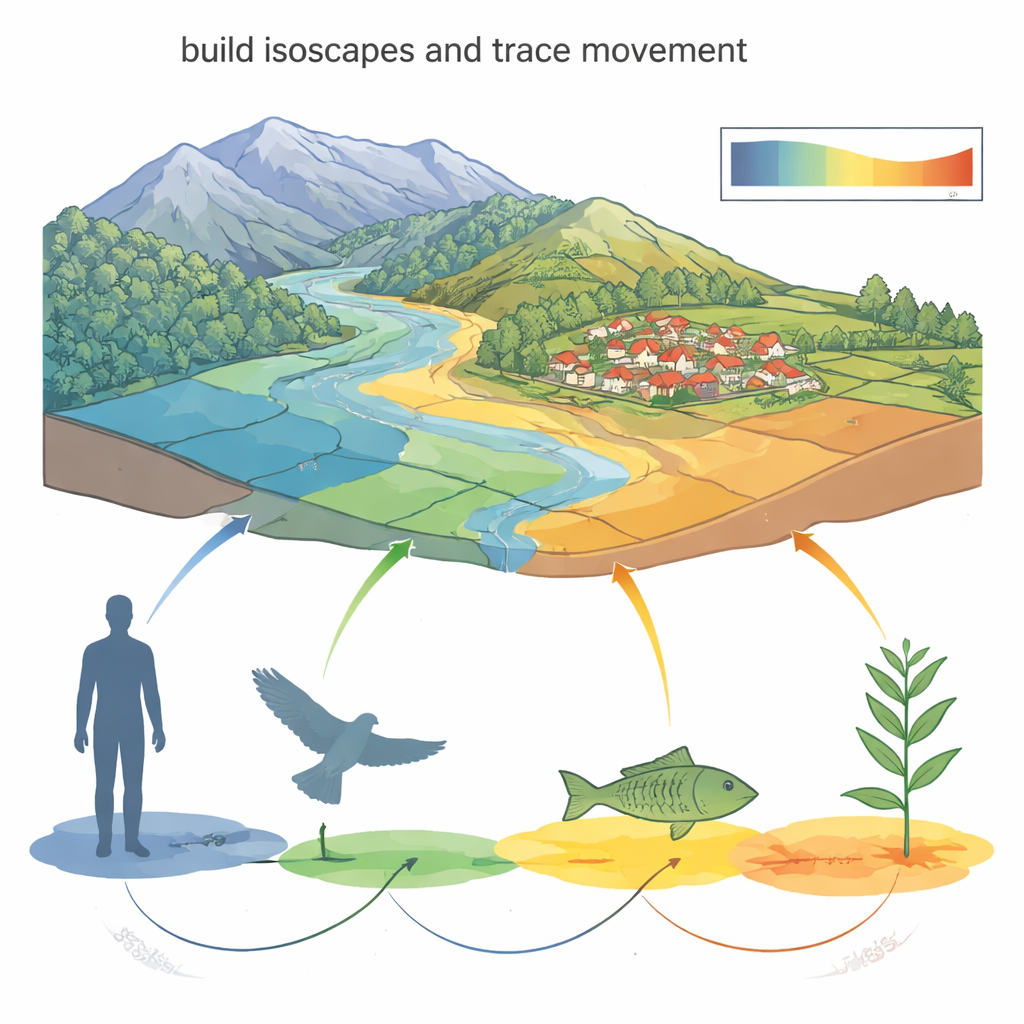
Filling gaps and sharing responsibly
The compilation also highlights where information is missing. For example, Europe is relatively well covered, while large parts of Australia, northern Africa, and western Asia have few measurements. The authors suggest that future sampling efforts could target these blank spots. They also emphasize the ethical dimension of their work: measuring isotopes often requires destroying a small piece of precious material, such as human remains from archaeological sites. By sharing data openly and linking each entry to the original study, the authors aim to reduce repeated destructive sampling, spread the benefits of costly analyses more widely, and ensure that the scientists who first collected the material receive appropriate credit.
What this means for everyday questions
For non-specialists, the take-home message is that there is now a single, public, global “phone book” of environmental strontium signatures that can help answer a surprising range of practical questions: Where was this person or animal likely to have lived? Is this food product really from the region printed on the label? Are wildlife, crops, or water sources being influenced by distant geological or human-made inputs? The new database does not answer these questions on its own, but it gives researchers in fields from ecology and archaeology to forensics and food science a common, rigorously checked foundation on which to build more accurate maps and models of movement and origin across our changing planet.
Citation: Stantis, C., Willmes, M., Le Corre, M. et al. Global compilation of bioavailable strontium isotope data. Sci Data 13, 299 (2026). https://doi.org/10.1038/s41597-026-06643-3
Keywords: strontium isotopes, geolocation, migration, isoscapes, open data