Clear Sky Science · en
Infrasound Array Dataset of the 2021 Eruptive Paroxysms of Etna Volcano
Listening to a Volcano’s Deep Voice
When a volcano erupts, it doesn’t just unleash fire and ash—it also whispers in very low sounds that our ears can’t hear. These “infrasounds” travel through the air for many miles and can reveal what is happening inside the volcano long before people see lava or ash. In this study, scientists share a new open-access record of these hidden sounds from Mount Etna in Italy during a remarkably busy eruptive year, offering a powerful resource for improving eruption forecasts and keeping nearby communities safer.
Why Quiet Rumbles Matter
Mount Etna is one of the world’s most active volcanoes, frequently sending up lava fountains and ash clouds that can disrupt air traffic and dust nearby towns. To keep watch, Italian scientists operate a dense network of instruments measuring ground shaking, gas, and ground deformation. Over the last few decades, they have learned that infrasound—very low-frequency sound waves—can be especially useful for spotting the start of eruptions, tracking their progress, and estimating how much ash and gas are being released. The problem has been that high-quality, public infrasound data from active volcanoes are rare, making it hard for researchers worldwide to test new methods.
Building an Ear for Etna
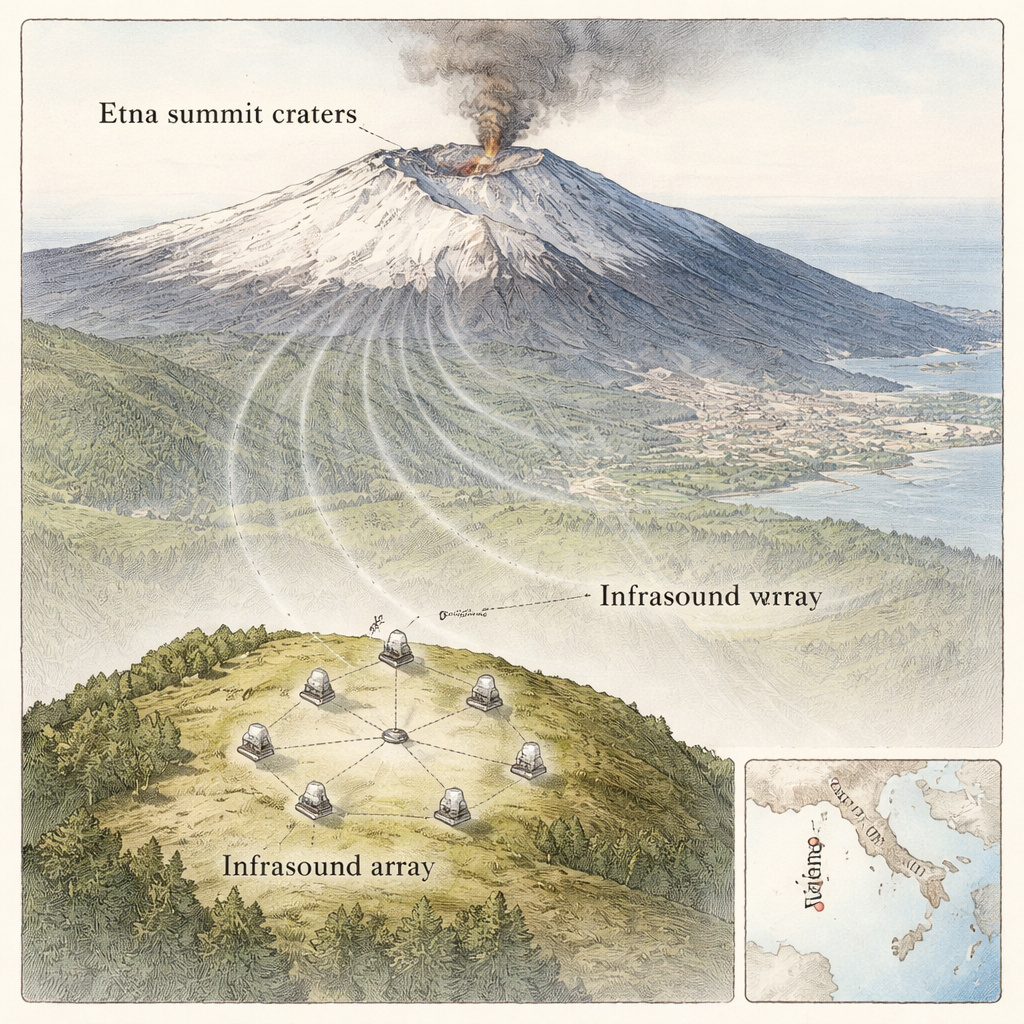
To tackle this gap, the team installed a special “listening post” on a hill called Monte Conca, about six kilometers from Etna’s summit craters. Instead of a single microphone, they set up an array of six infrasound sensors arranged around a central point, much like microphones in a surround-sound system. This design lets them compare tiny differences in the arrival time of sound waves at each sensor, boosting weak signals and pinpointing where they come from. The sensors, built specifically for volcano work, are small, low-power devices that can record tiny pressure changes in the air over a wide range of frequencies.
Keeping the Instruments Alive on a Harsh Mountain
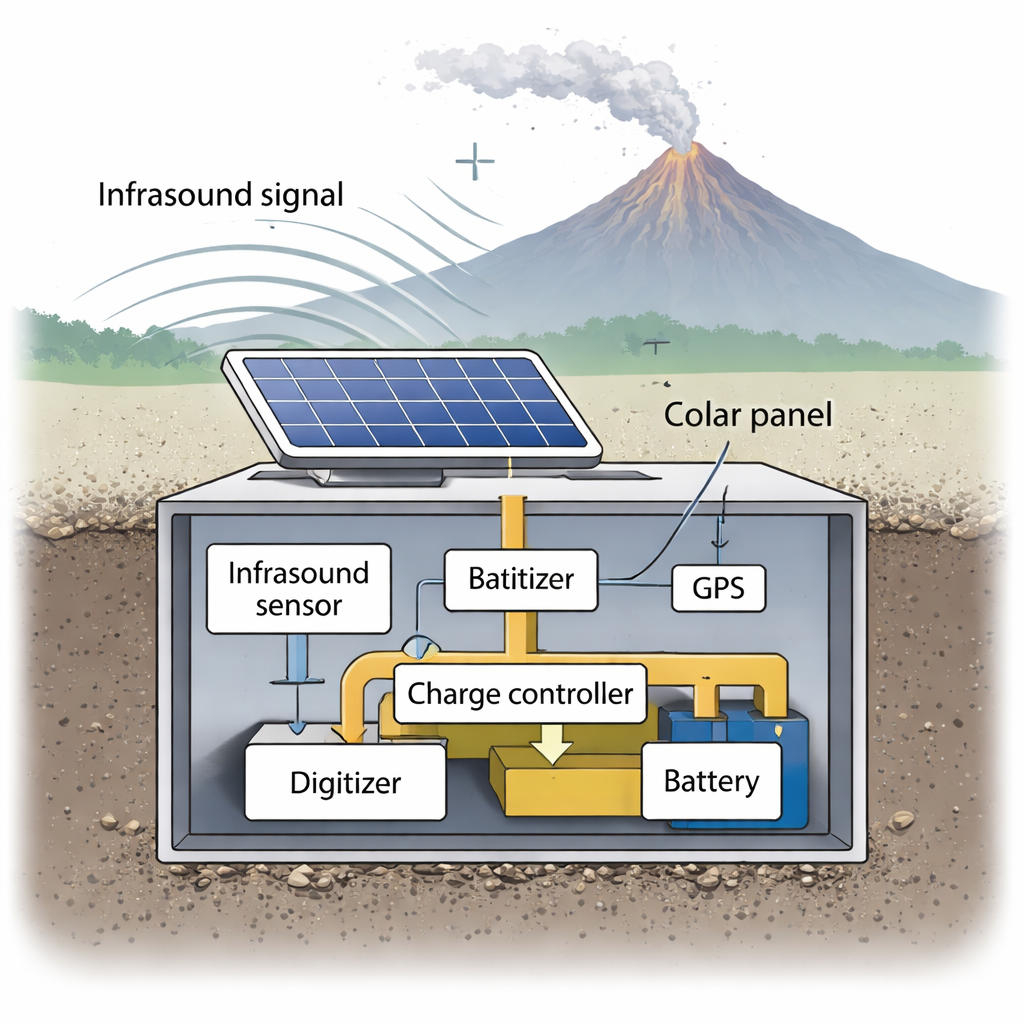
Operating sensitive electronics high on a snowy volcano for a full year is no small feat. Each sensor was placed inside a custom-built box that acts like a miniature life-support system. The box is waterproof and thermally insulated, houses the sensor, its digital recorder, and a large battery, and is topped with a solar panel to keep everything powered even through winter. Foam lining and a mechanical filter help shield the sensor from wind gusts that could mimic volcanic signals. This rugged design allowed the array to run almost continuously from May 2021 to April 2022, with only minor gaps for maintenance and one troublesome sensor that suffered repeated recorder problems.
Tracking Dozens of Eruptions in Fine Detail
During the deployment, Etna entered an especially lively phase. From late 2020 into 2021, the volcano produced more than 60 powerful outbursts known as paroxysms—episodes of intense lava fountaining and ash plumes that sometimes rose up to 10 kilometers into the sky. The new array captured 39 such events between May and October 2021, along with quieter degassing and smaller explosions from several craters. By treating the six sensors as a single listening system and using advanced processing, the scientists could filter out random wind noise and isolate coherent pressure waves linked to volcanic activity. They showed that different types of behavior, like gentle background gas release, bursts of Strombolian explosions, and sustained lava fountains, have distinct sound patterns and frequency signatures.
Separating Voices from Different Craters
One of the most powerful results is the array’s ability to tell which crater is “speaking” at any given time. By measuring the direction from which the infrasound arrives, the team identified stable clusters of signals coming from two main regions: the Southeast and New Southeast craters, which produced most of the dramatic lava fountains, and the Bocca Nuova and Voragine craters, which were often gently degassing. The explosive events from the Southeast craters showed sharp, impulsive waveforms dominated by frequencies around 1–2 hertz, typical of powerful gas bursts. In contrast, signals from Bocca Nuova and Voragine displayed more resonant tones at several distinct frequencies, shaped by the geometry of the vents and crater walls. These differences mean that, using infrasound alone, scientists can distinguish overlapping activity from multiple vents even when visibility is poor.
What This Means for People Living Near Volcanoes
For non-specialists, the key outcome is that Etna now has a proven “acoustic surveillance” system, and the full year of recordings is freely available for anyone to study. The work demonstrates that robust infrasound arrays can run year-round on a high, snowy volcano and reliably capture the subtle air-pressure signatures of both major eruptions and quieter gas release. This dataset will help researchers refine early-warning tools that automatically detect and locate eruptive activity in real time, supporting faster alerts for aviation and communities downwind. In short, by listening carefully to a volcano’s deepest rumbles, scientists are learning to anticipate its next loud outburst.
Citation: Zuccarello, L., Gheri, D., De Angelis, S. et al. Infrasound Array Dataset of the 2021 Eruptive Paroxysms of Etna Volcano. Sci Data 13, 296 (2026). https://doi.org/10.1038/s41597-026-06638-0
Keywords: infrasound, Mount Etna, volcano monitoring, eruption early warning, seismic acoustics