Clear Sky Science · en
Multimodal Phenotyping Dataset of Driving Fatigue
Why staying awake at the wheel matters
Long drives can quietly drain our alertness, turning an everyday trip into a dangerous situation. Drowsy driving is linked to thousands of crashes, injuries, and deaths every year, yet we still lack reliable ways to tell exactly when a driver is slipping from focused to fatigued. This study introduces a rich new public dataset designed to help scientists build smarter systems that can read the body’s warning signs and give timely alerts before a tired driver makes a fatal mistake.
A closer look inside the tired driver
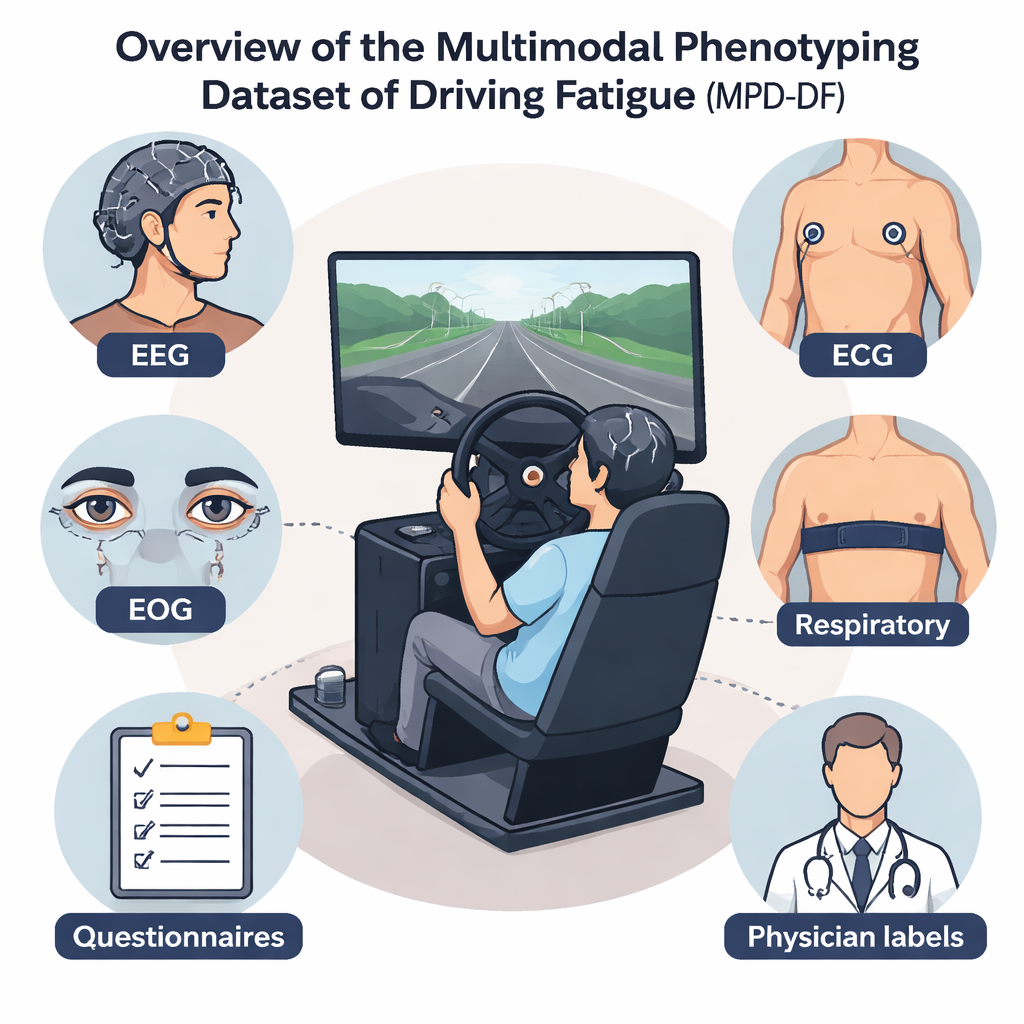
The researchers created what they call the Multimodal Phenotyping Dataset of Driving Fatigue (MPD-DF), a collection of detailed measurements from 50 adult volunteers who completed a two-hour simulated highway drive. Instead of relying only on self-reported sleepiness or on how the car moves, the team recorded several types of body signals at once: electrical activity in the brain (EEG), the heart (ECG), eye movements (EOG), and breathing effort from a chest belt. Participants also filled out questionnaires about their health, sleep habits, and natural “morningness” or “eveningness.” Together, these pieces form a full-body snapshot of how fatigue builds up behind the wheel.
How the experiment was carried out
All volunteers were screened to be generally healthy, well-rested, and free of caffeine before testing. In a controlled lab, each person sat at a simple driving simulator showing an uncongested highway with mostly straight roads—a recipe known to encourage mind-numbing monotony. They drove for about two hours at a low, steady speed while their brain, heart, eye, and breathing signals were recorded continuously, along with video. The room’s lighting, temperature, and noise were carefully kept within comfortable limits so that changes in the signals would mainly reflect growing fatigue rather than discomfort or distraction.
Turning brain waves into fatigue levels
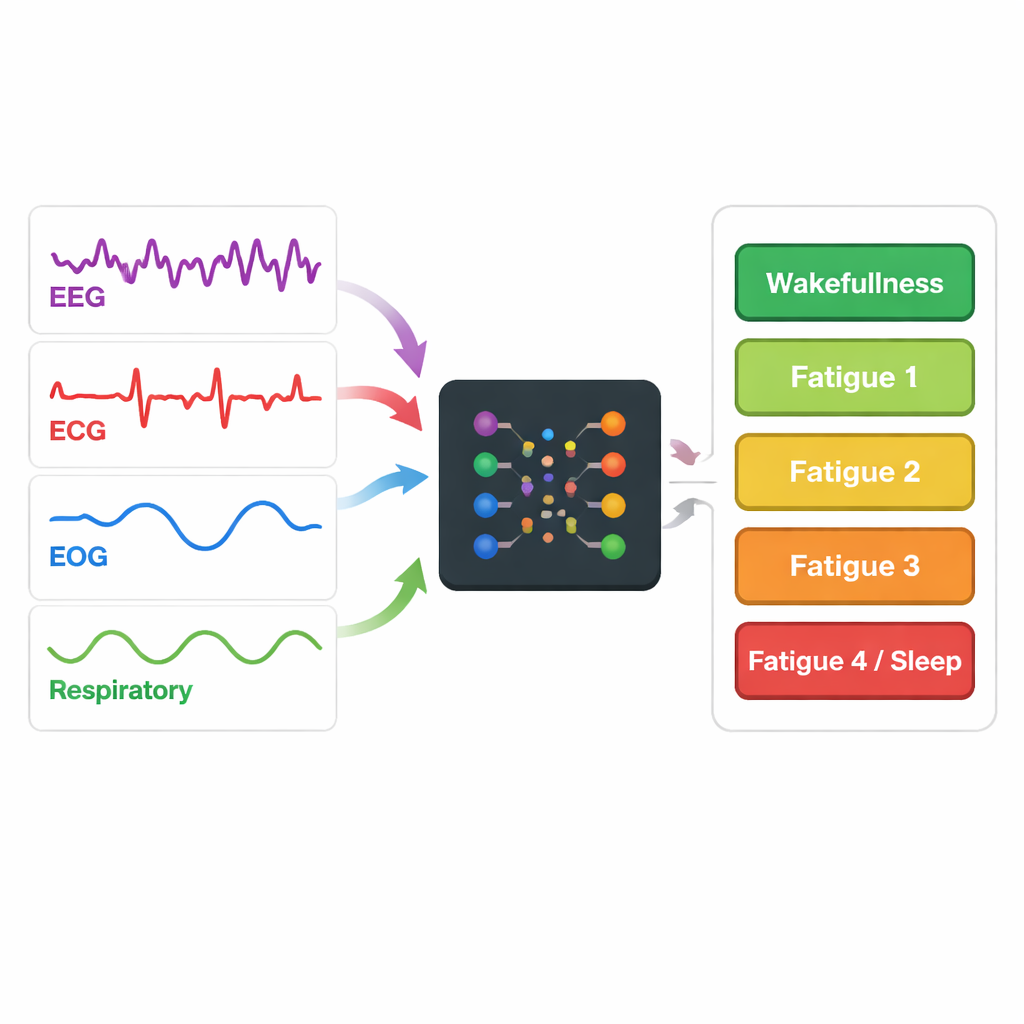
A key feature that sets this dataset apart is how fatigue was labeled. An experienced sleep-medicine physician reviewed each driver’s EEG signal and assigned one of five states every second: wakefulness, three increasing stages of fatigue, and finally light sleep. These stages were based on well-known patterns in brain waves, such as the rise and fall of certain rhythms and the appearance of sleep-related features. The expert also marked periods where the signals were noisy or unreliable. When the team examined all 50 records, they saw that almost everyone became measurably fatigued and some even slipped into sleep, confirming that the driving setup truly induced drowsiness.
Checking signal quality and first algorithm tests
To make sure the data are truly useful for future research, the authors rigorously inspected the signals. They showed that brain, heart, eye, and breathing traces all had the expected shapes and varied naturally over time. By mapping brain activity across the scalp, they observed consistent shifts in different frequency bands as drivers grew more tired, reinforcing the idea that EEG is particularly sensitive to fatigue. The team then fed each signal type separately into an existing deep-learning model designed to distinguish “alert” from “fatigued” periods. Even with this simple setup, the model correctly classified more than 80% of the time for every signal type, with EEG performing best, suggesting that the labels and recordings carry strong information about driver state.
Why this dataset could change road safety
For readers, the bottom line is that MPD-DF gives scientists and engineers a powerful, openly available foundation for building better fatigue-detection systems. Because it combines multiple body signals, detailed questionnaires, and second-by-second expert judgments, it can help researchers probe how and when different people become dangerously sleepy—and test whether their algorithms work across many individuals. In the long run, insights drawn from this dataset could support smarter in-car monitors, more realistic driving simulators, and personalized warnings that nudge tired drivers to rest before tragedy strikes.
Citation: Li, J., Fu, C., Tang, J. et al. Multimodal Phenotyping Dataset of Driving Fatigue. Sci Data 13, 289 (2026). https://doi.org/10.1038/s41597-026-06634-4
Keywords: driving fatigue, EEG monitoring, drowsy driving, physiological signals, driver safety